
The writing of the Power of the Heliodromus (book 2 of the Tocharian Gospels Series and the sequel to The Slaying of the Bull) is really moving now, but it was a bit of a slow start. I guess I didn’t comprehend the challenge I was taking on. Although I knew where I wanted the story to begin and outlined some key plot points for the first several chapters, I found myself bogged down in the research once I stepped back into the past.
As mentioned in my last post, the story begins in Baghdad under the Abbasid Caliphate in the mid-13th century. The thing is, I knew nothing about this city, and more importantly, nothing about medieval Islamic society. Baghdad, as it was in 1258, no longer exists. I don’t mean that it has changed. I mean that it entirely does not exist. Over 760 years of conflict and strife, there are not even ruins to draw from, no city wall, no foundations, nothing. The Mongols decimated the city first, exterminating 90% of the population and erasing all indications of the Abbasid Caliphate. What ruins were left were knocked down by the Ottoman Empire and rebuilt in their image. Physical archeological details of an empire that existed for half-a-millennium were gone, a tragedy too often repeated in human history.
Now, if there is no detail at all, I can let my imagination take over, but if there is some detail, I want to be authentic and incorporate that into my story. It just happens that Baghdad was such a gravitas, it was written about a lot and therefore fell in the gray area of third-person accounts with enough detail to moisten your mouth, but not enough substance to satiate your hunger. So, I needed to dig and do my due diligence to make sure I incorporated the details we have. As I am writing fiction, I don’t necessarily have to do this, but I feel these details are essential to establish the story’s credibility and help guide my imagination from venturing into the ridiculous.
The second speed bump is that the story takes place well after the Caliphate’s Golden Age. There are many details about the empire in the 8th and 9th centuries, but by the 13th century, the only information we have is mainly about its fall. I could make an educated guess, but that still irritates my academic side too much, and claws at my intercultural relations training. I don’t want to make the mistake of steamrolling over a vibrant and sophisticated culture with my western assumptions. Isa and Lwica are Christian outsiders living in a Muslim society during medieval times. So the next logical questions are how did Christians dress in an Islamic society? Where did they live, and what did that community look like? How were they received by and interacted with the Muslim majority? What food did they eat? What work was available to them? What did Muslim society/government/culture look like? Who were the main players? You get the point. It’s a lot of digging into a rabbit’s hole for one single chapter. But, after a week of solid research and a notebook full of notes, I finally got to a point where I could write more than a few sentences. Once the context was there and I got into dialogue, all those details paid off to make it a rich and vibrant beginning. I’ve finished the chapter (and boy what I journey it was), and now the story has begun!
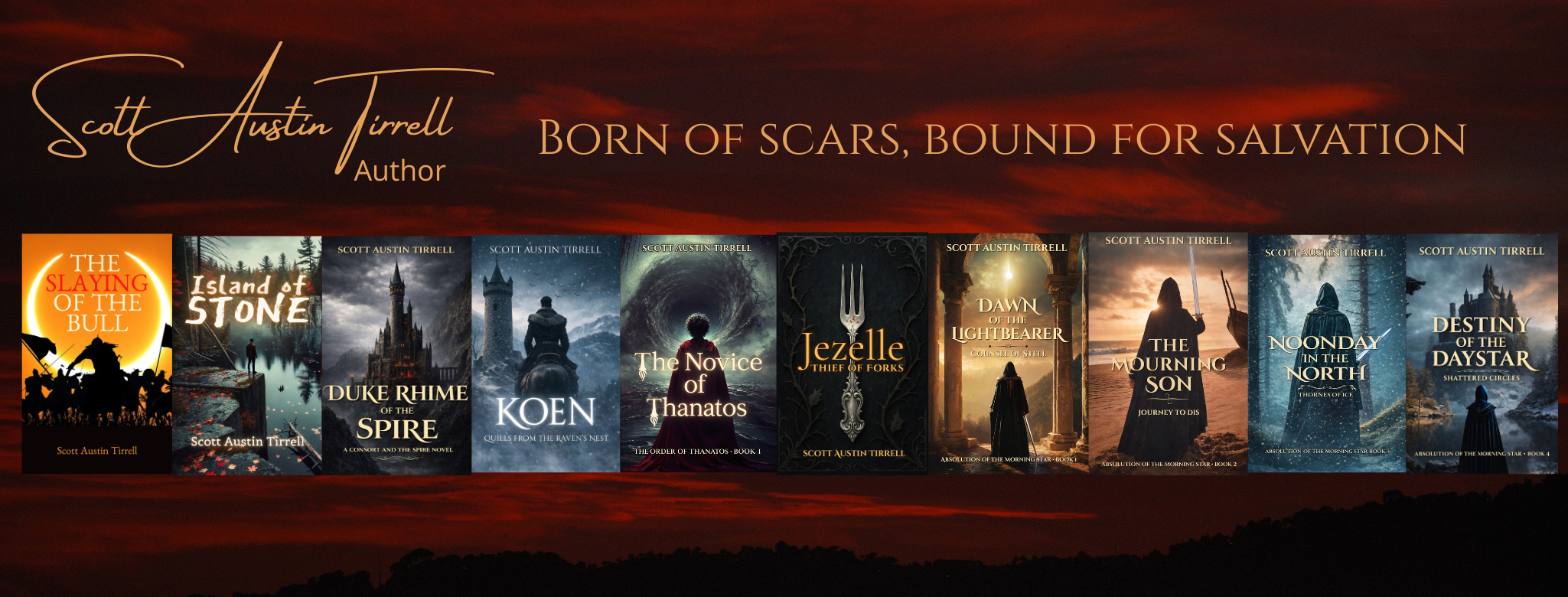
Be sure to check back for future developments as this book progresses. If you haven’t read The Slaying of the Bull (book 1 of the Tocharian Gospels Series), check it out and leave a review if you enjoy it. If not, send me feedback here. Although you don’t necessarily need to love history to enjoy The Slaying of the Bull, if you experienced deep trauma inflicted by some terrible history teacher and despise history, the Island of Stone is another example of my work. It is a psychological and mysterious thriller with supernatural undertones.
Cheers!
Discover more from Author Scott Austin Tirrell
Subscribe to get the latest posts sent to your email.
