
Ah, the Great Wall of China. As Chairman Mao said, “Bù qù chángchéng fēi hǎohàn” or “He who has not been to the Great Wall is not a true man.” At some point, I needed to write a post about this monstrous dragon. It is the most prominent symbol of China and is likely one of the first things you think of when someone mentions the country. It’s a sign of China’s history, power, grit, and technological ingenuity. It is also a symbol of its insecurity, the sacrifice of its people, and its long periods of totalitarian rule, but we won’t get into that here.
The first time I visited the Great Wall was as a tourist back in 2003 with the China Study tour I participated in college. Like most, we saw the touristy section of Badaling. It was SARS time, so in a way, we were lucky, as it was unbelievably quiet. Usually, being the most popular section, it is just wall-to-wall people (pun intended), but it was leisurely on this day.
If you haven’t had the opportunity to visit the Great Wall, yes, it is as impressive as it seems. How could it not be? The first emperor of China laid the first stones during the Qin dynasty some 2,200 years ago. The traditional date for the start of the Roman Empire is 27 BCE. So roughly 150 years before Rome. Almost none of this original wall remains, but each Chinese dynasty built their wall upon the remains of the last. The grey bricks we currently see are the remnants of a colossal re-construction completed under the Ming Dynasty in the 14th century as a tried and trusted method to protect China from nomadic peoples. Like all the times before, it would be a failure. The Ming Dynasty eventually fell to the Manchu, a semi-nomadic people from Manchuria, and would form China’s last dynasty, the Qing Dynasty.
The most contemporary wall stretches 5,500 miles, but archeological surveys show that the entire structure, with all its many branches, is a massive 13,171 miles long. To put both these numbers into perspective, the longest stretch in the contiguous United States is from Washington state to Florida and is a mere 2,802 miles. The complete perimeter of the US is 8,878 miles. The longest continuous flight in the world from Newark, New Jersey to Singapore is 9,534 miles. So, saying the Great Wall of China is a vast undertaking is an understatement and worthy of your awe.
We arrived on our tour bus after visiting the Ming tombs and spent about 2 hours at Badaling. I climbed 3,330 feet to the tallest peak of Beibalou. With my lungs burning from the exercise (exacerbated by smog-filled air), I thought myself special. I had seen the wall, and finally, Chairman Mao would consider me a true man!
I’m joking. I suppose seeing this section of the wall is as difficult a journey as becoming a true man modeled after Chairman Mao. As a quick aside, if you don’t know much about the Chairman, The Private Life of Chairman Mao, written by Dr. Li, his physician, is a great book. Don’t get me wrong. I was ecstatic to experience this world wonder. It was a place I always wanted to visit. The thing is, Badaling is not the “real” wall. Most of what you see, Mao’s government re-built in 1957 for propaganda purposes (Badaling is famous for being visited by Nixon in 1972’s warming of relations between China and the US). With being a popular tourist spot for so long, hotels and restaurants abound, vendors are plenty, and it has become somewhat of an amusement park with cable cars and even an alpine slide. Now, you can even avoid the traffic and take a high-speed train directly to the site. Last year, 9.9 million people visited Badaling.
For my second visit, I wanted to see the “real” wall, something remote and unadulterated, a journey more worthy to compare to being a true man. Luckily, I was not alone, and a group of us foreigners made it our mission to hike a semi-wild section of the wall between Jinshanling and Simatai. There are certainly more wild sections, but they are also challenging to get to, need real hiking skills, and are quite unsafe. If you’ve read my post on Chinese healthcare, you will know that ending up in a Chinese hospital was not high on my priority list. The Jinshanling stretch has repaired sections, but a large part is unrestored as it reaches Simatai. It seemed a good compromise. I should note that back in 2005, there were far more unrepaired sections than there are now. The total hike runs about 6.5 miles from Longyukou Pass to Simatai Reservoir. The wall winds through five mountain passes with absolutely beautiful views.
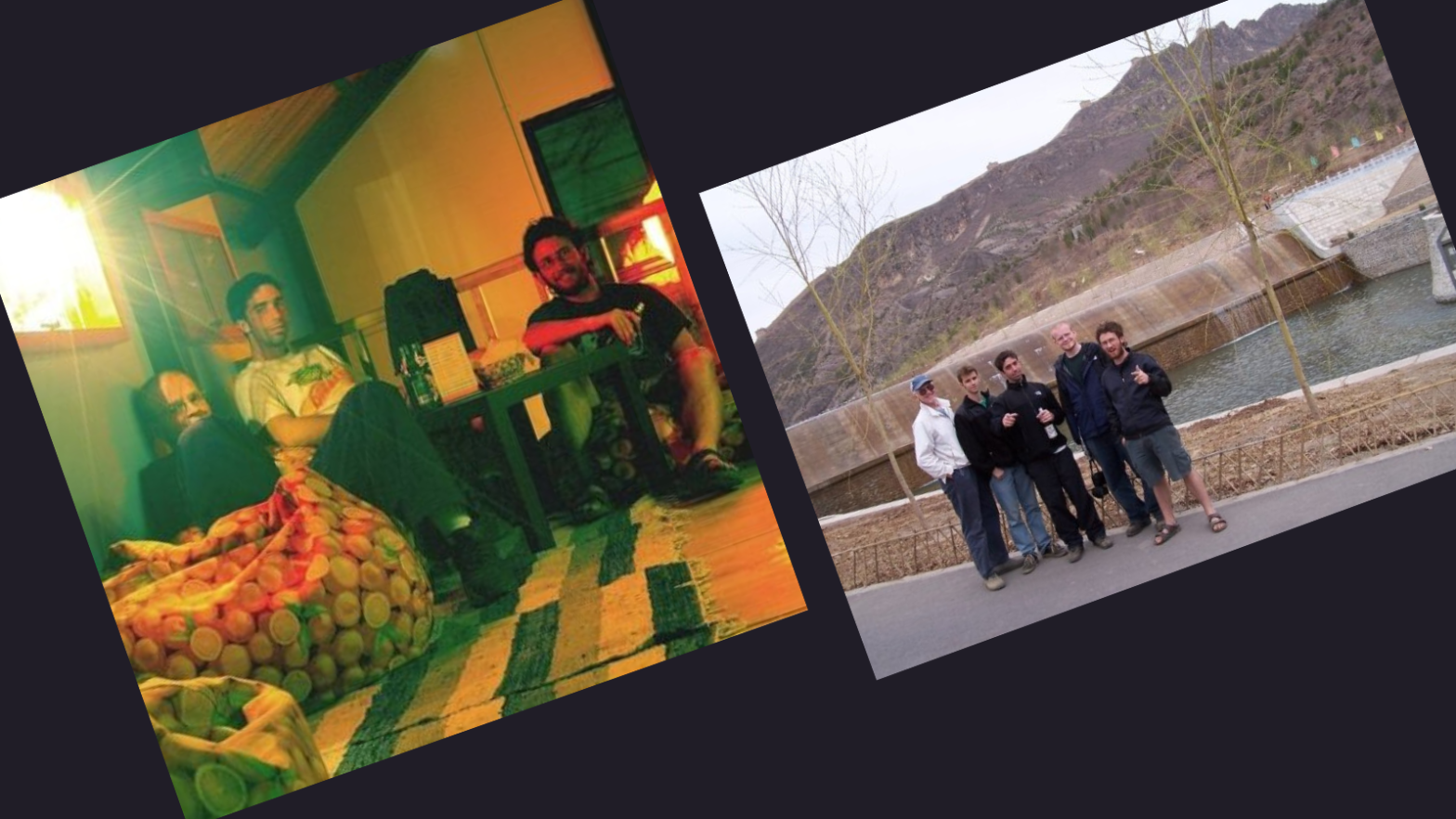
Back then, it was a hike that took about eight hours. Now, with more sections restored, it takes about five. Let me be clear, I made no preparations for this hike. You will notice a bit of a theme when I talk about my younger self (I’ve learned many lessons). I wasn’t alone, though. Four other foreigners from Hebei University accompanied me. We took a train from Baoding and arrived in Beijing the night before our hike. We spent the night in a youth hostel nestled in one of Beijing’s endangered hutongs (the real ones, not the tourist sites). It was a taste of old Beijing that fills me with nostalgia- a lazy nook of warmly lit bars built before the US was a country that now no longer exists (first picture above). We drank a bit too much lounging in bean bag chairs drenched in orange light, and then had a short night of restless sleep on hard bunk beds in a noisy hostel. As the sun rose, we stumbled into the back of a tiny van, rubbing the sleep from our eyes, and drove (slept) 2.5 hours to the wall.
Hungover, wearing a pair of Sketchers oxfords (great shoes that I remarkably still own, but not well attuned for hiking), and having no water, we ventured out for our 8-hour climb. We were not at Badaling. This place was a dirt road into the middle of nowhere with not another soul in sight. Although ill-prepared, it was a life moment full of scenery that my vocabulary can not adequately describe. Here has some great pictures of the section. Unfortunately, most of my photographs from that time were all taken on actual film. 2005 was before the prevalence of digital cameras.
The day started easy enough. As I mentioned above, the first section is restored and was a moderate hike with stable walkways, an occasional vendor selling little knickknacks and souvenirs, and just a s*** load of stairs. This path slowly degrades as you get further and just as you start to get tired. Soon, you’re climbing hand-and-foot up steep crumbling sections to remarkable views, and then almost sliding down the other side. This happens over and over and over again for miles. Wonderful for the soul, but hard on the knees. The group got spread out, and soon it was just me and my good friend Chris with no one in sight before or behind us.
In time, the burning muscles and lungs wear at the splendor, and we started to worry that we may have gotten lost. It seemed like the trail would never end, and as it was the Great Wall, you can see it continuing virtually forever before you. I’m embarrassed to say that we didn’t know when we were supposed to stop. They probably told us, but either it was in rough English, or we were in a hungover sleep. I was still very new to China (I think this was even before I met my wife) and wasn’t involved in the planning. Chris had been there longer but didn’t speak Chinese. We just tagged along with the experts. We didn’t know much of anything other than it was a trip to the wall. This disorientation was all exasperated by being very dehydrated, both from being hungover but mostly from climbing for 8 hours straight. Luckily, I was young. Now, I probably would have died.
By the time we got to the reservoir, I kid you not, my legs were so cramped I couldn’t go any further even if I tried. It would be a strange blessing. Unbeknownst to us, Chris and I had just started onto the now closed Simatai section after crossing a tumultuous chain bridge. I tried to take the first step up, and I couldn’t lift my leg. To say this was unnerving is an understatement as it had never happened before or since. My body was telling me it was time for a rest. We saw a little shack down a path and thought we would check to see if we could figure out where we were. Luckily for our growling bellies, it was a (very) local restaurant, but of course, no one spoke English. We managed to order some stir-fried egg with rice to recoup. It was awesome.
On the way back to the wall, we noticed the path down to the reservoir’s parking lot. We weren’t sure, but we thought that perhaps it could be the exit. As we ventured down, we saw the others patiently waiting for us. We joined them with nervous smiles. We had come too close to being lost on an even rougher patch of the wall. As mentioned, Simatai’s eastern side is now closed for safety reasons, which in China is saying a lot. Luckily, my cramped legs had saved us from disaster. It was a relief. To think, if I had drunk less beer the night before or brought a bottle of water, we may have continued up that wall and disappeared.
As we waited for our van to bring us back to Beijing, I had one of the best beers I’ve ever tasted to toast our victory over the wall and celebrate becoming a true man (second picture above). It wasn’t cold (cold beer or any cold liquid is hard to find in China unless it’s winter), and it was probably something generic like Tsingtao or the like, but it was fantastic. Good for dehydration? Absolutely not. Suitable for the soul? What do you think?
Cheers!
Discover more from Author Scott Austin Tirrell
Subscribe to get the latest posts sent to your email.

I really enjoy reading about your China adventures. It was cool to have the links to pictures of the wall where you traveled.
LikeLiked by 1 person
The more I read, the more I realise it’s a miracle you survived to write your memoirs!
LikeLiked by 1 person
You guys had fun, loved reading this ❤️
LikeLiked by 1 person
What doesn’t kill you makes you stronger 💪
LikeLiked by 1 person