
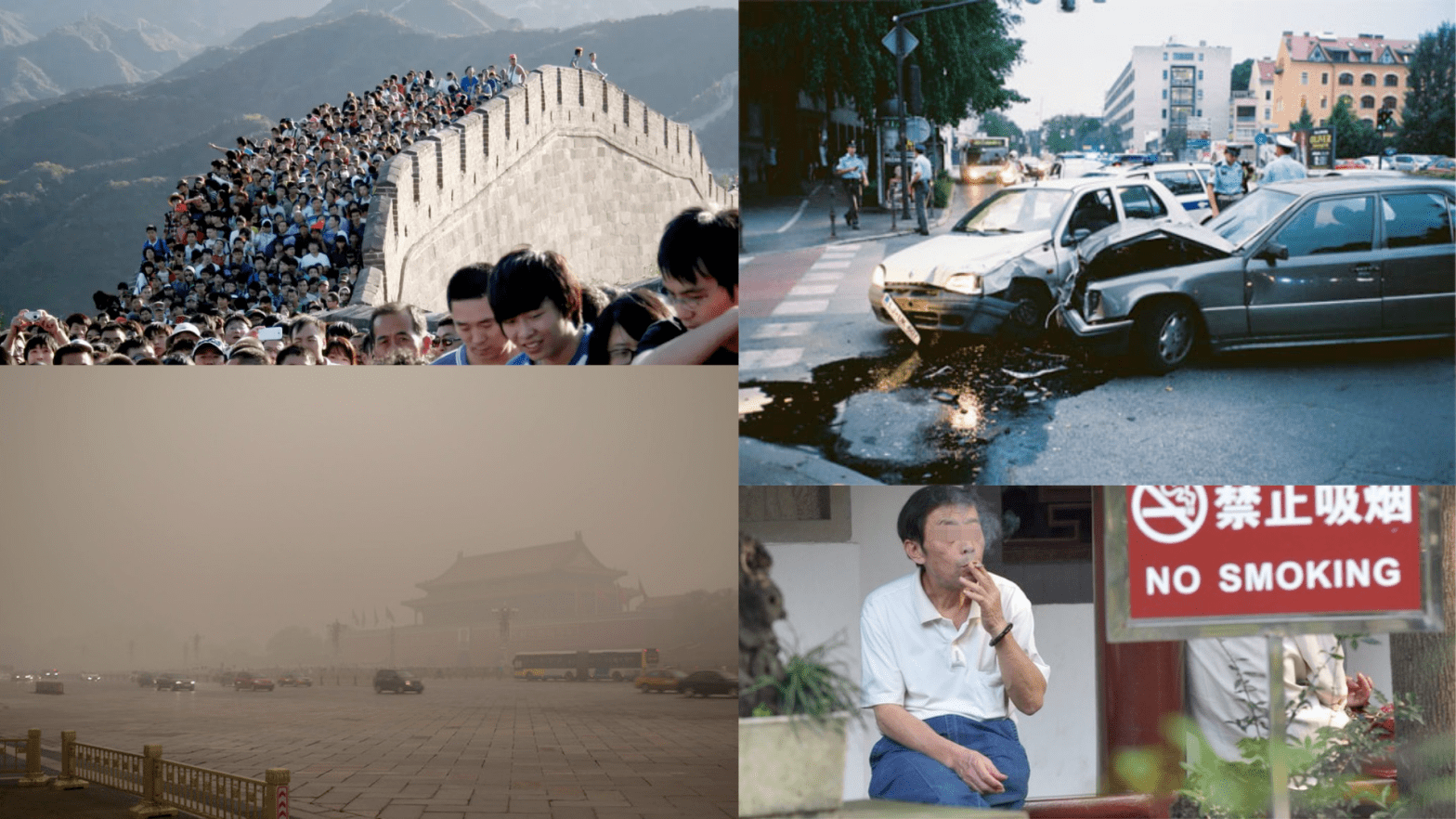
Many asked me this question as I packed my bags and moved across the world (especially my family). At that point, I didn’t really know. I hoped so and would soon find out! Ah, to be young. But the question continued to pop up over the years, especially when I tell someone one of my stories. If you’ve followed this series, you may think that perhaps it is not. Sure, a taxi driver kidnapped me, I almost starved, got deathly ill, was forced to eat fish eyeballs and drink liquid headache, almost got lost on the Great Wall, and went off-roading in a minivan, but, most of these adventures (and there are still more) were either my stupidity, just being a foreigner in a strange land, or, the result of living in a city. I have a bit more experience to draw from now than I did back then. It was my first adventure living in such a mass of people, so everything seemed a bit dangerous. I’ve now lived in Boston for the last 15 years, so urban life is no longer a surprise, and I now have something to compare with my Chinese experience.
It’s no secret that China is the world’s most populous country, with a current count of over 1.4 billion (2020). The density is about 400 people per square mile, four times more than the United States. Compared to other places globally, and considering China’s substantial total population, this is actually not very high. It ranks close to Denmark, a country you probably wouldn’t think of as overly populous.
Ah, but there is a caveat. Ninety-four percent of China’s population lives on 43% of its landmass (along the east coast), bumping its actual density to about 900 people per square mile, closer to Japan’s demographics. If we zoom in further to the city level, things get much more crowded. There are 81 global cities with a metropolitan area of over five million people (Atlanta or Philadelphia for a US comparison). Twenty of these are in China (25%). And, if you count the populations of just the city proper, the top two in the world are Chongqing (30.1 million) and Shanghai (24.1 million). To put this into perspective, 8.3 million live in New York City’s city proper. To be consistent, I’d love to compare the US’s largest city with an equivalent place in China by population, but you probably wouldn’t have heard of the Chinese city. Xi’an, the ancient capital and location of the terracotta soldiers, is close with 8.9 million, so it will have to do.
Why am I giving all these numbers? Because I want to get the point across that China is crowded. For someone in the United States (and especially someone who grew up in a town of 8,000 like myself), it is hard to conceptualize the sheer number of people. Why is this important? Because when you put so many people in close proximity to each other, there is bound to be conflict. Considering that China has close to 5 times the number of people crammed into an area roughly the same size as the US, you would think the crime rate would increase exponentially. This is not the case. In fact, on almost every crime statistic, the US ranks higher.
Crime statistics are complicated. There are many types of crime, and cultural differences may make something a crime in one country and not in another. The simplest way to compare counties is through their crime index, or the total population divided by the total reported crime. China’s crime index is 30.17 and ranks 106 on the list of countries. The United States crime index is 47.74 and is 56 on the list. Still not convinced? To help show this disparity, let’s look at something we can all agree is a crime (at least I certainly hope so) and would certainly be reported- murder. China is ranked 74th with ten murders per million, while the United States is ranked 43rd with forty-two per million. Let me hammer this home. If you live in the US, you are roughly four times more likely to be murdered than if you lived in China. It doesn’t make you feel incredibly safe (if you’re from the states). The smoking gun (pun intended) is likely the prevalence of firearms. You can love guns, but you can’t argue with the data. They lead to more death.
Thus, China is an incredibly safe country when it comes to the likelihood of being a crime victim. I have found myself walking down many a dark alley, sometimes late at night. Yet, I have never felt unsafe. The experience of stumbling into a “bad” neighborhood is a foreign notion in China, but, is a situation I’ve had often in Europe and certainly in the US.
Does crime happen? Of course, and I’ve been witness to it on multiple occasions. When being around so many people all the time, it is bound to occur. Pickpockets and thieves are quite common, so you need to keep your wits about you, especially in crowded areas like train stations. More than once, my wife and I have felt a nefarious nudge or a pull on a backpack zipper. If traveling alone, keep things well hidden.
Even without easy access to guns, violence can still happen. During my first month in China, I visited a nightclub with other foreigners. We stopped on the wrong floor, and as the doors of the elevator opened, we witnessed a guy just getting pummeled. It was quite the shock, but the “bouncers” were just as surprised to see a lift full of foreigners witnessing their crime- perhaps we saved that man’s life. Some other experiences include seeing two rickshaw pullers get into a physical altercation outside the local hospital in Baoding, where a wrench came into play and ended bloody. While visiting Beijing, we saw the aftermath of a young woman hit in the head with a rock for her purse. Sure they were unpleasant experiences, but I’ve seen just as violent and disturbing things living in Boston.
But, crime is not the only measure of safety, and although I have rarely felt unsafe in China in terms of crime, I can’t say the same about being in or around a motor vehicle. One of the apprehensions we have about taking my parents to visit China is that traveling in a car would scare my mother to death.
I always like to say that China is a country of laws, but it has no rules, and nothing highlights this more than driving. Sure, there are traffic laws on the books, but they are undoubtedly not followed, nor are they enforced. The motto seems to be to move forward as fast as possible and at all costs. Property, animals and people watch out! I’ve seen cars stop in the middle of the highway, turn around, and go the wrong way because they missed an exit. People will drive on sidewalks, honking their horns for the pedestrians to get out of the way. Trucks will pull out into traffic without looking. Cars will blast through red lights, and speed limits seem to be merely light suggestions (especially on back roads). And, there is no such thing as a right of way for pedestrians- at least not for the black luxury sedans with their tinted windows (and doubly so if there are any little red flags on the vehicle). For the “emperors” everyone is expected to heed or die.
Is it like the movie Madmax or something? No, not always (for an exception, see this post), and things are getting better. Motor vehicle death has dropped in China in the last 5 years. Since 1990, it led the world and this is an embarrassment for a face-saving culture. Say what you will about the Chinese Communist Party, but when that bright red light shines on a problem, it vanishes pretty quickly. China has developed an incredibly sophisticated surveillance system, full of speed traps and CCTV cameras, and breaking a traffic law just may land you with a ticket in the mail. For many, that’s enough. Owning a car in China is already incredibly expensive. But, for a millionaire, what is a few hundred RMB? Thus, you still see a lot of luxury vehicles with an absolute disregard for the law and safety. As the country grows and develops, and more cars join the road, it will continue to be a dangerous problem.
You may think I am exaggerating. I can only smirk and say to myself, “go see for yourself.” I can’t even count the number of accidents I’ve witnessed, either upon the point of impact or soon after. I’ve even been in a few fender-benders. Unfortunately, I am not just talking about collisions between motor vehicles, and the images of broken and bloody people are scars I will carry for life. I also have the grim distinction of actually saving my wife’s life when I pulled her back from being hit by a speeding taxi while we were shopping in Baoding. We joke about it now, but our lives could have been much different if I wasn’t paying attention. Even a nice sidewalk curb won’t stop a car. Be prepared for this if you go to China. Look both ways, and never assume they will stop.
Lastly, we can’t discuss China’s safety without mentioning the environmental factors- namely pollution. Now, to China’s credit (and I don’t compliment the Communist Party easily), they have made some pretty enormous strides over the last ten years in this area. Again, face and the big red light. I’ve seen vast swaths of the country go from dusty fields to forests. In 2019 alone, they planted 122 million trees, all part of China’s 40-year Billion-Tree Project (which began in 1978), a plan that will see a forest the size of Germany planted by 2050. Yes, they are a little late, but it was a herculean task. China is also at the forefront of reusable energy technology and is currently the world’s largest solar and wind energy producer. With no such thing as NIMBY (Not In My Back Yard), wind turbines dot the landscape.
Conversely, China is also one of the most polluted places on the planet, especially for air quality. It is no secret that this is the side-effect of double-digit growth and being the world’s manufacturer for the last 40 years. It may have lost the top spot to India, with Vietnam closing in, and the United States is indeed no saint, but it is still a huge issue and immediately apparent if you visit the Northeast during wintertime. There have been times I’ve looked out the window and felt I was in a post-apocalyptic movie as the sun disappears behind a cloud of brown smog (see picture above). You don’t just see it. You feel it in your eyes and throat. I’ve spoken about this and China’s water issues in other posts, but they contribute to the country’s total safety and warrant mention here. Cancers often associated with air pollution, such as that of the lungs and esophagus, and those linked with ingesting pollutants, such as cancers of the digestive system, are a significant concern in China. Lung cancer is the fourth leading cause of death, followed closely by Stomach cancer at number five.
But the largest causes of death (in order) are heart disease, stroke, and restrictive pulmonary disease. This leads to my last area of environmental concern, and that is smoking. Here too, China has made great strides in recent years and has banned smoking in most public spaces. Still, when I lived there, there was no place free from the smell of smoke- restaurants, shops, malls, taxis, trains, buses, and even hospitals and schools always had at least a faint smell of tobacco, if not downright foggy with smoke. Sure some of these places did not allow smoking, but I have several photographs of people taking a puff under no-smoking signs (see above), so the adage remains true- plenty of laws, but no rules. China remains the largest consumer of tobacco globally, with roughly the same amount of smokers as the entire US population. Two-thirds of Chinese men smoke, accounting for just over 50% of the world’s male smokers (and 27% for the ladies). Closer to home, my father-in-law smoked for more than 50 years (happily, he just quit!). You may think to yourself, that sucks for them, but I’m not a smoker. Well, second-hand smoke is real. It kills an estimated 100,000 annually in China. Things are getting better, but if you plan to travel to the Middle Kingdom, be prepared.
So, is China safe? Yes, as long as you don’t rub the Chinese Communist Party the wrong way (something I will touch on in my next post). If that bright red light shines on you, watch out! Sure, there are dangers and plenty of things that will kill you, but you can say the same about any place, and it is undoubtedly better than some places. It may come as a surprise, but you are more likely to be injured or even die at home than in any other place on the planet. Therefore, from purely a safety point of view, get out there and experience your world!
Cheers!
Discover more from Author Scott Austin Tirrell
Subscribe to get the latest posts sent to your email.

One thought on “My life in China, Part 22- Is China safe?”