
When you start living in a new country, it takes some time for your body to adapt. The changes in the food, water, and environment all take their toll, plus there can be a bit of stress involved. For all of us foreigners living in China, it took several months to a year to fully adapt. I had a friend that was never quite well the whole year he was there. He was pale, and no matter how much he ate, he kept losing weight. He would order a large container of rice stir-fried with egg every night before bed, hoping that he would gain some pounds- to no avail. Another friend developed heart palpitations and had to leave after just three months. In both cases, as soon as they got back to their home countries. They were fine.
Thus, I got sick quite often during those first few months in China. When I wasn’t blatantly ill, I felt run down much of the time, and although I didn’t lose weight, I didn’t gain any either. With the amount of food I was eating, I should have gained a lot. I tried many different foods I had never experienced before, and I wasn’t as careful as I should have been evaluating whether I should take risks. It was all so exciting and new, and I gobbled up just about anything people put in front of me. I learned some valuable lessons.
The water was part of the problem too. Growing up in the US, where you can drink from the tap in many places, it is hard to kick some of those old habits like rinsing your toothbrush. In China, especially in Baoding, ingesting just a few drops would put you out of commission for days. No washing fruit or vegetables that you planned to eat raw, indeed no glass of water to wet a dry throat at night, and when you showered or washed your face, you had to be very careful to keep your mouth shut. Even boiled water was full of pesticides and hard metals.
The environment also had a significant impact. It was much dryer than my body was used to in Baoding, and the air pollution in winter was extremely high. It all culminated in a sinus infection that latched on and never fully let go the whole time I lived in China.
I mention all this because very early on, I realized that I needed to start exercising more. For one, I wanted to boost my immune system. More importantly, I was fresh out of four years of college, with its late-night pizza and fried food, and thus had a dad’s body at the ripe old age of 25. I had already made a massive change to my life by moving to China, so I thought, what would be a better time to get in shape? I would soon find that here, too, there would be interesting differences and stories to tell.
Most of the other foreigners I lived with had already been in the country for six months or more when I arrived. The typical contract was for one year and began in September. This was probably March. Therefore, I had a bit of an advantage in that they shared many of their learned lessons with me, struggles that I could avoid. The friend I mentioned above with the rice had also realized he needed to exercise more and had found a local gym. He urged me to join, so I agreed, thinking it would be like an establishment I was used to in the US. At the time, gyms were relatively rare in China and especially so in Baoding.
That first day of my new exercise routine, we walked across the street from Hebei University and into an apartment building. We went up the dark and dank stairwell to the fifth floor, the climb becoming part of the new routine. As a side note, virtually all residential buildings with less than seven floors do not have elevators in China. My in-laws live on the fifth floor of theirs, which at their age is quite a hike. Anyway, we came to a hall with a girl sitting at a little desk. We fumbled with our bad Chinese and managed to communicate that I wanted to sign up for a membership. I think it was like 100 RMB (roughly $15 at the time) for three months or something like that. Regardless, it was cheap. My friend then led me into the gym. It was, in many ways, like stepping back in time, inexpensive for a reason, and an introduction to a middle-aged Chinese man’s notion of exercise.
The entire space was probably about 500-600 square feet, certainly not a gymnasium. Immediately to the left of the entrance was a floor-to-ceiling mirror with a bar like you see in a dance studio. In front of that was a weight bench with an assortment of mix-matched barbells and free weights. Directly ahead were three antiquated weight machines, only one of which worked. To the right was an open area with some medicine balls and two ping pong tables, one of which was occupied by two older gentlemen (the only others in the room). As soon as we entered, their spirited game came to a sudden stop, with the sound of the ping pong ball bouncing its way off the table. They just stared at these two young foreigners who were most certainly very well lost. Beside them was a table with a hissing water boiler and several thermoses. Yes, not a water cooler, a water boiler, which leads me to my first significant difference.
Most Chinese do not like to drink cold liquids, especially in winter, and this is certainly the case for the older generations. There are various reasons for this aversion. For one, the water safety issue mentioned above. As people need to boil tap water to drink it, they just got used to drinking hot water. Secondly, the Chinese believe that hot water aids digestion. Some of this comes down to the amount and type of oil ingested in the Chinese diet. As this oil solidifies when cold, there is a belief that the same thing will happen in their stomach if eaten with cold water and thus causes digestion problems. Thirdly, one of the basic tenets of traditional Chinese medicine is the concept of maintaining a balance between yin (female) and yang (male). They consider water as yin and hot things as yang, so hot water is like a tonic that balances these two forces. Organ temperate and the flow of qi, the body’s vital energy, are all affected by this balance.
Thus, drinking hot liquid is good for your health, and drinking cold is bad. As I’ve mentioned before, this made finding a cold beer almost impossible. In the winter, you could ask a restaurant to put a couple outside. In Bai Lou, where we lived, the restaurant knew our likes and kept some in the fridge, but it was warm beer outside of this and in the summer, hot beer… yum. In the gym, drinking hot tea or water is all fine and dandy in the winter, but this was the spring, and it soon became sweltering in that little room. The Chinese don’t like a cold wind either, for much the same reasons as mentioned above, so no AC. It would be 100 degrees in that gym, and the sweaty old-timers would be doing their exercises while drinking glass after glass of boiling water. I didn’t know if I should be impressed with their strength, or worried that they would drop from heat exhaustion.
Now, for the exercises. As you’ve certainly ascertained, this was not a western gym. It was a workout/ hangout space for the local retirees. I used this “gym” for about six months before I found other means, and during that time, I did not see a single person under the age of 50 (other than my friend, of course). Their exercise typically included a routine of stretches and calisthenics of their own design, ping pong, and drinking glass after glass of either plain boiled water or tea that had been used and reused about a hundred times. Only once did we see one of these gentlemen use weights in a feeble attempt to test our strength in a spontaneous bench-pressing competition. I guess his qi was particularly powerful that day. We had to put a stop to it because we were afraid he was going to hurt himself. Other than that, the retirees usually stayed on their side of the gym and us on ours. The place wasn’t much. It was a dump, actually, but it had its own indistinguishable charm and was enough for us. My friend and I got to the point where we knew the guys that hung out there and developed a bond. We would always smile and wave and try to communicate here and there. It was a strange experience, but one where you find joy when you weren’t expecting it.
After six months, my friend decided not to renew his contract and left. He didn’t find as much joy in China as I did. He was a “real” teacher of English majors and got frustrated with the cheating he saw from his students. Something I will discuss more in the future. When he tried to fail some of his students because they blatantly copied their final essays, the administration stepped in and made him change his grades. It put a sour taste in his mouth, so he left and eventually taught English in Korea for several years. Anyway, the gym wasn’t as much fun alone, so I stopped going.
Instead, I took up jogging. But first, I needed shoes. I had never really run for exercise before, and the only shoes I had with me were a pair of leather oxfords. They were the best pair of shoes I ever owned. I still have them, actually, and they are in excellent shape for traveling worldwide, but they weren’t going to do for running. Hiking the great wall? Sure. But running, no. Now, I am a size 14 foot. Finding shoes in China, even now, is virtually impossible. It is hard enough in the states and often comes down to picking what a store has, not what I want. Thus, I asked if my parents could send me a pair. This process took about a month. Luckily, they fit, because I wasn’t about to return them.
I laced up my new shoes, threw on a pair of shorts, and went for my first jog ever. Welcome to the parade! I thought walking down a street was an attraction, but running? Oh my god. For one, jogging wasn’t yet a thing in China, so no one could figure out what the foreigner was running from. Secondly, and more importantly, this lanky red-headed foreigner was only beginning to get in shape. Have you ever had people stare at you while you huff and puff and feel generally miserable? In any event, it was an uncomfortable spectacle, and I came very near to giving up on that endeavor.
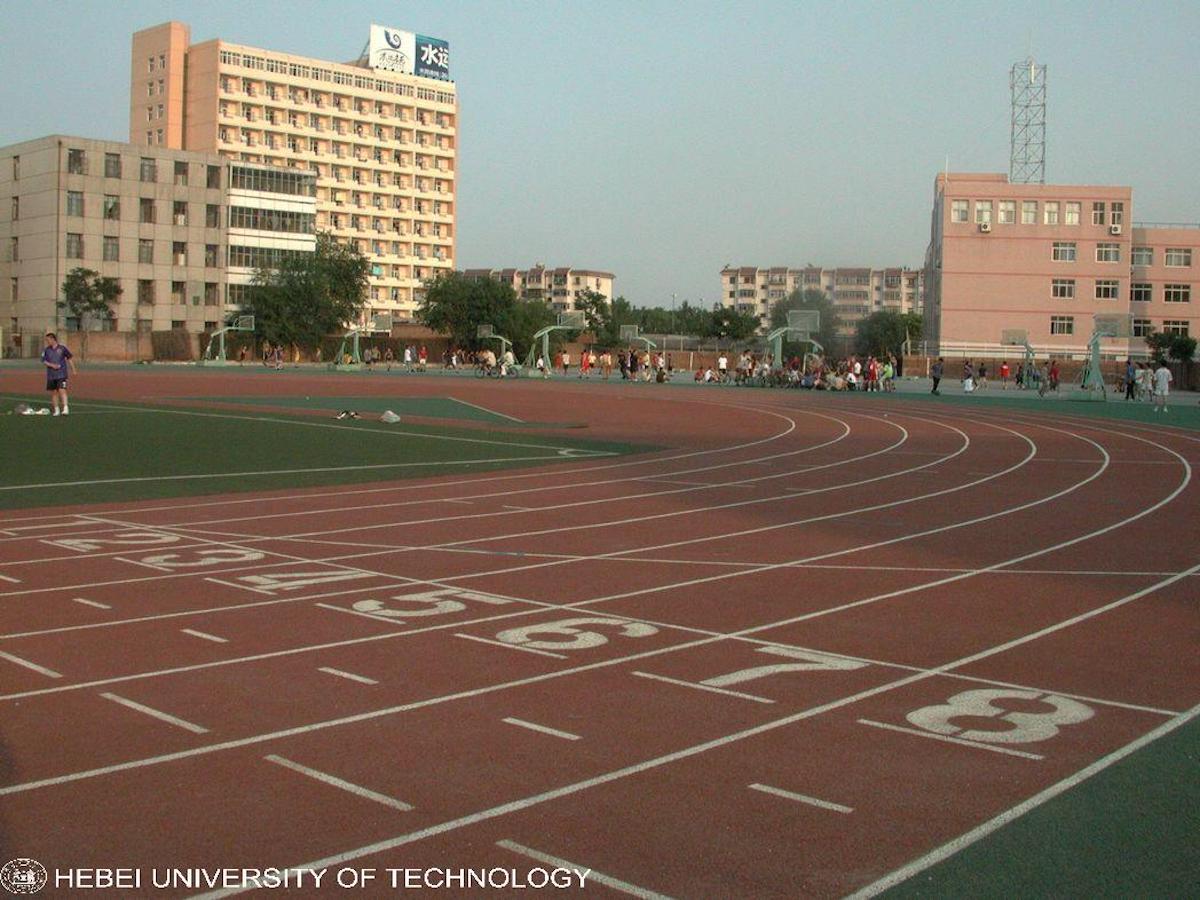
Luckily, next to Bailou was Hebei University’s track stadium. It would be a perfect place to run. The problem was a 3-meter high fence surrounding the field that was promptly locked in the early afternoon. With teaching during the day and such, my schedule made it much more convenient for me to jog in the early evening. Luckily, our fenced-in compound connected with the track, and that section I could easily climb over. So, I trespassed, and I have no regrets. It was great. For one, I had the whole track to myself. Two, there would be no audience watching the foreigner jog. And most importantly, in a sea of people that was Baoding, China, it was the one place I could get away from the crowd. The track also had pull-up bars and other such static exercise equipment, so I developed a nice routine.
Then, I hurt my knee, and it all stopped. My wife and I still scaled the fence for a place to walk from time to time, but some of the workers saw us climbing back one evening close to when we left for the US. The next day, the sound of them welding spikes on the wall woke us, and it was the end of an era. In most universities in the world, such places are open 24-7 to encourage exercise. I mean, what can you do to a track lit with floods and surrounded by apartments? Anyway, I have fond memories of running that track as the sun went down in bands of orange.
I think the point of this post is that experiences like mine are not all crazy adventures. Although I certainly had my fair share of those, sometimes it’s as simple as exercising in a different land that paints its memories in your mind. When living abroad for a long period, the amount of difference you face changes your whole outlook on your own culture and way of doing things, and I think that is always a good thing. It keeps your mind open to experiencing life in all its variations. Did I expect that the first time I would go jogging would be in China? Certainly not. But now, any time I go for a run or, more likely, see someone running, I smile and shake my head and think of that young lad in a world of firsts.
Cheers!
Discover more from Author Scott Austin Tirrell
Subscribe to get the latest posts sent to your email.

Interesting post – brought back memories of living in Japan! Thanks for sharing!
LikeLiked by 1 person
Did you boil the water in the end`?
LikeLike
I mean with a filter kettle to be on the safe side?
LikeLiked by 1 person