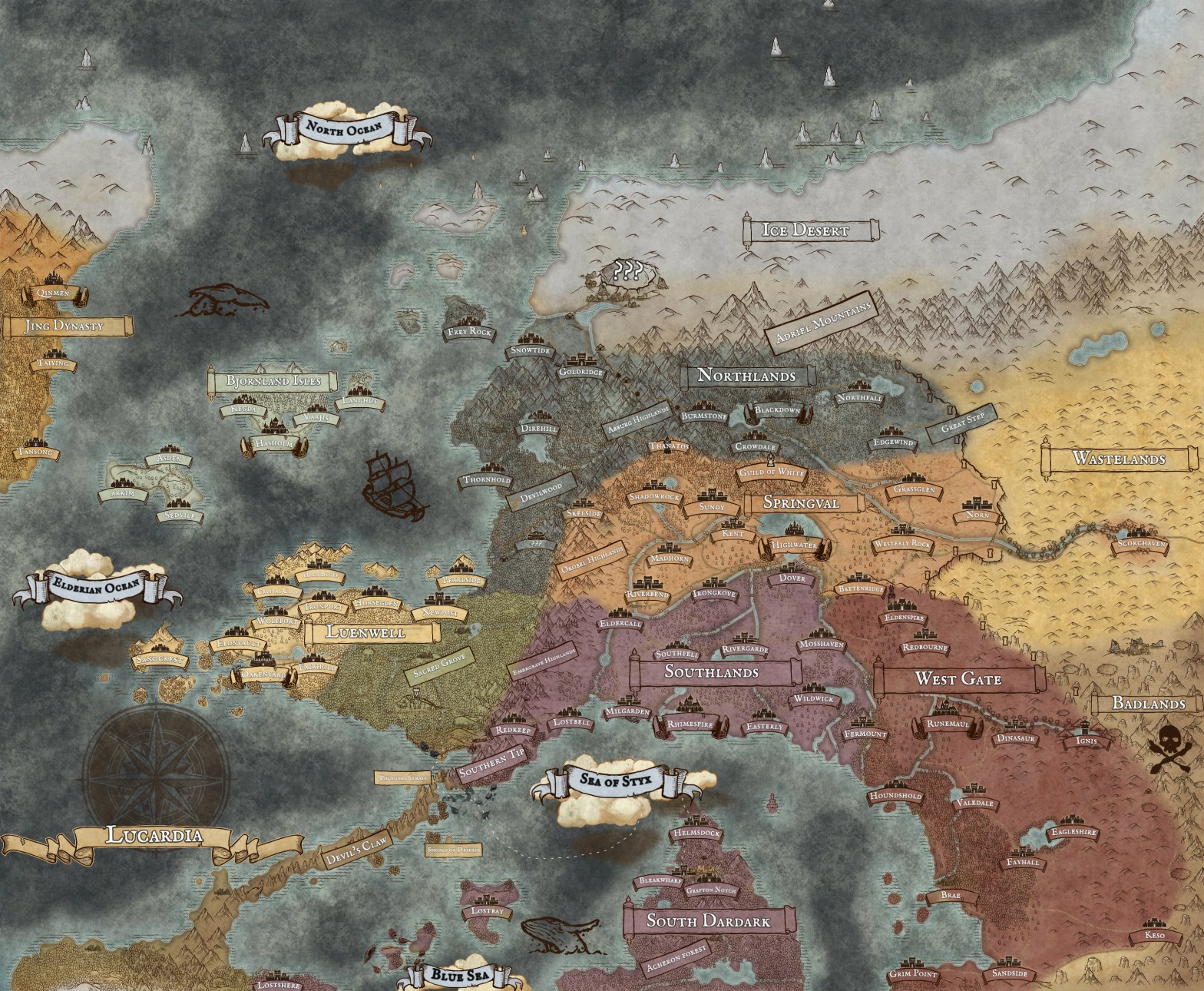
It’s hard to imagine a world without speedy lines of communication or easy means of travel, and this poses particular issues when trying to write medieval fantasy. The Lucardian Empire, the setting for my Absolution of the Morning Star series (map above), is roughly 2,500 miles across at its furthest points, which is approximately the size of Europe (or about four million square miles in total). It is a varied landscape of deserts, plains, forests, and mountains. The seat of Vesper the Uniter at Highwater is roughly at the center of this vast landmass, but still, the closest border to the capital is about four hundred miles away (the furthest is about 1,200 miles).
To put that in perspective, a horse during the medieval period (remember, this covers a thousand years) could realistically travel about 35 miles a day (depending on many factors such as gait, food, road conditions, weather, etc.). If pushed very hard, 50 or even 100 miles was possible, but it would not be sustainable travel (the horse would need to rest for a few days in between). At this typical rate, it would take about eleven days for a paper message to travel from the closest border to the emperor’s hand. Four days might be possible if an established relay system moves the news between fresh horses- something that would be expensive and used only for emergencies. Communications from the empire’s furthest reaches would take more like a month (or about two weeks with a relay system). That’s only to receive the message. It would double the time if it required a reply (or more if the answer required lengthy deliberation). Many follies could befall a messenger from point A to point B- bandits and rouges, enemies of the state, lousy weather, the horse could throw a shoe, or worse, the messenger. How many times did people and their messages simply disappear?
The same logistics work for extended travel, which is vital in the Absolution of the Morning Star series. Erik’s home is gone, and he searches for answers and meaning. By the third installment, he has ventured from Grafton Notch to Helmsdock, across the Sea of Styx to the Luenwell Pennisula, transversed the mighty Sacred Grove to Newpost, and is now in the great northern pine forests of Devilswood on his way to the city of Thornehold, the seat of his maternal grandfather. Erik’s journey has been 2,400 serpentine miles- some by ship, but the rest on foot.
For walking during this time, 20 miles a day was feasible. Still, with hard-soled, ill-fitting leather shoes transversing unmaintained paths, saying Erik’s feet hurt each night is an understatement. Securing food that didn’t perish or finding drinkable water would be challenging. Carrying it with you slowed your pace considerably. My wife and I sometimes walk to get our groceries. The closest grocery store is about fifteen minutes away. A full backpack may weigh up to fifteen pounds, especially if we need potatoes and milk, for example. That weight on your shoulders in the summer heat for fifteen minutes is challenging. It is only a little over a flat mile, but it certainly puts my characters’ struggles in perspective, especially when a person requires about two pounds of food and 3-4 liters of water daily (about ten pounds a day total).
When I was younger, my friends and I used to camp, and we would hike with packs of close to one hundred pounds. So I know it’s possible to carry a few days of provisions with the right gear (at this time, it would probably be a large wicker basket and some rope), but doing so for twenty miles a day for months adds all sorts of strange logistics to calculate and keep in mind. Rabbit holes are plenty. I don’t want to bore my readers with the nitty-gritty of logistics, but knowing what is possible or impossible is essential for its believability, and throwing a juicy nugget of information can go a long way to establish credibility.
If travelers didn’t want to carry their supplies, taverns and inns were typical during this period. However, buying your vitals and a soft bed required money, and carrying lots of coin in the deteriorating Lucardian Empire would have its own issues. Bandits and rouges would canvas these hubs to see who had lots of jingling shiny stuff to spare and then follow you to the wilderness where no one would hear you scream. Again, how many people simply vanished?
“What about hunting?” you may ask. My story takes place in a time roughly equivalent to the late medieval period (15th and 16th century). At this point, hunting was primarily reserved for nobility, and poaching game on the aristocracy’s large tracks of land could be punishable by death (or at least some sort of maiming punishment). It is not like you could just look up on Google maps to see property lines. One never really knew whose land they might be on. Hunting could also be dangerous in its own right. Try shooting an arrow at a charging boar, or worse, a bear, and see how it ends up for you. Wikipedia lists several monarchs killed through hunting here. On a side note, King William II of England was killed in a hunting accident by an arrow shot from the bow of Walter Tirel. Yes, he’s an ancestor of mine. And if you love fantasy, you know how Robert Baratheon died.
With the ship travel found in the Dawn of the Lightbearer, Erik’s journey got a little boost, but coupled with periodic rest and the tale’s many diversions, I estimate the story for the Absolution of the Moring Star series covers about five to six months off grueling travel, thus far. That’s a lot of someone’s life spent getting from point A to point B. But it did happen, and probably more often than you think. For the large majority of medieval people, they spent most of their lives within a fifty-mile radius of their home village. Still, they did travel, often on pilgrimage, escaping natural disasters, or because of war. The most significant event of the medieval period, the Crusades, saw large groups of people moving vast distances comparable to Erik’s journey.
And this brings me to armies. Forced on an arduous march, they could do 25 miles a day, but it was probably more like 12 if they wanted to keep pace with supply lines (which was essential). The news that an enemy approached only slightly outpaced the enemy itself. It did not leave much time to prepare- probably enough to dig some ditches and set up bulwarks, but not enough to mobilize an entire country. Remember, it would take weeks for the call for aid to get everywhere and additional weeks for soldiers to mobilize and travel.
As I write these books, I sometimes get frustrated with the pace. Danger approaches. Why aren’t they doing anything? But that would be true to the times. Everything was frustratingly slow when you discussed the macro. Hence, much of the Absolution of Morning Star takes place in the micro, where the action stimulates readers. A few months’ journey during this period has plenty of material for a rich yarn. Though, it’s hard to keep all this distance and time in mind. I constantly pull up my map to see how long it would take to get from here to there or determine how long news would take to spread. Sometimes I can’t write what I want to write or need to switch gears solely because of logistics.
But it’s not all bad. Surprises were common and mysteries abundant during this time, and this helps put in perspective why faith was so crucial for medieval peoples. People vanished, guests or enemies appeared unexpectedly, and everyone had to be self-reliant as they faced danger at every turn.
The Absolution of the Morning Star series is moving along nicely. Since my last post, I’ve written about 7,000 more words for Noonday in the North. Last night, I killed a significant character. I won’t give details, but it marked the mid-point of the series and was an important milestone for me. As I’ve said in the past, I write by destination, and this was a massive landmark. I didn’t know how or when I would reach it, but my characters somehow knew the way and got there in a manner I could never have predicted even a week ago. The journey might be long, but the destinations are worth it.
Cheers!
Discover more from Author Scott Austin Tirrell
Subscribe to get the latest posts sent to your email.
