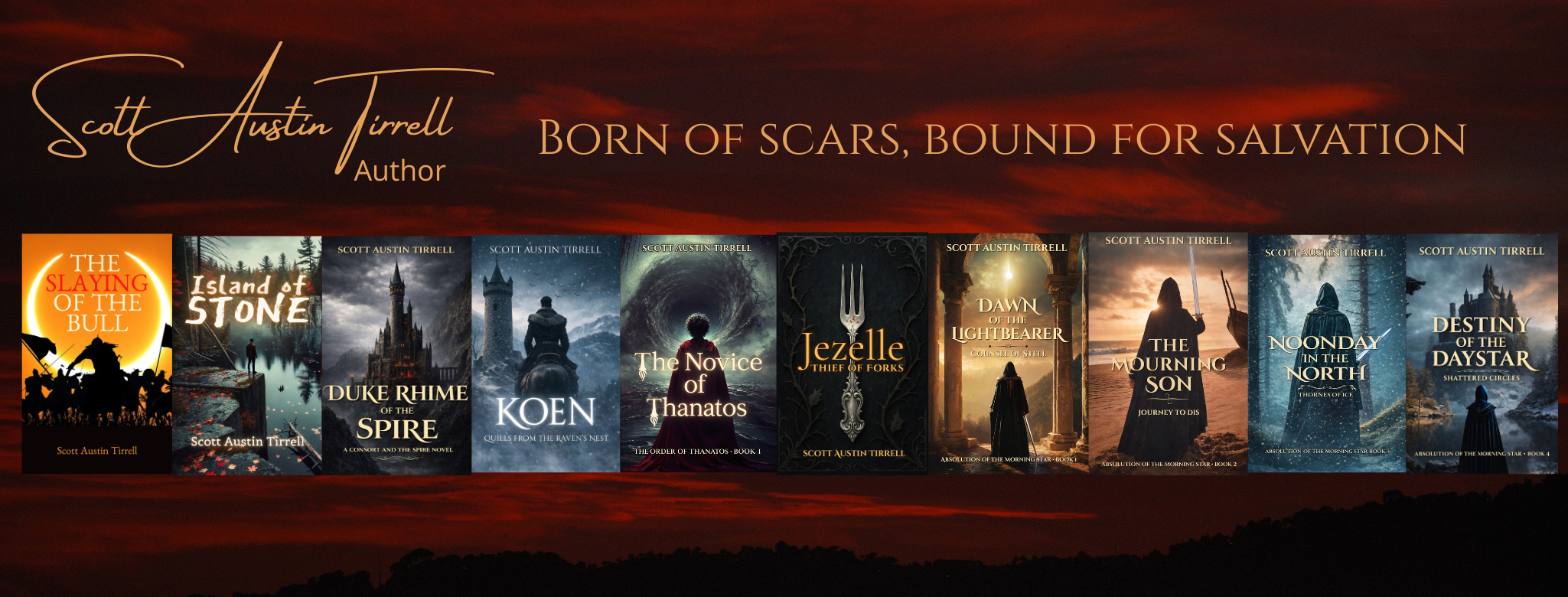

Now that I’ve finished the first draft of the fourth book in my Absolution of the Morning Star series, I thought it was a good time to reflect on and examine what I have created thus far.
Welcome, fellow traveler, to the world of Lucardia—a realm where legends whisper through ancient forests, secrets linger beneath sacred oaths, and destinies are forged amidst relentless strife. If you’re like me, drawn to epic dark fantasy that challenges perceptions of light and shadow, questions the nature of faith and sacrifice, and delves into the murky depths of human ambition and morality. You’re in for a thrilling journey with the Absolution of the Morning Star series.
My Vision of Power and Ambiguity
When I set out to write Absolution of the Morning Star, I didn’t want to create a simple tale of good versus evil. The world of Lucardia constantly shifts the lines between right and wrong, and the characters grapple with conflicting loyalties, dark temptations, and the heavy price of their ambitions.
I wanted to explore what happens when flawed individuals are placed in extraordinary situations where their choices impact their lives and shape the course of nations. In this series, power isn’t just about wielding a sword or casting a spell—it’s about influence, manipulation, and control over one’s own fate.
But I’ll be honest: Absolution of the Morning Star isn’t for those looking for easy answers. It’s for readers who enjoy diving into complex narratives, where characters are left to navigate their own beliefs, decisions, and consequences in a world that rarely offers simple solutions.
The World of Lucardia: A Living, Breathing Tapestry
Lucardia isn’t just a backdrop for the series—it’s a world that feels alive, with its myths, landscapes, and political tensions. I spent a lot of time weaving together this land’s geography, history, and lore, from The Mourning Son’s desolate shores and ancient groves to the wind-swept mountain paths of Noonday in the North.
When I began building Lucardia, I aimed to create a place that was both familiar and unsettling, with echoes of our own world but with its own rich mythology. It’s a place steeped in religious and supernatural influences, where gods and mortals, witches and knights, struggle against one another, often to disastrous ends.
For me, world-building is about more than just creating a setting. It’s about giving readers a sense of immersion, drawing them into a world where every landscape, every city, and every forgotten ruin has its own story.
Themes that Resonate Beyond the Page
While Absolution of the Morning Star is undeniably a work of dark fantasy, I always wanted the themes to resonate beyond the genre. This series is about power and sacrifice, the consequences of human decisions, and the moral grey areas where most of life’s most challenging choices reside.
I didn’t set out to write a story about clear-cut heroes and villains. Instead, I wanted to explore how even the best intentions can lead to tragic outcomes. I tried to raise questions about faith, loyalty, and the influence of divine forces—questions that don’t always have clear answers.
In Lucardia, power struggles aren’t just battles fought with swords and sorcery. They’re struggles of faith and trust and struggles for control over one’s destiny. Sometimes, the hardest battles are the ones the characters must fight within themselves.
A Narrative of Transformation
One of the most exciting parts of writing Absolution of the Morning Star has been exploring the transformation of its characters. In this series, people are rarely who they first appear to be, and their journeys often force them to confront their capacity for darkness.
Take Erikson Gray, for example. His journey begins with discovering an ancient, mysterious sword known as Lightbearer. This sword becomes both a tool of redemption and a symbol of darker temptations for Erik, serving as a focal point for his internal conflict. I wanted to create a character whose transformation wasn’t just about external challenges but also about introspection, moral dilemmas, and spiritual crises.
But Erik isn’t alone in facing these challenges. In the prequel, Koen: Quills from the Raven’s Nest, I wanted to explore the backstory of Erik’s father, Koen the Gray, a character struggling to secure Lucardia’s future amidst political machinations and a doomed marriage. Through his journey into the Wastelands, where he encounters the enigmatic Erikini, readers witness how desperation can lead someone down a perilous path. His struggles and best intentions create the world Erik inherits.
Faith and Spirituality: A Double-Edged Sword
In Absolution of the Morning Star, the Caspian faith is an intricate web of contradictions—promising hope and salvation while concealing the unsettling possibility that it is built on a lie. This faith, rooted in the myths that created the realm, offers solace and guidance to the people of Lucardia, holding their society together in the face of chaos and uncertainty. However, as the series unfolds, it becomes increasingly evident that the foundation of this faith is not as unshakeable as its leaders would have their followers believe.
The Caspian faith’s power is not only derived from its doctrines but from the belief that it was divinely ordained, symbolized by the sword and sun—a reminder of the Great Beholding, where humanity was saved by trapping one of God’s chosen within a sword. This emblem embodies divine intervention and the immense sacrifice and power it took to secure humanity’s survival. However, this same symbol serves as a tool of control, wielded by those in power, to enforce loyalty and obedience in Lucardia.
In Absolution of the Morning Star, the Caspian faith stands as both a guiding light and an instrument of control, offering hope and structure to the common people of Lucardia amidst a world of turmoil and betrayal. It promises divine protection and frames their struggles as part of a grander plan. Yet, beneath this veneer of salvation lies a haunting ambiguity: was this faith born from a monumental act of divine intervention or cleverly constructed deception? As rumors of forbidden knowledge and hidden truths surface, cracks begin to form in the faith’s rigid hold over its followers. Erikson Gray finds himself grappling with this unsettling duality, questioning whether the hope offered by the Caspian faith is genuine or an illusion designed to maintain control. This tension between sacred narrative and the possibility of manipulation drives the series forward, blurring the lines between truth and deception and portraying faith as both a refuge and a prison.
Crafting an Atmosphere of Mystery and Tension
Setting and atmosphere are crucial elements of storytelling. I wanted the landscapes of Lucardia to do more than just provide a backdrop for the action. I wanted them to reflect the themes and emotions of the story to create a sense of immersion and tension.
Take the Llwyn Sanctaidd, or Sacred Grove, highlighted in The Mourning Son. This ancient wilderness is teeming with magic and danger, serving as both a physical and symbolic barrier between Erikson and the truths he seeks. The grove represents his internal struggle and his fear of confronting his past.
Similarly, the lost city of Dis in The Mourning Son reflects the fragmented memories and histories of its people. Dis, once a thriving place filled with magic and wonder, now lies abandoned in the heart of the Sacred Grove, overgrown and teeming with remnants of forgotten rituals and buried secrets. I wanted each setting in the series to feel alive, steeped in its own lore and mysteries, with layers of history waiting to be uncovered by those daring enough to venture into its depths.
The Bonds that Hold Everything Together
While epic battles and dark secrets drive the plot, the relationships between the characters give Absolution of the Morning Star its emotional core. Friendships, alliances, betrayals, and love all play a significant role in shaping the fates of the characters and the broader world of Lucardia.
Erik’s interactions with those around him—like Agar, the loyal yet cunning Knight of Norn, or Ailis, the smuggler and guide through the sacred grove—aren’t just secondary plot points. They’re essential to his journey, each one challenging him in different ways and forcing him to confront uncomfortable truths.
I’ve always believed that the bonds between characters make a story come alive. In Absolution of the Morning Star, these bonds aren’t static—they evolve as the characters grow and change. This evolution makes their struggles feel real and their choices poignant.
A Tale of Redemption and Ruin
As the series concludes in the final two books, the stakes are higher than ever. The choices made by characters like Erikson Gray, Jezelle, and Margaret (a new point of view character in Destiny of the Daystar) will determine not just their fates but the fate of Lucardia itself. And yet, despite the looming sense of doom, I’ve tried to weave a thread of hope throughout the narrative.
Redemption has always been a central theme in this series. But it doesn’t come easily or without sacrifice. I wanted to explore what it means to seek forgiveness, make amends for past mistakes, and face the consequences of one’s actions.
Absolution of the Morning Star isn’t just a story about confronting external threats. It’s about facing the darkness within oneself and in the world. It’s a tale of resilience, where there is a possibility—however faint—of finding absolution even in the face of ruin.
Why I Think You’ll Love Absolution of the Morning Star
If you’re looking for a dark fantasy series that goes beyond the usual tropes of heroes and villains, light and dark, then Absolution of the Morning Star is worth your time. My goal has always been to create a narrative that challenges its readers with difficult questions and explores what it means to hold power, seek redemption, and confront one’s own capacity for darkness.
I wanted to write a series that feels both epic in scale and deeply personal, with characters whose journeys resonate long after the final page. So, if you’re ready to dive into the world of Lucardia, I invite you to join me on this journey. Pick up a copy, lose yourself in its pages, and see where the shadows take you.
Discover more from Author Scott Austin Tirrell
Subscribe to get the latest posts sent to your email.
