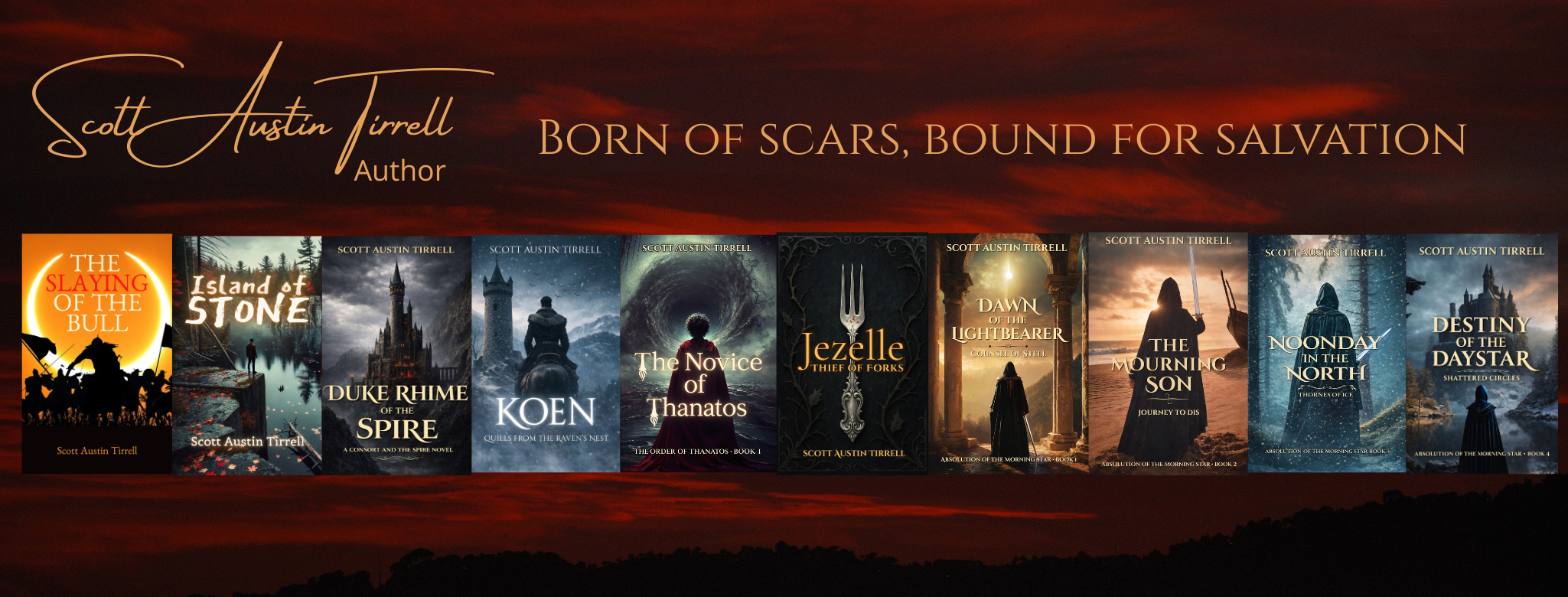

Now that Koen: Quills of the Raven’s Nest is back from the editor and getting all patched up (we’re almost there), I’ve fallen back in love with the book.
I wasn’t supposed to write Koen. Not yet, anyway.
When I began charting the course of the Absolution of the Morning Star series (AMS), I had a firm trajectory—six books, a complete arc, each installment pulling the reader deeper into Lucardia’s slow, apocalyptic unraveling through the eyes of its protagonist, Erikson Gray. Koen wasn’t meant to interfere. He was a shadow figure, a prologue ghost—the dead father, the tragic hinge—mentioned in passing, then buried beneath decades of consequences.
But he wouldn’t stay buried.
While drafting the early volumes of AMS, I kept running into his absence. Not in the plot, where his role was complete, but in the emotional architecture of the world. Whenever Erik Gray lifted his sword or dreamed of empire, I felt a presence behind him—a failed prayer—a man who had reached for a legacy and returned with a curse.
That man was Koen the Gray.
He isn’t the hero of a prophecy or the chosen one. He’s not the keystone of a kingdom. But he is the fulcrum upon which so much of Lucardia’s suffering pivots. I didn’t know that when I started the series. I only knew that the realm was wounded. Writing Koen taught me where the wound began.
And so, I stopped what I was doing. I turned away from the final books in the Absolution of the Morning Star series and stepped back in time.
I wrote Koen because I had to.
The story begins not with a battle but with a husband and wife confronting an impossible struggle. A cold room. A soft breath. A woman staring at the ceiling and saying, “Your father will kill me one way or another.”
This book isn’t a war epic. It’s a bruise.
Koen is a prince sent north to seal a truce with a bride who will bear the child that will heal the realm once and for all. Rachel—his wife, his equal, his constant ache—is both balm and blade. Their love is real. That makes it unbearable, for they were never meant to succeed. The union was already a corpse wearing royal silk from the moment the vows were spoken.
And Koen… Koen is the kind of man who still believes in miracles.
What follows—the witches, the curses, the forbidden paths through Lucardia’s darkest corners—I didn’t plan those either. I followed Koen into the dark. I let him make desperate decisions, seek out ancient forces, chase shadows no sane man should trust. Not because he’s foolish. But because he’s a man with no good choices left–a desperate man. And sometimes that makes monsters of us all.
There’s an old saying in Lucardia: The wind changes when the crows stop cawing. Koen hears that silence and walks straight into it.
When I first dreamed of them, the Nyth Cigfran—the Raven’s Nest—was only a myth, a half-formed idea. But through Koen’s desperation, they took root and fed into AMS. His belief gave them breath. I hadn’t realized, until writing Koen, just how central they were to the metaphysical engine of the series.
Magic in Lucardia isn’t glitter and spectacle. It’s debt. It’s corruption. It’s the body altered to appease the void. And the witches of the Raven’s Nest are keepers of that old economy. Flesh for promise. Pain for hope. The story of Koen isn’t just about a prince trying to save his line—it’s about a man discovering what he must sacrifice for legacy… and how easily love is the first offering laid upon the altar.
Rachel haunts this book. She is its beauty and its grief.
I’ve written about fierce queens and cunning spies, thieves who outwit gods, and monks who debate with the dead. But Rachel—for all her quiet—is the most human. She never asked to be part of a treaty. Rachel didn’t choose the cold of Blackdown, or the weight of southern shame. She is a silent scream. But she loved Koen anyway. That, to me, is the heart of the tragedy: she gave him everything she had, and it still wasn’t enough to stop the tide.
When I wrote the final scene, I realized Koen was never just a prequel. The wound that never sutured would pain Erik through the entire Absolution of the Morning Star series.
I couldn’t tell the story of Lucardia’s downfall until I had first told the story of the man who tried to save it the old way. With love. With faith. With the belief that a quick ride and a little magic could rewrite fate.
Koen: Quills from the Raven’s Nest will be here soon. It is not a tale of triumph. It is a story of ash, regret, and the embers we cling to anyway. It is a love story doomed from the first page. And it is the hidden root beneath the empire that AMS chronicles in full bloom—and eventual ruin.
Koen will break your heart. It certainly broke mine. But from the ashes, Erik rises and gives flight to a truly epic dark fantasy.
Cheers!
Discover more from Author Scott Austin Tirrell
Subscribe to get the latest posts sent to your email.

I’ve moved to Substack.
https://open.substack.com/pub/annettekristynik?r=cmfg0&utm_medium=ios
LikeLike