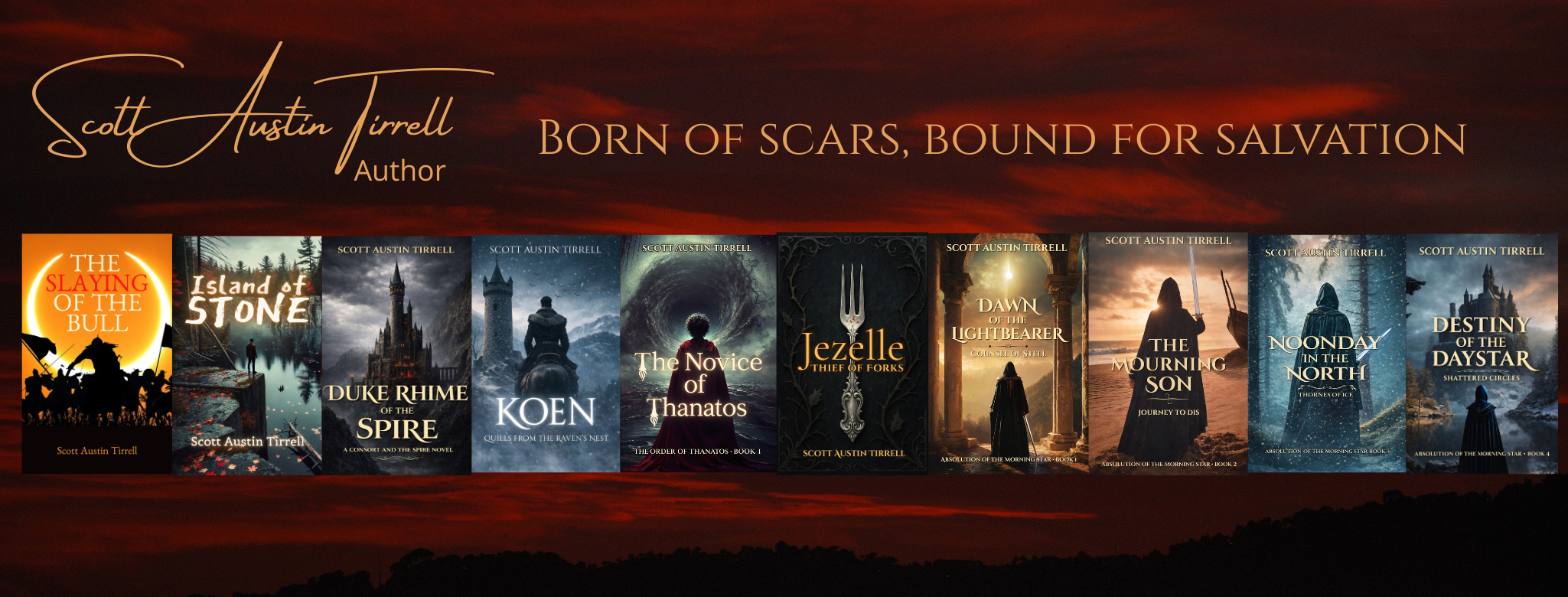

I didn’t set out to avoid heroes. But every time I tried to create one—the kind who stands tall, speaks clearly, and always knows right from wrong—I felt like I was lying. The stories I needed to tell weren’t about saviors. They were about survivors. About what happens after the battle, after the prophecy, after the world keeps turning. That’s where I found the truth. And that’s where I choose to write.
Sometimes, my characters act heroic, but I don’t write heroes.
Not the kind who arrive cloaked in virtue, chosen by fate, destined to restore the world. I’m not interested in that story—the one where good triumphs because good was always meant to. I don’t believe in clean victories or in power that doesn’t stain the hands that wield it. The world doesn’t sort itself neatly into villains and saviors. And if it did, it certainly wouldn’t keep its promises.
What interests me are the people who survive power. People who lose themselves trying to do the right thing and aren’t sure they succeeded. People who stumble through the wreckage of kingdoms, of faith, of family, and still carry on—if only because they can’t stomach the alternative. My characters don’t fit in the role of hero because I didn’t write them to. I wrote them to endure. To change. To be broken and rebuilt by the choices they make. And that’s far more honest to me than any prophecy ever will be.
Let me show you what I mean. Take Koen, the man who wanted a miracle.
Koen the Gray was born into shadow. Not powerless—just peripheral. The second son of an emperor who saw peace as leverage and children as currency. When the empire’s uneasy truce demanded a northern bride, Koen was the one sent. He was the one who bent to his father’s will and played diplomat in a war disguised as a marriage contract. When the bride proved unable to bear children, and the lie revealed, Koen did not rage or rebel (at least immediately)—he recalculated. And then, quietly, he broke.
His story isn’t one of romantic rebellion or noble sacrifice. It’s about a man pushed to the edges of his faith, who leaves the safety of palaces and treaties to beg a miracle from witches. His quest isn’t born from destiny—it’s born from desperation. The empire expects him to produce an heir. His enemies expect him to fail. And somewhere between those expectations, Koen makes the only choice he has left: he trades certainty for hope, even when that hope tastes like ash.
He doesn’t save the empire. In many ways, he damns it. But he acts. And he carries the weight of those actions without excuse. That’s not heroism. That’s responsibility.
Evaline: The girl who learned to smile with sharp teeth
No one asked what Evaline wanted. Daughters of debt-laden noblemen rarely are. Her fate was settled in silence—sold to Duke Rhime of the Spire to erase a balance her father couldn’t bear to owe. She entered Eldenspire not as a bride but as a hostage in a house built on fear. Her new husband spoke little, and when he did, it was only to command. She learned quickly that in a place like this, stillness is a survival tactic and obedience, a kind of armor.
But Evaline is not obedient. Not really. She watches. She listens. She adapts. She discovers the shape of her power in how little she reacts and how well she controls herself. She learns that strength, in places like Eldenspire, is not measured in outbursts—it’s measured in restraint. She teaches herself to smile without softness. To agree without yielding. She sharpens herself so quietly that no one notices until it’s far too late.
Her story is not about rebellion either. It’s about endurance. It’s about what it means to survive a life chosen by others and to begin—inch by inch—to shape it into something her own. There’s no sword in Evaline’s hand (just a knife). But there’s will. And in her world, that’s more dangerous than any army.
Mishal: The Boy Who Carries the Dead
Mishal doesn’t fight dragons. He doesn’t storm castles or lead armies. He speaks to ghosts. Or rather, they speak to him—and he listens because he has no other choice. In the Order of Thanatos, where the dead are shepherded through the Threshold, Mishal is a novice, a servant of silence and ritual. But nothing in his life has been as simple as doctrine suggests.
He doesn’t believe all spirits are ready to cross. He doesn’t even believe the Order always tells the truth. And that doubt makes him dangerous. While the others chant prayers, Mishal asks questions. When the others bury the past, he exhumes it.
His gift is not clarity—it’s confusion. His power doesn’t offer resolution—it demands sacrifice. He wants to do right by the dead, to ease their pain, to honor their memory. But the further he walks into the Order’s secrets, the more he begins to see that truth and mercy don’t always go hand in hand.
Mishal doesn’t want to be a hero. He just doesn’t want to become the thing he fears the Order already is.
Erik: The Boy Who Took the Blade
Erikson Gray didn’t grow up with dreams of greatness. He grew up poor in Grafton Notch, the blacksmith’s nephew, known more for his bruises than his prospects. His life changes not in battle but in silence—when he stumbles into a forbidden grove and finds a dying man impaled on a tree. The man gives him a sword, seemingly as a gift, but it’s a curse.
The sword, Lightbearer, is ancient, heavy, and not entirely quiet. Erik is not sure he wants it, but it could be valuable. The moment he wraps his fingers around the hilt, his life begins to unravel. Death follows him. Shadows hunt him. And something buried in his blood begins to stir. He doesn’t rise to meet destiny, not at first. He runs from it. He hides the blade, lies about what he’s seen, and tries to hold on to the pieces of himself that the world keeps tearing away.
He is not brave because he charges forward. He’s brave because he hesitates, and still doesn’t stop, because he has no choice.
I don’t write heroes. I write people caught in systems too old to question and too sacred to escape. I write the ones who carry power like a curse, who want peace but are shaped by violence, and who are given choices only after they’ve lost everything else. I write the slow corrosion of certainty. The long path through guilt. The moment you realize there may be no such thing as salvation, only survival.
There’s no glory in my stories. There is no shining final battle where good wins because it deserves to.
I didn’t set out to write stories without heroes. I just couldn’t lie about what survival really looks like. And if there’s truth in that—raw, fractured, unvarnished—then maybe that’s enough.
Cheers!
Discover more from Author Scott Austin Tirrell
Subscribe to get the latest posts sent to your email.

This wrecked me in the best way. You didn’t just write characters—you wrote truths we’re not supposed to admit: that survival is messier than victory, and power never comes without blood on your hands. I see Koen, Evaline, Mishal, and Erik not as failed heroes—but as reflections of the rest of us who keep going, even when the prophecy doesn’t call our name.
LikeLike