
A few weeks ago, standing amid the remains of the Herculaneum in Naples, I was reminded why ruins have such a hold on my imagination. A decade ago, I visited Pompeii — vast, sprawling, monumental in its decay. Pompeii overwhelms with its scale, but it also distracts with its size. The Herculaneum, smaller and more intimate, offered something different: the ability to explore. To linger in the rooms, follow worn mosaics with my fingertips, and imagine not the grandeur of a fallen city but the small, daily lives interrupted and preserved in stone.
But this fascination began long before I ever set foot in Italy. I grew up in a small mill town where ruins were part of the landscape — the crumbling structures that once drove the local economy. There was also a now-defunct State Hospital campus, its abandoned buildings slowly succumbing to time and nature (I wrote about them here). As a child, I played in these derelict structures. As a teenager, the dark cellars and forgotten corridors became rites of passage — places of exploration, of imagination, of daring. Ruins were never distant, historical curiosities; they were my playgrounds, my proving grounds, my first encounters with the way the past can echo into the present.
It’s no wonder, then, that ruins have found their way into my stories. They are fragments of time we can touch. They are the aftermath of ambition, conflict, beauty, and failure. They are the silent witnesses of memory. When I weave ruins into my fiction, it’s not simply for atmosphere or worldbuilding; it’s because they embody a tension that fascinates me: the coexistence of what was and what has been lost.
They are mysteries — half-forgotten, half-revealed. Even when we know who, when, and even why, so much remains untold. The records may give us dates and deeds, but they cannot capture the texture of life — the way light once fell across a workshop floor, the sound of a child’s laughter in a courtyard now open to the sky. In ruins, we encounter the ghost of the physical world — not a spectral haunting, but the quiet persistence of lives once lived, etched into stone and timber. They invite us to imagine, to wonder, to listen.
Ruins are not just places; they are experiences. They remind us that everything we build is impermanent. And yet, their endurance suggests that even in decay, something essential persists.
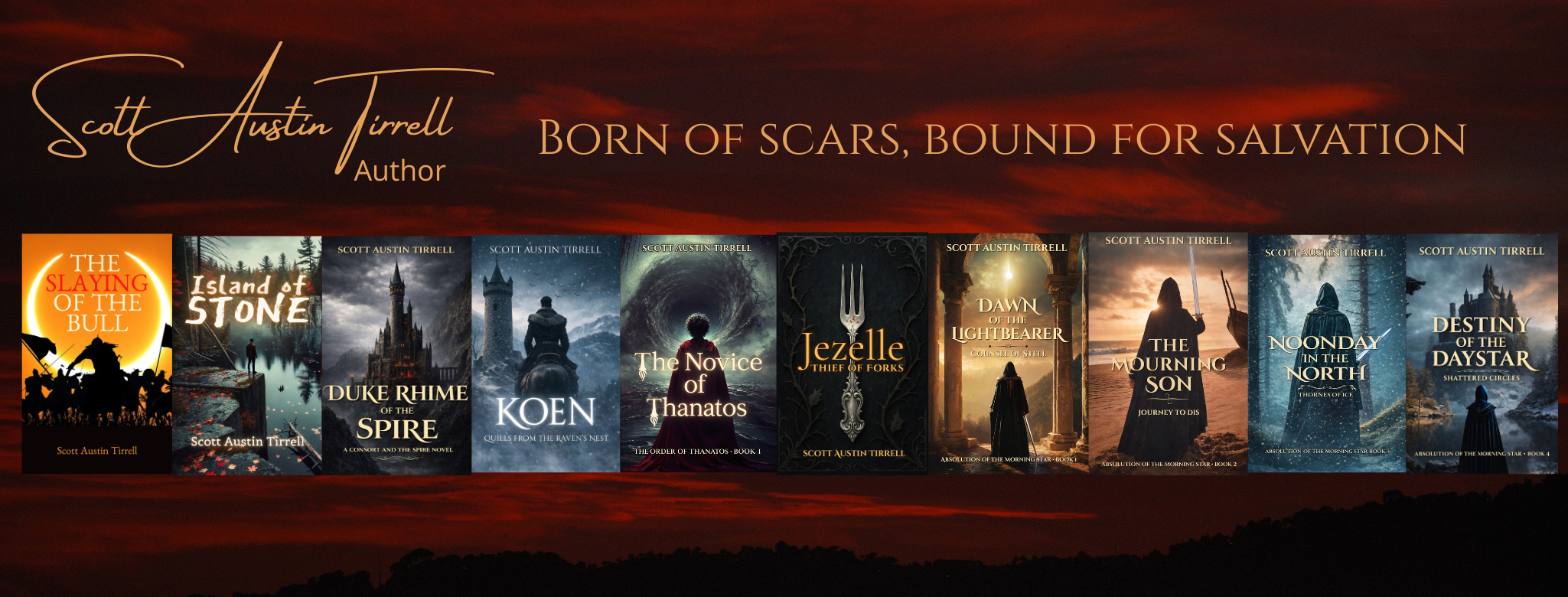
It’s no accident that ruins occupy such a central place in my writing. Across Absolution of the Morning Star (AMS) and my other books, ruins are more than mere backdrops — they are shaping forces, characters in their own right.
- In Dawn of the Lightbearer, the Ruins of the Ancients (Sheol) on South Dardark loom over Grafton Notch, casting literal and metaphorical shadows upon the people who live under them, and the tunnels beneath the city hint at a history longer than its walls.
- In The Mourning Son, the ruined castle guarding the entrance to the Luen Well stands as a decaying sentinel against an unknown enemy, and the underground city of Dis is integral to the story, a buried civilization whose mysteries refuse to stay dead and hold a past that forged Lucardian history.
- In Noonday in the North, Jötunheimr, a new ruin in the Devilwood, will soon go the way of all the other pocks on Lucardia’s surface, and the enigmatic white tower unveils a test for Erikson Gray posed by a demigod trapped by magic long since forgotten.
- Throughout the series, we hear of Blackdown Castle, the former seat of Erik’s father, which glistens with the salt that has killed the land and stands as a reminder of what happens when failure prevails.
- Lastly, Direhill, with its ruined castle, is where Erik glimpses the shape of future greatness, setting the journey of Destiny of the Daystar in motion.
Even beyond AMS, ruins thread throughout my work:
- In The Novice of Thanatos, there is the abandoned mill, the ancient temple of Cernunnos, and the burned-out monastery at Thornhold — each a scar of history, each a quiet participant in the unfolding drama.
- And, soon, readers will walk the Ruins at Hazor and those of Ignis in Koen: Quills from the Raven’s Nest — places where history, myth, and ambition collide to form the path Koen’s son must walk.
Each ruin carries its own story, often untold, often unknowable — and that is precisely the point, for ruins resist finality. They are what is left when the story has, ostensibly, ended — but they whisper that no story ever truly ends. In a ruin, you can feel the weight of what was and the ache of what might have been. They challenge us to piece together meaning from fragments, to see beauty in brokenness, and to understand that imperfection and loss are inevitable parts of creation.
I write about ruins because they are living contradictions: endings that are also beginnings. Destruction that is also endurance. Silence that is also a kind of language. They remind us that even in the collapse of greatness, there is dignity. Even in the dust of forgotten empires, there is memory. Even in ruin, there is story.
Cheers!
Discover more from Author Scott Austin Tirrell
Subscribe to get the latest posts sent to your email.
