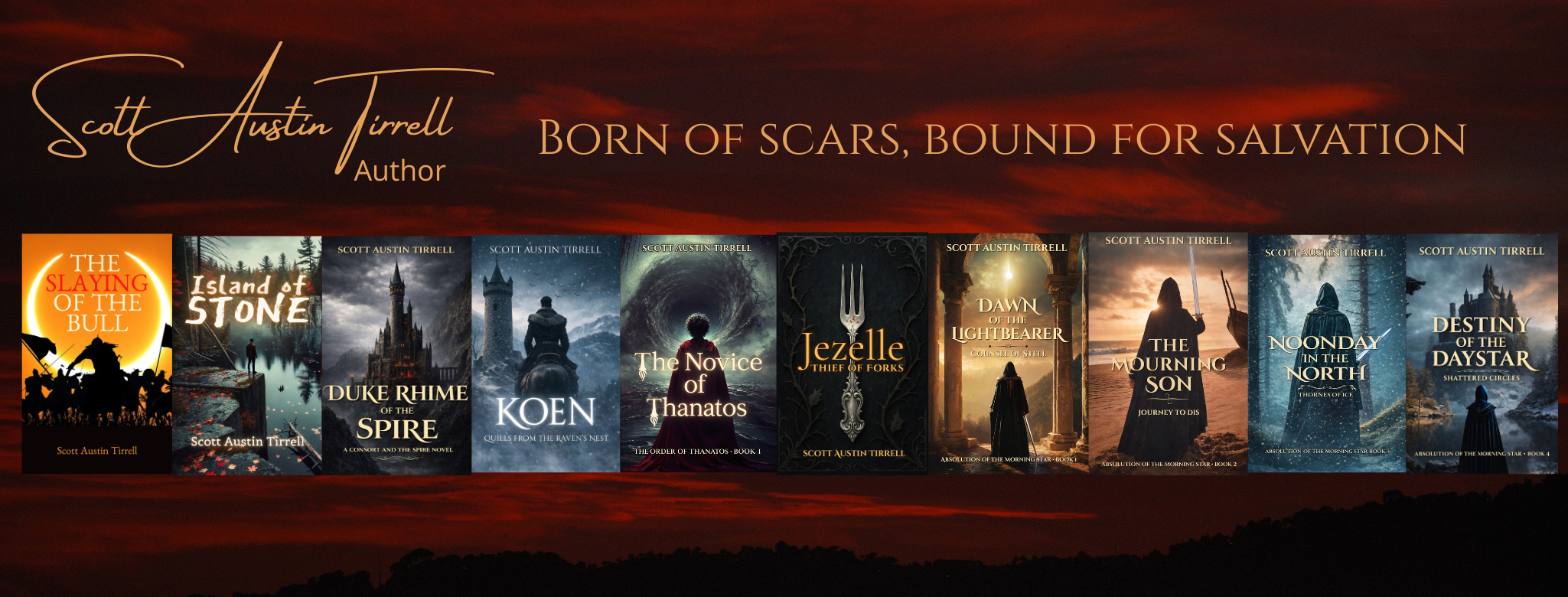
This week, I decided to write a brief history of Eldenspire, the core setting of my forthcoming book, Duke Rhime of the Spire (available for pre-order now, releases July 29). I intended it to be a short history, but I soon found myself writing most of the day and finishing at close to 4,000 words. Sometimes, the longer you write, the harder it is to keep things short. Yes, I know, brevity has its place, but not here, as I was trying to encapsulate 500 years of history in a few paragraphs. But 4,000 words is too long for a blog post. My average is around 1,000.
Therefore, this will be the first in a six-part series on the history of Eldenspire through its caretakers, House Battenborne. It traces from its founder, Dirk, who was bestowed stewardship of Eldenspire, through to the family’s height under Duke Rhime. It ends where Duke Rhime of the Spire will begin, in the tensions before significant change.
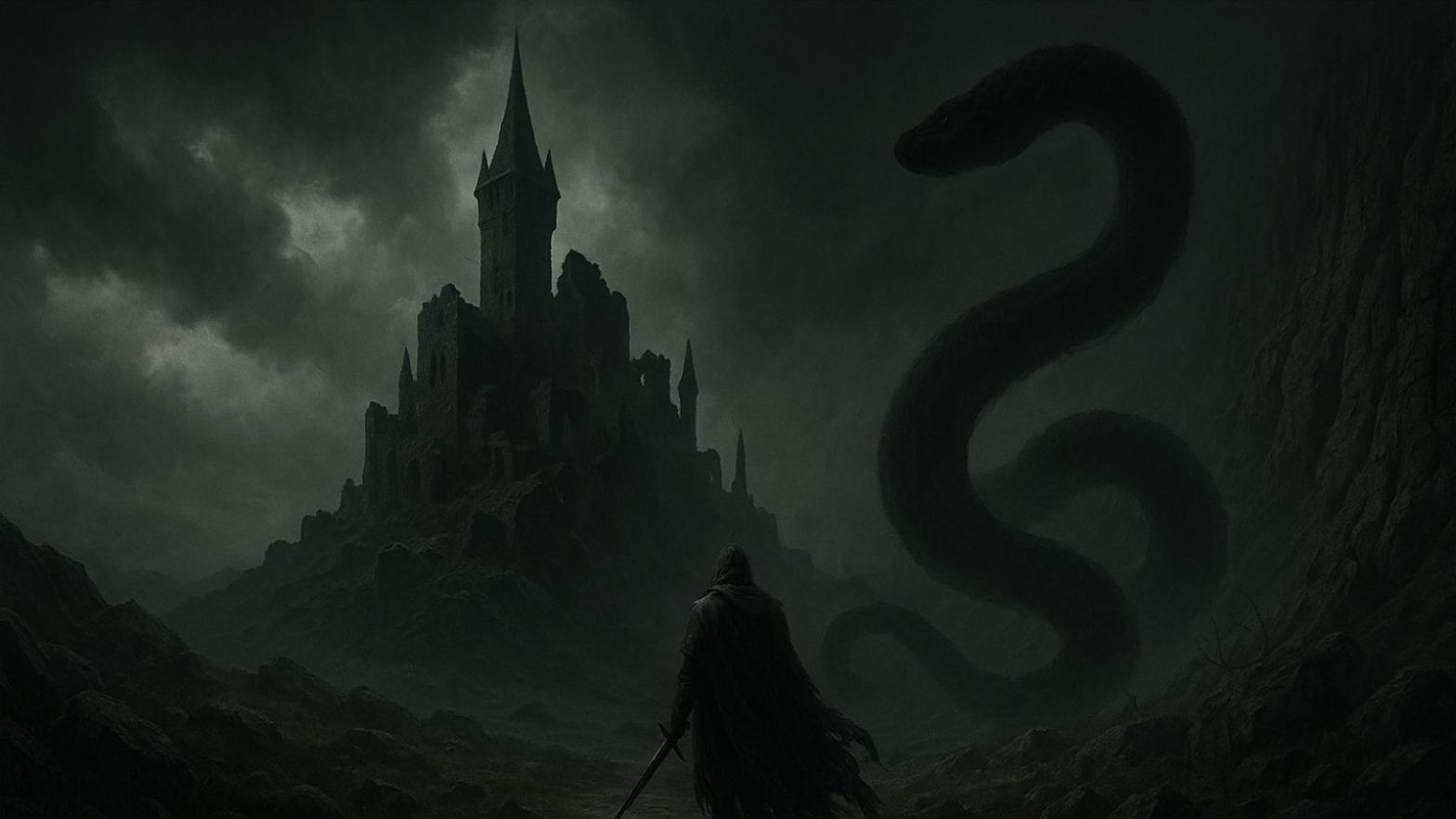
The motto of House Battenborne is In Luce Volvitur, In Tenebris Dentes – Coil in the Light, Fangs in the Dark. Let’s begin with the serpent.
I. Dirk of Battenborne and His Curse (130–160)
In the year 130 of the Common Lucardian Era, with the great uniting emperor, Sathanas the Wrathful, dead and his five sons vying for dominion, Lucardia teetered at the edge of collapse. What had once been a unified empire splintered into ambition, suspicion, and blood. The mighty armies of Sathanas’s sons massed at their borders, and they transformed from princes to warlords. Amid the turmoil, when Lucardia required a strong sovereign, Emperor Bartholomew—nephew and the chosen heir of Sathanas—vanished.
Contrary to what the chroniclers of the Five Kingdoms would want you to believe, Bartholomew did not flee. He served a higher purpose than to be a lame sovereign struggling to hold together an empire. No, Bartholomew left to destroy the very weapon that gave him his mandate.
Ljós Leggja, the magically forged blade, had once been the salvation of humankind in their war against the Nephilim. But it was no ordinary sword—it was a prison. Bound within it was a celestial force that had aided humanity during their time of need. It was the result of a desperate gamble that came at great cost. Its presence corrupted faith, twisted minds, and spoke in whispers only the bearer could hear. It was a horrid, ungodly weapon that turned a sage king into a tyrant and brought as much pain as it did salvation. At the time, the learned agreed that it should cease to be, but every attempt to destroy the blade had failed.
Disillusioned by the bloodshed and malevolence of his uncle’s reign, Bartholomew gathered a company of twelve and set out in search of the sword’s elusive creator. He believed that if the maker could forge Ljós Leggja, he might also possess the power to unmake it—and in doing so, free the bound Seraph, Lucifer, to set the world right. But it was a doomed quest. Aspar, the great Nephilim swordsmith, had been slain not long after completing his terrible masterpiece.
Among those twelve was Sir Dirk, a knight from a minor house nestled in the fields of Battenridge. He was Bartholomew’s closest companion, bodyguard, and shield-bearer, and his loyalty would become a thing of legend, but like most legends, it was all a disguised lie.
As the emperor and his men ventured into the wilderness at the far edge of civilization—where even birds did not fly and the stars grew dim—the Oathtakers came. These creatures never dared to venture into the realm, their weakness to salt magic not yet forgotten. But here, in their dark shadows, amongst moss-laden forests never harvested, they held dominion.
These were not beasts or even men, not anymore. They were the remnants of a pact long buried: mortals who had given their souls to the Nephilim in exchange for eternal life and unnatural power. In the wake of their banishment, the Nephilim had left their agents behind, withered but enduring, bound by purpose and madness. They were the dark spear-tip of the Nephilim, cast aside and searching for redemption.
The Oathtakers could not take Ljós Leggja. Oh, no. It was not a thing that could be stolen. The blade had to be given—surrendered freely to another wielder. If not, it was just another piece of iron.
So the Oathtakers tried another path, one their former humanity knew well—to twist the counsel of a friend.
They found Dirk alone one night, guarding a narrow pass of black stone and thorn-choked earth from panthers, while the others slept. They spoke to him, not in threats, but in reason. They whispered half-truths and poisoned promises. They claimed Bartholomew was misguided, that the sword was never meant to be destroyed. That it was meant to be wielded by those who understood its purpose: the Oathtakers—the true successors of divine will- those married from celestial magic and human spirit. They said that in destroying Ljós Leggja, Bartholomew would doom humanity to ignorance and weakness.
They begged Dirk to persuade his friend and emperor. To influence him. Just a word. A suggestion. They did not ask for treachery—only loyalty, redirected.
Hungry, desperate, and longing for home after many years of trudging through swamps and briars, Dirk bent to their promises.
As Bartholomew’s retinue ventured further into the grove, as they starved, fell ill, and suffered creeping madness, Dirk whispered in the king’s ear, night and day. As others deserted or died, Dirk remained, pleading with Bartholomew to accept reason, to hand over the burden, to end the madness, and return home. No one would know the sword’s fate but them.
But Bartholomew, seeing that he stood alone in purpose, fled into the wilderness and was never seen again.
Dirk had failed. And the Oathtakers do not take kindly to failure. They spoke a final word and vanished into the stone, smirking as they left.
In that moment, they poured into Dirk the Nathair an Doimhne—the Serpent of the Depths—a living corruption, the strongest of Oathtaker craft, a curse like none other. It twisted through Dirk’s veins, invisible but unyielding. A parasite, a shadow, and a seed. A punishing scar to pass through the generations until the name Battenborne was no more.
Dirk, alone and on the verge of death, returned to Lucardia almost eleven years after they left. None of the others survived. He could tell any story he wished.
So he did.
He claimed the sword was gone. That Bartholomew had gone mad, slaughtered the others, and tried to kill Dirk, too. He proclaimed they fought—and that Bartholomew, overcome with madness, fled into the forests, never to return. He swore that he stayed with wet eyes of conviction, that he did not want to abandon his friend and emperor in his time of need, but when the forest remained silent, and his own death crept closer, he accepted that Bartholomew was lost forever.
The self-proclaimed Kings of Lucardia, Sathanas’s sons, desperate for any reason to smudge the memory of their cousin, liked this story, and so Dirk became a hero. They named him the man who resisted the temptation. The one who stayed loyal to the last. The model of duty and service.
But those who knew Dirk before his great journey saw that he had changed.
His skin had taken on a pale, waxen sheen. His eyes were no longer fully human. He spoke less. Laughed never. The fire in him had quieted—but it had not gone out. Oh, no. It had gone inward, to coil in his belly and whisper in his blood.
In the years that followed, the five kingdoms solidified, the civil war cooled into a smolder, and the land festered under kings who did not trust one another but feared their own people more.
Drageoir, the first King of Westerly, eager to reward loyalty but uneasy around the man before him, granted Dirk a holding far from court: a ruined fortress on the Great Step, on the edge of the Wastelands, where few would dare tread.
Dirk accepted.
He rode alone to the ruins said to sit atop a nexus between this world and the next—a place where the Veil thins, and voices sometimes echo from the other side. The fortress had once been a bulwark against the horrors of the far west, but now its towers lay shattered—save one: a single, unbroken spire of black stone.
Dirk looked upon it and saw refuge—perhaps a prison, but also, through its strong magic, a possible cure. He gave it a name.
Eldenspire.
Be sure to come back on Wednesday for Part II: The Spire’s Age of Restoration (160–300)! Check out Duke Rhime of Spire’s trailer here, and find the first chapter here.
Cheers!
Discover more from Author Scott Austin Tirrell
Subscribe to get the latest posts sent to your email.
