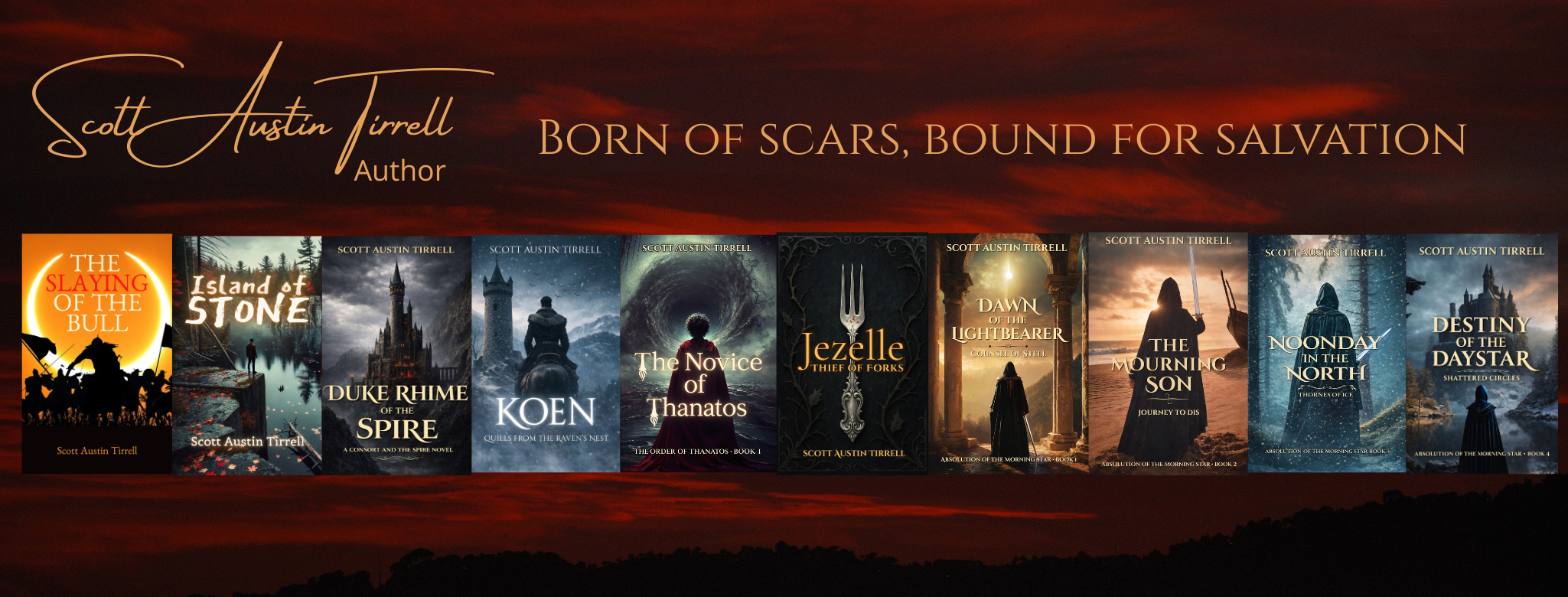

Welcome back to the six-part series detailing the history of Eldenspire and the family that called it home, the Battenbornes. Duke Rhime of the Spire is available for pre-order now and releases July 29th!
Here is what we learned from part 1: After Emperor Sathanas’s death, Lucardia fractured as his sons vied for power. Amid this chaos, Bartholomew, the emperor’s heir, vanished on a secret mission to destroy Ljós Leggja, a cursed sword binding a celestial being. Sir Dirk of Battenborne, his loyal companion, joined him—but succumbed to the manipulation of the Oathtakers, ancient corrupted beings serving the Nephilim. Dirk tried to sway Bartholomew, failed, and was cursed with the Nathair an Doimhne—a living corruption passed down through his bloodline. He returned alone, lied about Bartholomew’s fate, and was hailed a hero. Given a distant, ruined fortress as a reward, Dirk named it Eldenspire and began a dark legacy that would haunt Lucardia for centuries.
Now, for Part II: The Spire’s Age of Restoration (160–300)
Though granted as a gesture of honor—or perhaps as a calculated exile—the ruined fortress Dirk claimed became something far more consequential. It was no courtly seat, nor a jewel of imperial design. Dirk arrived with no noble retinue, only a weathered cadre of mercenaries, builders, and stonecutters paid in coin and bound to silence. The fortress was shattered, its stonework twisted by ancient fire or siegecraft no longer remembered. Its bones were strong, but its spirit was broken. The first few winters were grim, marked by starvation, raider incursions, and the uncanny howls of the wind through hollowed towers. But from foundations older than any map and welded by remnants of lost magics, a dynasty took root—its shadow cast not only across the Great Step, but deep into the veins of history.
The restoration began in earnest with Dirk’s eldest son, Elstan the Builder, born beneath a makeshift roof where the solar now stands. He was the first Battenborne of Eldenspire, and he claimed that distinction fiercely. Elstan patched the broken curtain wall with slabs of blue-grey highland slate, quarried from the cliffs above, and raised the Gatewatch Tower anew using black mortar that smoked faintly when rain touched it. He refused to rebuild the central Spire—“Let no hand reach higher than the curse,” he once said—but he filled the surrounding towers with flame-cauldrons and beacon posts. The fortress regained its breath, then its bones, and eventually its voice.
Settlement followed, humble at first. Herding families made use of the lower slopes, and outcast herbalists found welcome in the forested ridges. Traders dealing in furs, wild iron, and saltroot drifted to the cliffs seeking safety from the Wastes. Their homes, a scattering of huts and slate-shingled hovels, formed what would come to be known as Spiretown. But the city it grew into bore the name of the fortress it served: Eldenspire.
Though distant from Westerly Rock and far removed from the heart of courtly intrigue, the Battenbornes maintained formal allegiance to the crown. Tribute was paid in coin, ore, and well-bred horses. Messengers from the Spire were punctual, polite, and brief. The Battenborne lords answered imperial summons when required—but rarely stayed long, and never spoke out of turn. They governed their lands with practical efficiency, largely without oversight. Few envoys from the capital dared the long trek north twice.
In time, this independence became tradition. The Battenbornes were regarded in the capital as “the Silent House,” and their envoys were received with both deference and unease. Their words were few, but rarely forgotten. During succession disputes or border skirmishes, their calm judgments carried unusual weight. One lord’s quiet nod at a council gathering once resolved a standoff that had threatened civil war.
For nearly a century, their lands prospered. Unpredictable storms from the Wastelands carried ash and glittering mineral rains. These enriched the soil with unwholesome fecundity. Hills bloomed with thornfruit and long-rooted trees that bore harvests out of season. The valley fields grew grains with husks like burnished copper and stalks as tall as a man’s shoulders. Locals whispered of “black gold”—the uncanny richness of the earth that fed both field and vine. Orchards grew beside gorges where nothing had thrived before. Vineyards crept up the ridgelines, their wines said to grant vivid dreams or numb pain altogether.
This strange abundance turned Eldenspire from a military relic into a place of quiet legend. Caravans brought southern merchants who sought saltroot tonics, ash wines, and ironwood carvings. What was once a fortress became a beacon at the edge of the world—unreachable to many, but spoken of by all.
Yet the curse remained.
Though no Battenborne of this era was ever accused of dark deeds or sorcery, whispers lingered in the crevices of the old walls. Some children were born with eyes of mercury or obsidian, and never spoke past the age of three. Others aged slowly—far too slowly—spending decades with youthful faces that inspired reverence or fear. A few heirs took solemn vows of silence before adulthood, choosing the cryptic halls of the Spire’s underlevels over the world beyond. These were said to serve as vault-keepers, tending to the old sealed doors and rune-etched locks beneath the foundation.
No record exists to show that any relic was ever destroyed.
Scrolls inscribed in vanished languages were bound in lead and stored in the Deep Keep. Carved idols of eyeless figures were sealed in pitch-lined vaults. Ritual implements—rings, mirrors, chalices—were catalogued by torchlight, but never cast into fire. The Battenbornes claimed neutrality toward the arcane, but the Green Faith, the dominant creed of the land, found their silence suspect.
No priest of the Green Faith remained long at Eldenspire. Some departed after a single sermon. Others vanished into the vaults and were never spoken of again.
Still, the Spire endured. Its lords made few laws and fewer demands. They rarely taxed the harvests and asked only for service in times of war. Their presence loomed in the high windows and the shadowed halls, but they interfered little. To most of their subjects, this distant stewardship was a mercy.
Yet all things turn. By the latter half of the third century, the black gold dulled. The rains from the Wastes became dry and sharp, scouring the ridges without feeding them. Crops withered slowly, as if forgetting how to grow. The wines grew bitter, and the thornfruit began to rot on the branch. Some said the land had been overfed, others that the blessings of the Spire had merely run their course.
And beneath it all, the serpent slept on—undisturbed, but not forgotten. Its dream pressed upward, slow and patient, warming the stones beneath Eldenspire, humming faintly in the bones of the oldest walls.
The Age of Restoration ended not with fire or blood, but with the uneasy quiet of prosperity spent, and something darker waiting in its place.
Be sure to come back on Saturday for Part III: The Long Watch and the Darkening (300–580). Check out Duke Rhime of Spire’s trailer here, and find the first chapter here.
Cheers!
Discover more from Author Scott Austin Tirrell
Subscribe to get the latest posts sent to your email.
