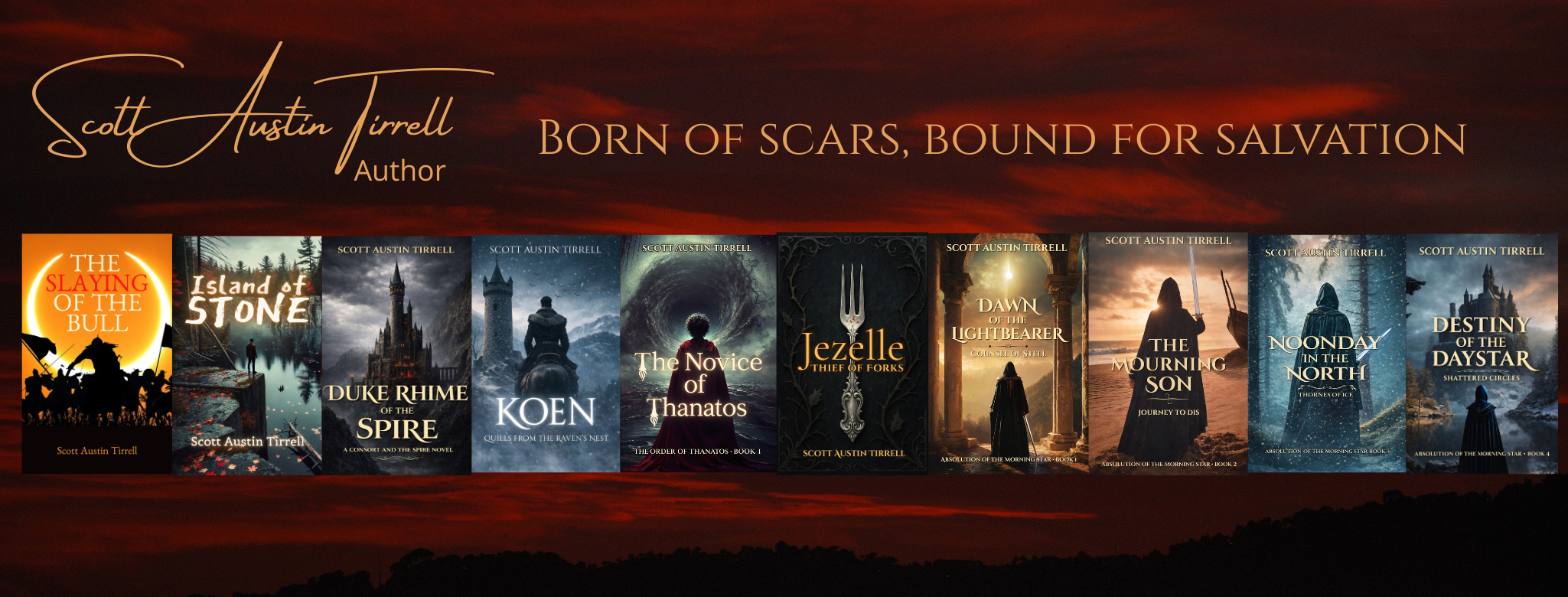

I felt I should give the opening chapter of Duke Rhime of the Spire some extra context and lore, in case you are interested.
In the depths of the winter of 674 CLE, when the snows came early and the passes closed before the last herds were brought down from the high country, the banners of Lysena hung stiff and frostbound above their keep. The valley below lay hushed beneath drifts as tall as a man, the market square empty save for a few bundled shapes hurrying between doorways. The smoke from the chimneys was thin, for wood had been rationed since the turning of the year, and the hearths in the count’s hall burned low even as water froze in the wash basins. The people of Lysena were no strangers to hardship—flood years, locust swarms, the lean seasons that followed a bad lambing—but this winter carried with it a silence that was not born of weather alone.
It was whispered in the kitchens and the stables, murmured in the corners of the taprooms, that ill omens had befallen Countess Lysena. It was not illness that brought a physician with his herb chest, nor was the kind of affliction that makes a priest whisper blessings at the bedside. This was something darker, spoken of in lowered voices. Some said she had been taken from the keep entirely, spirited away by hands unknown. Others claimed she had been accused in the King’s court of treachery—an accusation that, if left to stand, would have brought the ruin of her house and the scattering of its lands. Some said it was her heathen religion and its worship of the sword and sun. Whatever the truth, it was not the kind of matter that could be answered with grain from the storehouses or coin from the treasury. It was the kind of matter that could undo a family’s name, unravel generations of loyalty, and leave a county adrift in the treacherous currents of court politics.
Count Alric Lysena was not a man given to rashness, but the depth of the crisis left him with few choices. He could appeal to the King directly and risk the scandal breaking into open view, or worse, suffer the king’s increasingly unhinged wrath, or he could turn to the one man who stood both as his friend and his lord—Duke Varion Battenborne of Eldenspire. The decision was simple.
The journey to the Spire was not an easy one in such a season. Snow choked the roads, and the river crossings were treacherous with ice. Yet Alric rode under a moonless sky, taking with him only two men he trusted with his life, their cloaks stiff with frost before they had gone ten miles.
Varion was no stranger to entanglements. His sobriquet, “the Cunning,” was not born of idle court gossip but of decades spent balancing the ambitions of the crown, the demands of his vassals, and the knives forever aimed at his back. He had brokered peace between houses that had been at feud for generations, outwitted foreign envoys who sought to pry into Westerly’s weaknesses, and kept Eldenspire’s coffers full through both famine and flood. He understood the cost of every favor, for he knew that nothing in the realm was given without price. And yet, when Alric was shown into his presence, gaunt from the ride and with desperation plain in his voice, Varion did not hesitate.
Accounts differ on the exact nature of the Duke’s intervention. In one telling, his men struck hard and fast at a camp of mercenaries in the eastern hills, returning with the Countess under cover of darkness. In another, he spent three nights in private audience with the King, emerging with a signed letter that quashed the accusations against her before they could be read in the Hall of Judgement. A third version speaks of a rare antidote brought from across the narrow sea, purchased at a price only Varion’s merchants could afford, administered in secret by the Duke’s own physician. Whatever the truth, the result was the same: the Countess was restored to her place at Alric’s side, her name unsullied in public record, the matter settled without so much as a ripple on the surface of courtly life.
But in Westerly, the settling of such a matter is never without its undercurrents. The aid Varion extended was costly—not only in gold and steel, but in the currency of influence that is spent sparingly by men in his station. He had leaned on allies, traded favors, and perhaps even crossed lines the King himself had drawn. When all was done, and the Countess sat once more in the high seat of Lysena Keep, Alric and Varion put their names to a formal bond. It was not a punishment, nor a shackle of conquest, but an acknowledgment of what had been given and what must, in time, be repaid.
The terms were gracious. Lysena would provide additional levies in the event of war, cede a fraction of its toll rights along the northern trade road to the Spire, and permit Battenborne-appointed overseers to advise in certain matters of commerce and law. These were not crippling concessions, and indeed many in the county saw them as a fair exchange for the Duke’s timely aid. Yet even the gentlest terms, once written into the fabric of governance, have a way of tightening their hold. Over the years, the Battenborne presence in Lysena’s affairs became a familiar thing—merchants from the Spire setting up shop in market towns, officers from Eldenspire drilling alongside the county’s men-at-arms, and trade flowing ever more freely along routes under Battenborne control.
For Count Alric, the debt was a point of honor. He did not chafe under it, for he understood that to repay it was to keep his house’s word and to honor the friendship that had saved his family from ruin. But honor is a fragile currency in the politics of the realm, and not all saw the matter in so simple a light. There were those in the King’s court who whispered that Varion’s intervention had shielded Lysena from justice, that in doing so he had placed the loyalty owed to his vassals above that owed to his sovereign. Such whispers are rarely shouted in the open, but they have a way of reaching the wrong ears.
It is said—though none will put it to record—that when the King’s assassins came for Varion and the duchess years later, slipping through the corridors of his own hall in the small hours before dawn, the true cause was not treason writ in some intercepted letter, nor the plotting of foreign crowns. It was the memory of that winter’s rescue, and the unspoken defiance it represented. To protect Lysena, the Duke had defied the King’s will, or perhaps concealed from him a truth the crown had every right to know. In the careful balance of power, such acts, however cloaked in friendship, are remembered.
Evaline Lysena was not yet born when the snowbound winter changed her family’s fortunes, but in time, she sensed that the grown-ups spoke more softly and moved with greater urgency, but was too young to understand why. She grew to womanhood in the long shadow of both the debt and the man who had made it possible. Her father spoke of Varion with a kind of restrained fondness, never forgetting that the Duke had been both savior and creditor. Her mother never spoke of that winter at all, taking the secret to her death, though the silence itself told stories Evaline could not yet put into words.
In the years after Varion’s assassination, the nature of the debt shifted. What had been a bond between two men became an obligation owed to the Battenborne line. Duke Rhime, Varion’s son, inherited not only the Spire but the accounts his father had kept—written in a precise hand, each debt and bond and promise catalogued alongside the terms of its repayment. Rhime was not his father; he did not wrap his dealings in warmth or couch them in the language of friendship. The bond with Lysena remained intact, but under his gaze, it felt less a gentleman’s agreement and more a ledger entry, one of many in the machinery of the Spire’s rule.
For Evaline, the weight of that inheritance was more than political. The debt was not just coin and levies; it was a shadow across her family’s name, a reminder that Lysena had once been unable to stand on its own. In court, she sometimes caught the lingering glances of those old enough to remember that winter, the subtle turn of a conversation when her mother’s name was near to being spoken. Even her older sister, who was close enough to share everything else, never spoke of the slander. Evaline had learned to move gracefully through such moments, to meet them with poise, but the knowledge remained: the silken cord still bound her house to the Spire.
Time has a way of smoothing over the rough edges of history, turning scandal into anecdote, and debt into tradition. In the official records, the bond between Lysena and Eldenspire is described as a “mutual agreement of aid and trade,” its origins noted only in the most neutral of terms. The market towns thrive under the protection of the Spire’s patrols, the roads are safer than they have been in decades, and the coffers are never entirely empty. For the common folk, the arrangement is a net gain. For those who know the whole story—or enough of it—the truth is more complicated.
In the quiet moments, when the duties of the day are done and the keep is still, Evaline sometimes walks the ramparts alone. She looks out over the valley her family has ruled for generations, the same fields her father and his father before him swore to protect. The mountains are dark against the winter sky, their passes already filling with snow, and she wonders if another storm might one day come that would test her as it once tested her parents. She wonders, too, whether she would make the same choice her father did, to ride through the night to Eldenspire and place her family’s fate in the hands of another.
Some debts, after all, are not meant to be paid off. They are intended to endure, to be passed down with the titles and the lands, as much a part of the inheritance as the keep itself. House Lysena’s debt to the Spire is such a one—born of friendship in a time of darkness, bound in honor, and shadowed by the fall of the man who made it possible. Whether it will one day be lifted, or whether it will tighten its hold in the years to come, is a question only the future can answer. But in Lucardia, where memory is long and the balance of power delicate, no one forgets the winter when the Duke of the Spire saved the Countess of Lysena, and in doing so, sealed both their fates.
Read more about how this debt was paid here and what it will mean for all of Lucardia!
Cheers!
Discover more from Author Scott Austin Tirrell
Subscribe to get the latest posts sent to your email.
