
Below is the third in a series of reports to Emperor Vesper Zuilkaarme on the strange happenings that occurred throughout Lucardia around the time of Prince Koen the Gray’s disappearance. You can read more about that disappearance here.
To His Most Illustrious Emperor,
I place before you an accounting of Dagon Light and the late disappearance of the Caspian monks that kept its flame. I write with due brevity where facts are firm, and with care where only inference can tread. Please excuse my presumption in providing the following details. His Imperial Majesty is in no doubt an expert on his realm, but I offer the account below for the record.
Dagon Light stands upon nothing more than a scatter of seabird-whitened rock at the seaward edge of the Candoria Crest—no soil worth turning, no timber to cut, only slick ledges and seams of marram where the wind will allow. Were the tower absent, no chartmaker would trouble a quill to mark the place. A shallow cove on the lee offers landing only by a shingle of pebble and shell; there is no port, jetty, or staging, and outbuildings are few beyond what necessity has attached to the keeping of the tower. The station exists because the Candoria itself is treachery given form. The Fermont River carries its endless load of silt to sea, which the tides then comb and pile into bars and knives; channels open and close between seasons, and wrecks of the unfortunate become their own shoals. The Light’s present purpose is therefore plain: to hold mariners clear of a graveyard that rearranges itself while one looks away.
By measure taken at the gallery, the tower rises two hundred seventy-eight feet above the shoals, highest in Lucardia by a margin that leaves sailors with opinions. It is built in white granite, uniformly close-grained and tightly jointed, its batter so slight that one senses it more than sees it. Age is in the stone, but not in a manner our ledgers can name. The tower was not raised in this or one hundred generations before, nor can any clerk produce a founding writ or master’s mark. It was found neglected, refurbished at great expense, and returned to service by the Caspian Church; beyond that, the bones of its story are missing. There are persistent tales of a lower door that once opened into chambers beneath the waterline—some speak of vaults, others of cities—but such talk is without proof. The base rings sound; the plinth is solid. If older works lie below, they are not readily reached.
The beacon’s strength stems from its fuel. As His Imperial Majesty likely knows, the light burns Dragon’s Breath: the long-lived volatile taken from dragon remains where such can be lawfully mined by your decree. I record the fact without presuming to instruct; Your Majesty knows what it is, and what mischief it courts when parted from wise hands. Here, its characteristics, not its romance, concern us. It was procured at great expense, and the stockpile here is considerable. One hundred monks kept it in good company, but to find it unprotected is disturbing. The flame’s greenish beam is visible for nearly thirty miles from this elevation and resists quenching even in violent weather, so its use here is sound. Still, the allocation of such wealth during these troubled times may bear reconsideration.
Custody bears recounting. Roughly ten years before the storm that ended the clerical tenure, the Caspian Church sent a missionary company to reclaim Dagon Light. Testimony from the island’s own books and from passing craft agrees that they arrived in strength—near a hundred souls—and had dwindled by ordinary attrition to fewer than thirty by the time of the event; twenty-seven were counted by the brothers themselves in their roll call. They raised a small chapel and several outbuildings at the foot of the tower, kept regular watches at the gallery, and wrote copiously in ledgers that are now in imperial safekeeping about the comings and goings. The hardship of the place needs no embellishment: no crops to speak of, water kept in cisterns, resupply hostage to weather and the Crest’s knife-work, and a solitude that thins even robust spirits. That some died of exposure, accident, and sickness is no mystery. That all should vanish at once is.
The hurricane of 982 scoured the coast. Vessels at a distance saw the tower struck hard and long; then the sky cleared, as it will, with that cruelty storms keep. After, the Light still burned, but searches by sea and land found no living monk. Here, the surface account favors the Church’s public claim—that the cohort succumbed to the storm and sea. Yet, specific details argue against a simple drowning explanation. Namely, although all the outbuildings were ravaged by the storm, the tower itself was left unharmed. We found the great iron door open, with debris blocking the door pushed aside. Inside was untouched by brine and still smelled of bodies. If the monks had harbored here during the storm, which they most certainly would have, they vanished soon after.
There are inventories of provisions that tally to feasts on days of death. A monk’s aside—recorded by visitors in seasons before the storm—complains of being “cursed”; another warns that “meat spoils quickly in this air,” urging haste after a loss. Such sentences do not make verdicts. They do, however, set a table where rumor will dine. The rumor most often repeated is that in the last lean winters, the brothers fell to cannibal practice to survive. I could not prove this, and I did not seek a spectacle of proofs; the island yields few secrets willingly. I note what is said because men act upon what they believe, not only upon what they know.
There are firmer signs of theft. The chapel and dwellings are bare where they should not be. The reliquaries, icons of gold and silver, and the great emblem of the faith—the sword-and-sun of gold that visitors widely attested—are absent. No broken casket, no scattered gilt, no trove buried in haste has yet been found within the precincts. That the sea took both brothers and golden treasure without leaving a single trace of either is possible in the way that all things are possible once, but it is less likely than the alternative: hands removed them. Whether those hands were friendly—carrying holy relics off the island before the worst—or foul—seizing advantage amid chaos—remains to be learned.
In the aftermath, Your Imperial Majesty’s officers set a garrison upon the rock. The arrangement is serviceable and straightforward: the Church retains nominal stewardship by ancient habit; imperial soldiers, by right and necessity, keep the light, hold the cove, and maintain the ban on visitors. Dragon’s Breath and all instruments of the station are inventoried under seal. Since the posting, there have been no further losses, and the beam has not failed. I recommend this posture be maintained. The Candoria kills without malice and will continue to do so; the green light kills nothing and saves many. Currently, its inventory is secure. Whatever judgment must yet be rendered upon the Church’s conduct, seamanship is better served by a steady lantern than by a quarrel.
Two further matters bear Your Imperial Majesty’s attention. First, the island breeds stories faster than gulls. Some are only the flotsam of fear; some cling like tar. Among these, the notion that Dagon Light is of a piece with the great Spires has taken hold—those points where, in our oldest accounts, the world thins and the old winds come through. Eldenspire and Rhimespire are invoked by name. I ascribe no certainty to this. I record it because the belief shapes conduct: pilgrims will attempt landings under the pretense of piety; opportunists will follow pilgrims; both will find a garrison that does not parley. Second, the matter of what lies beneath the tower is not closed. If there are voids or older works under the plinth, they are not presently accessible; however, a period of low water and a measured survey might reveal whether the rock is as solid as it appears. Such knowledge is practical; a collapse at the footings would darken more than our temper.
To conclude with what can be held in the hand: Dagon Light remains the most incredible beacon in Lucardia, bright and visible to thirty miles, its purpose unambiguous and its origin obscure. The island cannot support a colony; the tower can support a flame. The Church’s cohort has vanished in a manner that a storm alone cannot fully explain. Their treasures are missing. Signs of foul play exist, although their nature is not yet apparent. Your soldiers now keep the watches and the silence. I ask only the Emperor’s leave to keep both.
Your humble servant,
Captain Edwin Turnbolt, Your Imperial Majesty’s Navy
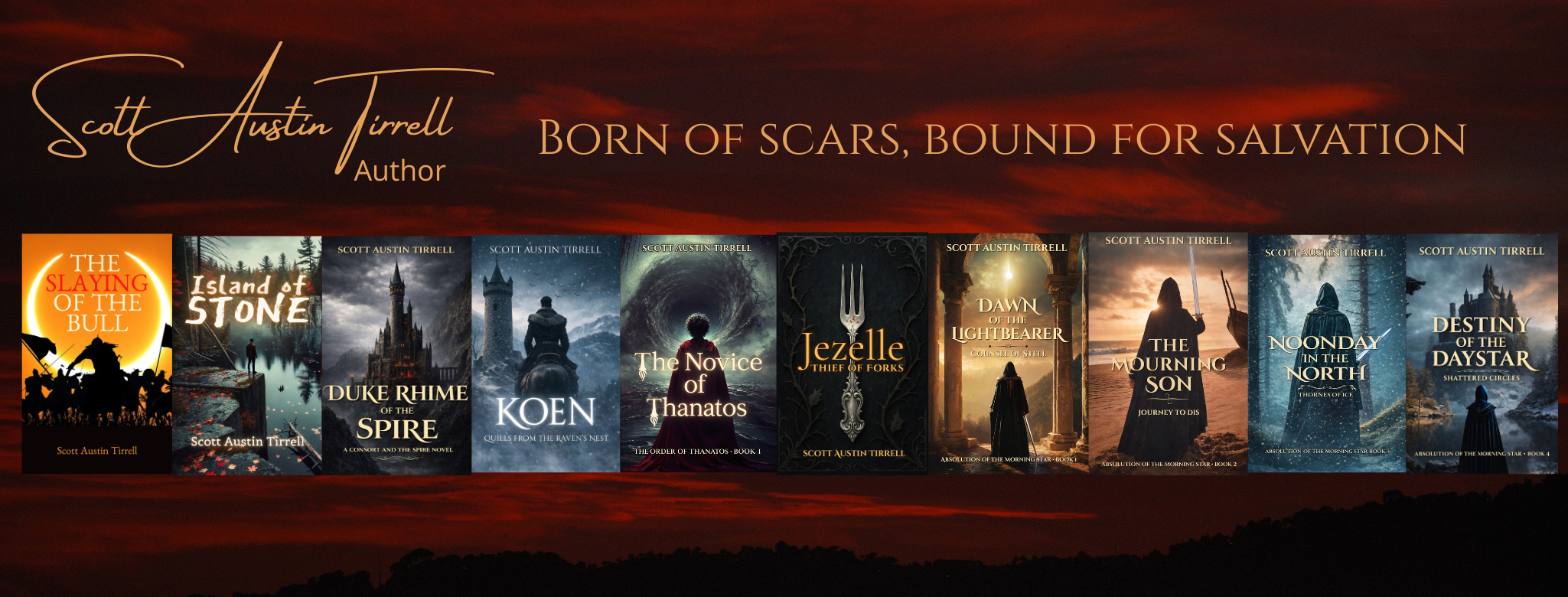
For those who have read Koen: Quills from the Raven’s Nest, the mystery behind this note is known. For those who haven’t yet delved into the pages of my newest novel, here is a crumb.
Cheers!
Discover more from Author Scott Austin Tirrell
Subscribe to get the latest posts sent to your email.

Loved this! Rumors of passages beneath the tower and some ancient mystery surrounding the Spires are most intriguing….. BTW small point: “role call” should be “roll call” for “reading names from a list to take attendance” Way to remember this: “in the days of old, a roll of names would have been rolled up into a scroll.”
LikeLiked by 2 people