I believe in circles—in fact, I’m a bit obsessed. The Oroborus is Emperor Vesper’s heraldry for a reason. I’ve been writing a lot of posts about my quest to define my writing world, and I apologize for bringing you along on this iteration, but perhaps it is helpful. I’ve touched on everything below in the almost 400 posts I’ve produced over the years, but I feel I’m finally making progress in wrapping my head around a conundrum that deeply affects every day of my existence—why I write.
I don’t always start with a plot.
Most of the time, I start with an image.
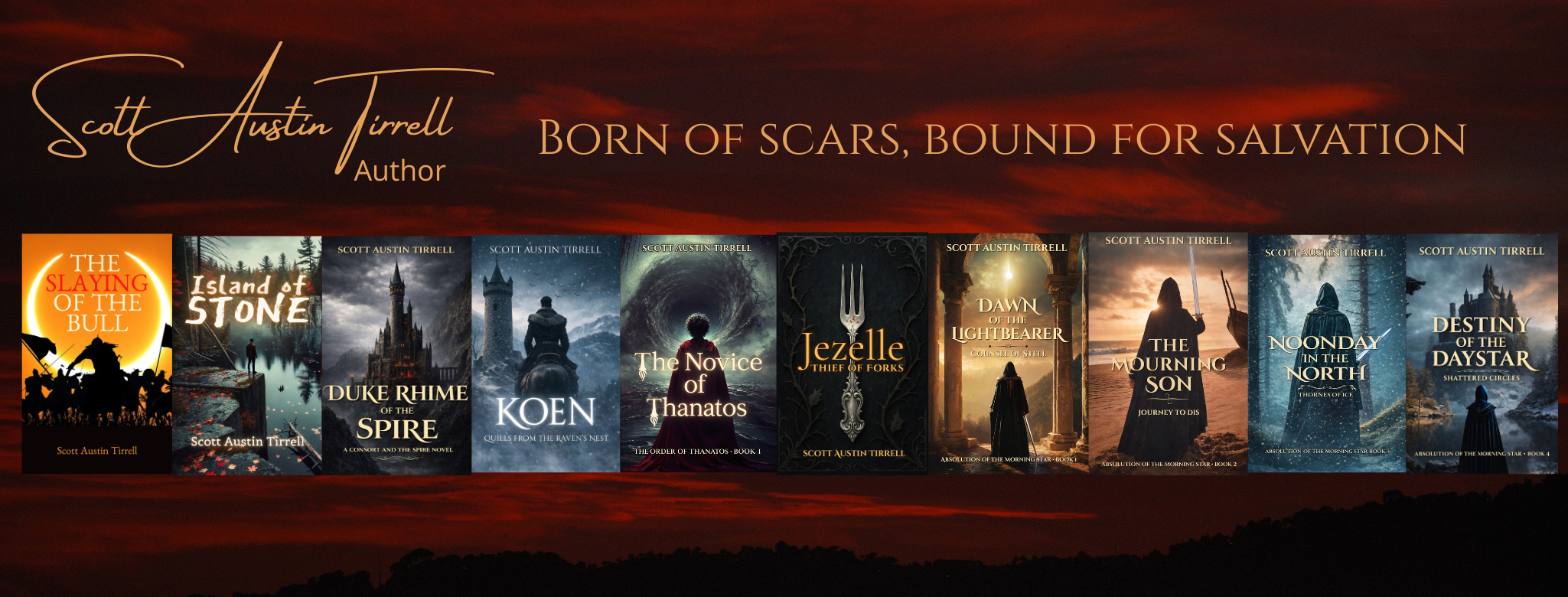
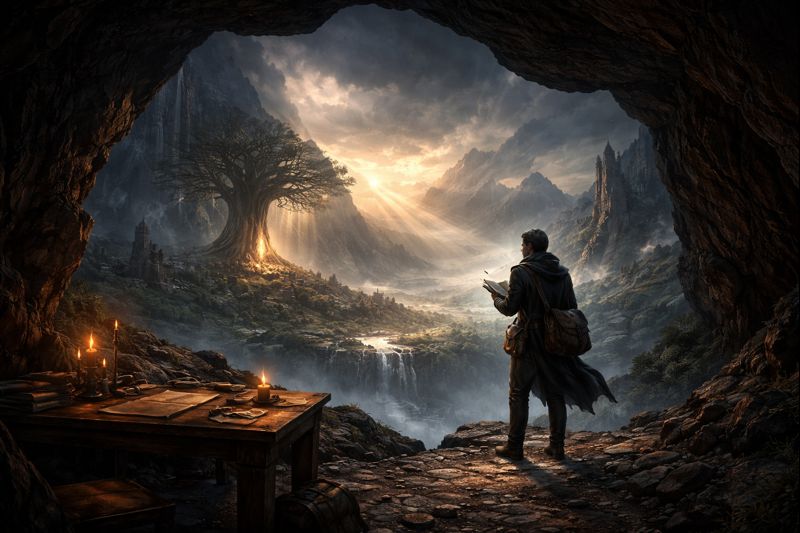
A huge tree in a cave, lit by shafts of sun that somehow found their way through a fissure in the stone. Koen on horseback under a gray, snowy sky, alone in a field with a single tower in the distance like a warning or a promise. A little girl—Jezelle—being led to the doorstep of a brothel, a red lantern glowing like a wound you can’t look away from.
That’s how it begins for me. Not with an outline, not with a theme, not even with a character bio. It begins with a moment that feels real, even though it isn’t—like I stumbled into a place that already existed, and my job is to bring back proof. Once the image arrives, the rest of my life has to make room, because here’s the truth, stripped of the fluff: I write because I have to.
All writers say this. But I say it not in the romantic way. Not as a flex. Not because I think I’m special. I mean it in the simplest, most physical sense. The stories don’t politely knock. They press. They accumulate. They start showing up unwanted, in the space between waking and sleep, in the quiet moments when my brain has enough room to do what it actually wants to do. They distract, claw, and eat away at my emotions. If I don’t get them down—even as a note—my mind keeps running, and they accumulate until I feel them begin to slip away. Each is death, each is mourned. Think of the psychological burden of that—that is why a writer must write.
Getting an idea onto the page is relief. It’s like cracking a valve. Even a single line can change the pressure in my head, and once I’m in it, once it’s going well, it’s hunger. It’s intensity. It’s that feeling you get on a long road trip when you don’t want to stop because you know the next turn might reveal something you’ve never seen before. I’ll write until I have to force myself to shut it down for sleep… and then my mind refuses to shut down with me. I’ve jumped out of the shower still dripping because I knew if I didn’t write something down right now, I wouldn’t sleep that night.
This isn’t a cute habit. It’s an engine, and I’ve learned what happens when I try to turn the engine off.
I went ten years without writing. I hate that decade. My 30s feel like lost years—everything bleeding together, gray and formless. Quieting the stories in my head through unhealthy means almost killed me. Almost ruined my life. I replaced my own work with other people’s stories—movies, shows, anything to stimulate my brain enough to keep it from chewing through itself. The irony is that the pandemic, for all the damage it did to the world, saved my life. Isolation gave me permission to return to the page. Time opened up. Silence returned. And in that silence, the stories came back like I’d left a door cracked and they’d been waiting outside the whole time.
So when I say I “fear” what happens if I don’t write, I’m not being dramatic. I know what happens. I don’t want to go back.
That’s the personal reason. The survival reason. The reason beneath the reasons. But that’s not the whole thing. Because if writing were just therapy, I could do something else. There are plenty of ways to cope. Plenty of ways to decompress. Plenty of ways to distract yourself until the clock runs out.
What I’m chasing is deeper than distraction. I’m chasing creation. If I couldn’t write, I’d draw. I’d paint. I’d build. I’d make music. I’d do something that takes an internal thing and drags it into the physical world. I love that bridge—mind to matter, idea to artifact. That is one of the few kinds of magic I’m convinced is real. It even bleeds into my professional life. MIT’s motto is Mens et Manus—Mind and Hand—and it’s a mythos I can actually live by. I don’t just want to think. I want to make.
In writing, that act of creation turns into a place I can live. I feel most at home when I’m deep into a journey through my world. Worldbuilding is icing on the cake for me—the mysterious ruins, the vast vistas, the harsh weather, the sense of scale that makes a human being feel small. I thrive there. Not in cozy comfort, but in awe, in mystery, in fear, in the quiet, cold realization that we’re a speck on the edge of something ancient and indifferent.
If you’ve read my work, you know I drift to the dark. I’ve tried to explain this to myself for years, because it’s not like I grew up surrounded by people who loved dark fantasy. Quite the opposite. My mother introduced me to Tolkien. Early on, she was the one I wrote to. We had long conversations about my stories. She’s still supportive, but my writing has moved beyond her comfort zone. My wife enjoys my work too, but dark fantasy isn’t her natural home either, and that’s been hard, if I’m honest. It’s a strange thing to feel like you found your genre and then look around and realize no one close to you is passionate about it.
But I think I finally understand why I ended up here, because I believe the darker side of life is where the truth is. For most people on this planet, life is darkness with glimpses of light. Life isn’t perfect. It has perfect moments. And the darker it is, the more the light matters. If it’s all light, everything washes out. Nothing has weight. Nothing means anything. No contrast. No relief. No earned joy.
That dichotomy is where I live as a writer. I want the reader to cringe, to suffer, to hurt in places they didn’t expect, and then I want them to laugh, to breathe, to feel relief like someone just loosened a rope around their neck. I want the experience to feel like life—highs and lows, hurts and pleasures, not sanitized into something smooth and inoffensive.
I’m not here to shield anyone from reality. And I’m not here to force anyone to change, either. People talk about “challenging” readers like it’s a switch you flip, but the truth is, you can’t challenge someone who doesn’t want to be challenged. If they don’t want to look, they won’t. If they do look, they may not have a sudden enlightenment. They may just get angry. They may punish you for showing them something they didn’t want to see. So I’m not in the business of forcing transformation. I’m in the business of telling the truth as I see it, and trusting the right readers to find it. If something resonates—good. If it doesn’t—so be it.
And here’s where it gets even more personal: beneath the dark, beneath the awe, beneath the obsession with scale and mystery, there’s a single question that keeps showing up in my work, whether I want it to or not—fate versus free will, destiny versus control.
My characters crave control of their destiny. They fight against fate like it’s a living thing. And if I’m being honest, so do I. I fear losing control. I’ve gotten better with it as I’ve aged. I’ve learned the hard way that the world does not care how tightly you grip the wheel. You can steer the boat all you want—sometimes it’s still going to catch the current. I can dress that up in different metaphors, but it’s always the same truth: I’m a captain struggling against the weather.
That’s why the “bad guys can win” shows up so often in my stories. They win the short game. They win the easy victories. They win the moments that make you want to throw the book across the room. Not because I like misery for its own sake, but because that’s the reality I see, and because when the light finally shows up, when someone earns a breath of peace, it matters. It’s not cheap. It’s not handed out like candy. It’s fought for.
And yes—there’s a part of me that wants control in writing too. A semblance of it. I can’t control the world, but I can take an image from my mind and make it real on a page. I can turn chaos into form. I can take the messy human experience and shape it into a journey with a beginning and an end. But here’s the paradox: I don’t feel like I’m the one with the power on the page. My characters feel like they write themselves. I’m along for the ride. They have the power. They surprise me. They say things I didn’t plan. And my cleverest writing—the stuff that lands, the stuff that feels alive—often arrives without strategy.
Which is… frustrating, honestly. Because it pokes directly at my obsession with control. It reminds me that even in the one place I’m “creating,” there’s an element of surrender. Something beyond my conscious mind is steering the ship. Maybe that’s part of why I keep doing it. Maybe I’m practicing surrender without calling it that.
I also know where I thrive in the process. I enjoy drafting, but I love revising. The first few read-throughs after a draft are my favorite part—molding the rough form into what I actually meant. Adding the little details that make the work sparkle. Sharpening sentences until they cut clean. Bringing the vision closer to what I saw when the image first arrived.
And lately, the praise that hits me the hardest isn’t about my imagination or my descriptions—though I’m grateful for those. It’s character. Because I’ve worked hard at it. Especially with Jezelle. I’ve tried to bring her to life with everything I know, including what I’ve learned about developmental psychology, trauma, survival, and the way a mind adapts under pressure. For a long time, I chose not to dip inside characters’ heads too much. I like the cinematic challenge of showing emotion rather than telling it—building a face the reader can read without me narrating it. But Jezelle pulled me deeper. Neck-deep. And I want her to resonate. I want her to feel real, not because she’s “relatable,” but because she’s human—sharp edges, messy contradictions, survival instincts, moments of tenderness that don’t erase what happened to her.
That’s the kind of truth I mean.
Now, all of this ties directly into what I wrote about last time—success, praise, economics, the craving to know whether the work “landed.” I’m still wrestling with that. I’m not cured. I still crave readers, even though I’m an introvert with social anxiety who can happily go two weeks without much social interaction. It’s funny: I don’t get lonely easily, but the vacuum after you finish a book is its own kind of loneliness. You write for six months. Sometimes longer. Then you wait. Sometimes a year passes between your first sentence and your first real reader response. That’s a long time to go without knowing if what you’re making wants to be read.
And when feedback does come, it’s a mixed bag. The worst criticism isn’t even “harsh.” The worst criticism is vague. “I didn’t like it.” That isn’t craft. That’s a door slammed in your face. There’s no dialogue there. No handle to grab, no way to improve, no insight into what failed. So yes, I worry too much about criticism. I’m working on it. I’m trying to let it teach me without letting it poison me.
I’m also trying to forgive my weaker self—the version of me that wants praise, wants validation, wants the work to be received and loved. I’ve spent years telling myself I should only write for art, that wanting readers is somehow a corruption. But that’s not honest. Of course, I want to be read. Of course, I want my work to matter to someone besides me. Storytelling is communication, not just creation. Wanting a connection doesn’t make the art false. It just means I’m human. The trick, I think, is not letting that desire become the steering wheel.
Because if the only thing guiding me is economic success, then I’ll start shaving off the very edges that make my work mine. I’ll start sanding my stories into something safe. I’ll start writing toward comfort zones that aren’t my home. I’ll trade truth for approval. And I’ve lived the alternative life—the one where I quieted my inner worlds and tried to survive without them—and I’m not going back.
So, what is the core of why I write?
It’s this:
I write because creation is how I stay alive.
I write because awe makes me feel human again.
I write because darkness is real and light means more when it’s earned.
I write because I’m still wrestling with fate and control, and the page is where I can fight that battle honestly.
I write because I want to build a thousand years of Lucardia and leave it behind like a cathedral made of words.
I have almost thirty books still to write in this world. A thousand-plus years of history. So many stories I want to tell. And more than proving anything, more than collecting praise, more than chasing a number on a screen, my real impetus now is simple: I don’t want to leave this world before I’ve said what I came here to say.
And if you’re reading this—if you’ve been walking through my ruins, staring across my vast vistas, feeling the harsh weather and the smallness and the awe from the safety of your couch—then maybe the most honest version of the reader-writer contract is this: you’re not just consuming my “healthy addiction.” You’re giving it a place to land. You’re proving that the worlds inside one person’s mind can become real in someone else’s.
And that, more than praise, more than economics, more than any external definition of success, feels like the point.
Because I can live without applause.
But I can’t live without the stories.
Cheers!
Discover more from Author Scott Austin Tirrell
Subscribe to get the latest posts sent to your email.

You are a channel for these stories. You especially enjoy the revision process because that is where you have the greatest control, the most choices to make on your own as a writer. The stories and characters have their own existence, and will resist you if you try to make them do or say things that don’t fit, AND they rely on your craft to make them shine. Which you do!
LikeLiked by 1 person
I think I overuse the word “Wow!” when I respond to you, Scott, but your writing makes me feel like that round-mouthed emoji who doesn’t know what else to say. The depth of your insight, your willingness to make yourself vulnerable, your self-awareness all contribute to what you have to say, and you say it with such polish! Kudos!
LikeLiked by 1 person
Editing is like listening to the story behind the story – the story that wanted to be told, behind the one that was written. You try to see that story in the words the author used (even if that author is yourself). You try to see where that story got hidden beneath a different one and you try to draw it back to the light. Sometimes what you cut away is a good story; but it’s not _the_ story. And sometimes you can see that the real story needs some key parts to be re-written, to make the focus clearer. Editing might need multiple passes but eventually, as you listen to the story, you know it’s finally ‘right’. But maybe the first draft is like that, too … You’re listening to a story you can’t quite make out but you know it’s compelling; you know it wants to be told. Hone your listening skills, Scott, and the stories will carry on telling themselves to you.
LikeLiked by 2 people
I start writing in a similar manner to you. I have an idea or image and must write it down as an anchor-point. Once I’m rooted, action begins to take place. That is, the story’s foundation is of primary importance.
LikeLiked by 1 person
Do you know how refreshing it is to discover that there’s someone else out there who also doesn’t start with a plot? I get images too, or snatches of conversation. Like you, for me, the writing process is a discovery of worlds, characters (they really do take the story off in unusual directions don’t they?) and history. Thank you again for being so honest. You make me feel normal!
LikeLiked by 1 person