The number 13 has a bad rap, but the more time I spend in the 13th century, the more I realize the complexity of the age, and the more I love it! It is not a period many are familiar with, but some profound things happened, and some exciting people made their impact. It’s a perfect home for fiction as the key events are known, but the details are hazy. This is the sweet spot for my type of writing!
The Middle Ages are often called the Dark Ages, but that is a misnomer in many ways. The use of “dark” here has a route explaining the period after the fall of Rome- generally the 5th to the 15th centuries. Initially, the use of “dark” referred to the lack of historical documentation and not the absence of light. Still, as the light and dark comparison also relates to good versus evil, these notions stuck to the age.
Immediately after Rome’s fall may indeed have been “dark” in the evilness sense of the term, but by the 13th century, some 800 years after Rome, Europe had mostly recovered. The notion of Chivalry grew among the fighting orders of Christ. There was the rise of the Christian monastic orders like the Dominicans and the Franciscans. With these groups focus on knowledge and teaching, we see the expansion of manuscripts and the explosion of books with the introduction of moveable type printing. Other significant technological advancements like the introduction of gunpowder, glasses, and the magnetic compass appear. There were undoubtedly politics and intrigue during the age with the struggle between the Church and the European kingdoms, and the great clash of cultures as Christians, Jews, and Muslims try to co-exist in the holy land, but the ramifications were not all negative. This is the time of well-known thinkers like Thomas Aquinas, Albertus Magnus, and Roger Bacon and less well-known (in the west) greats like Nasir al-Din al-Tusi (who will play a role in The Power of the Heliodromus). It is a vibrant and sophisticated one hundred years and, in many ways, a transition period.
There was undoubtedly conflict, much of which bled over from the 12th century. The Crusades continued with 4th through 9th, the far less successful of the bunch as religious zeal was replaced by greed. And as discussed in The Slaying of the Bull, the vast Mongol Conquests decimated unimaginably large swaths of land and exterminated up to 50 million people. The 13th century was also the height of Church power, but therefore, it was also the beginning of its decline.
As many of you know, I am working on my second novel in this period. I’m digging deeper than ever before, and thus, expanding outside of the Christian realms. The Slaying of the Bull was grand and delved into many of the complexities listed above, but a sequel should take it a step further, right? All told, the 13th century’s hallmark in Europe was the struggle for the survival of the Church, both from threats internally and externally.
The ramifications of this struggle would spur profound developments down the road, namely the loss of the Holy Lands, the rise of the Kingdoms of France and England (and their battles), the Protestant Reformation, and the Renaissance. It would also lay the framework for the plague. All these are arguably essential developments, not just for Europe, but for the entire world. These significant changes often appear in popular history, but what’s not so often discussed is how they came about. This is the home of The Slaying of the Bull and The Power of the Heliodromus- namely, the 13th century. Was the Church triumphant in their struggle? Well, that’s an interesting question, for the struggle is not yet over. Books one and two of the Tocharian Gospel series are only the beginning of the battle, but its end is still not in sight.
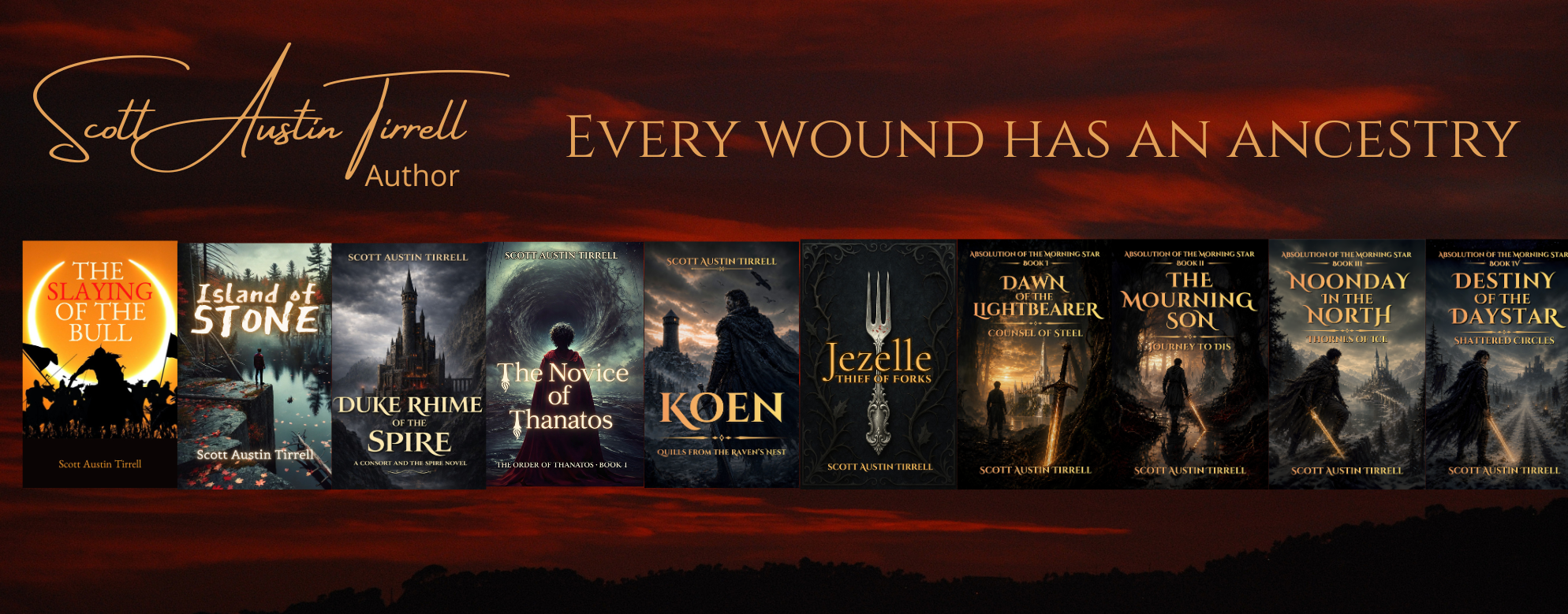
Some of the Tocharian Gospels‘ story will be history, and some will be fiction, but it will all be intriguing and, at the very least, raise some interesting questions. Start this journey now with The Slaying of the Bull! The Power of the Heliodromus (updates here) will be out soon.
Cheers!
Discover more from Author Scott Austin Tirrell
Subscribe to get the latest posts sent to your email.
