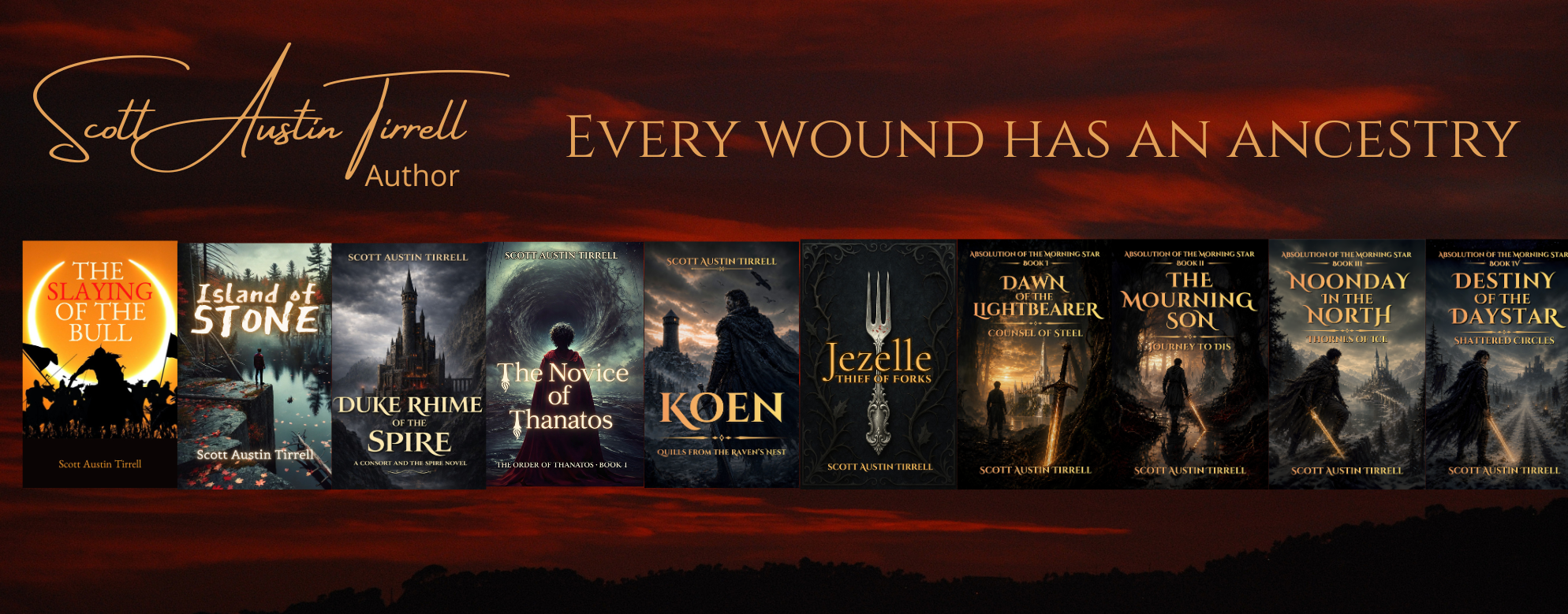

Yesterday, I realized that The Slaying of the Bull‘s Amazon description had gotten a bit tropey. There was a heavy chosen one vibe, and apparently, that isn’t good. Admittedly, I hadn’t realized how much hatred there was for the chosen one until I read a few top-ten pet peeve lists from reviewers and then perused the comment section. Wow, what an eye-opener. People are just downright angry that anyone would even have the gall to write a chosen one story.
I grew up in the world of Harry Potter, Lord of the Rings, Matrix, Star Wars, Jesus, etc. and I’m sorry to see them go. It’s a core story that is part of the human experience. I mean, at the heart of our civilization are a group of chosen ones. Are people sick of those stories too? It’s an intriguing thought. I will say, though, that in general, it is getting harder to please people these days. If you don’t believe me, check out some of the lists I mentioned above. They are a trope of the blogging world and easy to find. They basically say that every type of story has been overdone. Unfortunately, this is a bit discouraging for a writer and likely leads to some disconnect. Readers want writers to write what they want to read, but they don’t know what they want to read until a writer writes it. Writers want to write what they want to write, and if they have to write what readers want to read, then they don’t want to write. Hey, I just created a new tongue twister! Say that three times fast.
The Slaying of the Bull is not a chosen one story per se. As much as it may appear that way, it’s not what is at the core. Initially, I thought it prudent to market the book to that audience, only to find out that people are sick of the chosen one trope, and there may not be any audience to target. The Slaying of the Bull is a fresh (as far as I know) take on the theme, but that means nothing if no one can get past the description. Bummer. Back to the drawing board.
Like anything, The Slaying of the Bull is much more complicated than a theme, and as it is just the first book in what will be a long series, things will change, grow, and develop. Isa, my main character, has all the hallmarks of being a chosen one, but unbeknownst to him (and the reader), his task is much more complicated and involves a process that will take much longer than expected. His path is full of doubt, false starts, disappointments, tragedy, and ultimately it will not end up how anyone imagines. At the heart of the overarching story contained in the Tocharian Gospels Series (for which The Slaying of the Bull is book 1), is humanity trying to figure out God’s plan for us, and in that, there is no chosen one, only shepherds. The task ahead of the Tocharian Gospels is enormous (hence the 5 or 6 books it will contain), and I’m not a sadist. I have no desire to put all this weight on Isa’s shoulders. We’re in this together!
I do want to sell some books, so, I changed my blurb to pull away from the chosen one trope. I hated to see it go. It’s a good theme that brought forth some remarkable stories over the years, but I can see how people may have gotten tired of it. The blurb now focuses on the impending threat to Europe and poses the question of whether Isa and his mysterious books will be enough to stop this threat. Isa is not the core of this struggle. He is just the eyes experiencing this moment of history. I hope that people will now give The Slaying of the Bull a chance and not pass it off as just another chosen one book, because it’s not. I pushed Isa into a role he may not be able to fill, and without giving away too much, his purpose in the story is much different than it first appears.
Many, if not most, authors hate writing the book blurb. It might seem easy on the surface. I mean, it’s just 150 words, right? Ah, but it’s the length that gets you. As an example, condense your entire life into 3-4 paragraph. Difficult, right? How about just a year? Still not easy? How about condensing your day? You get the point. There is a lot of trial and error for an Indie writer to choose the words that pop. We don’t have experts, editors, focus groups, or even just a few people that can give honest feedback working for us. This rendition of The Slaying of the Bull‘s description will probably be the 5th or 6th attempt. I know it is not the golden ticket to book sales, but it is one of the first contact points with the reader, and this makes it very important. Some of the words I chose are already rubbing me the wrong way, so I doubt this is the last change, but it is better than before, and that is an excellent place to be in a world that can never be perfect.
In the end, if readers still interpret The Slaying of the Bull as a chosen one story, so be it. I like the story and the most I can do is hope that others will too. These things run in circles and the book is online and not going anywhere. It may even outlive me. Perhaps 20 years down the road, the chosen one will rise again, and my book will be there waiting!
Cheers!
Discover more from Author Scott Austin Tirrell
Subscribe to get the latest posts sent to your email.

Time I followed you and glad I did. I like the idea of ‘the chosen one’, but recently, Jose Mourinho et. al, it has become very discredited. Use it as a theme without stating it as a theme. As far as I am convened, only Mohammed Ali was entitled to say “I am the greatest!” But I can’t ever remember him saying he was the chosen one!!! Thanks for being here.
LikeLiked by 2 people
Thanks so much for the follow and even more for the comment! The aspects of the chosen one theme that I like is placing a character in a situation where they have a huge burden thrust upon them with high stakes. I like developing a character and then putting them in a situation like this to see how they respond. In all my writing, this is how I approach a story. It is unclear to me if the pushback is on the chosen one that is great or someone normal who is thrust into a position that the fate of the world rests on their actions, and thus has they must become great. The latter is what I’m interested in writing about.
LikeLiked by 2 people
It’s a good approach to have. Clarifies the cut and thrust, good and bad. What on earth do you do at MIT? How often has Hungary (and the gates of Vienna) stood strong against the various invaders? Test question!!!
LikeLiked by 2 people
Too many times 🙂 Ottoman Empire, Holy Roman Empire, Bohemia, Nazis, Soviets etc. Just not a good location.
MIT is a job, writing is the passion!
LikeLiked by 2 people
I love that and I know what you mean. Well said. In my case, my vocation was teaching, and I loved it. I used as much creativity as possible in the teaching situations. I wish or leaders understood the Ottoman Empire a little bit better when they tried to solve the problems of the ME!!! The Seven Pillars of Wisdom seem to have been reduced to one.
LikeLiked by 1 person
Ha, well said. I don’t teach at MIT, but I have taught in the past. I work for MIT’s Graduate Education Office where I help students find, apply,, and keep fellowship opportunities as the Director of Graduate Fellowships. I review a lot of fellowship applications and help students improve their writing, which is the tie to my passion.
LikeLiked by 1 person
That is a noble commitment, and I mean that very seriously. Find, apply, and keep … the latter being very important as well. I loved teaching and research, but I hated the administrative bean-counting with a passion. My real passion was in the classroom.
LikeLike