I’ve heard that there are two types of writers in the world. Those that map everything out and those that let the story guide them. When I was younger and king of the world, my rule transferred to my writing. I saw myself as a great architect and schemer planning the beginning, middle, and end of my stories in exacting detail in an effort to be as clever as I thought I was. The problem is, I’m not that clever. A lesson life has taught me more times than I am comfortable sharing here. Although writers often compare themselves to gods, we are not. At best, we are conduits. At least for me, that level of planning for even a short work of fiction was exhausting, slow, and full of faults. It was also dull. Knowing all the points of a journey before putting it down on the page means it becomes as mundane as my commute to work, and the passion disappears from the prose. That isn’t to say some can’t do it and do it well (the pane transferring the light is just clearer for some), but when writing can’t pay the bills, why make it work?
Giving up and letting the story take you into the unknown isn’t easy either. It takes trust in the knowledge that every tale will find its way to the telling. You have to keep saying to yourself that it will all work out eventually. Will it always be great? Certainly not. Luckily, in writing, you have the luxury of going back and starting again. In my current WIP (writing in progress for the non-authors), two of my characters explored a cave. They came to a grotto, and for the life of me, I couldn’t move them forward. They just froze in that space and ruminated on the grandness of mother nature and the unknowns of the earthly deep. BORING! So, I brought them back to the entrance and started them down the path again. Suddenly, an iron-lashed door appeared before them. Hmm, what’s this? How strange. Why is this door in a cave deep in the forest? What could be behind such a mysterious panel? Was it locked? If not, why have a door in the first place. If unlocked, what does that mean? Should they go forward or retreat? Boom! The questions blossomed and the story continued.
As in life, the unknown can be scary. We want to know that we’ll be ok, that peril doesn’t await around every corner. But in writing? Oh, that is where the gold is, my friend. There is nothing like being as excited about an outcome while writing it as your reader will be reading it. If it is unexpected for you, it will likely be shocking for them, and that is why they are traveling on this journey in the first place. If it falls flat, and becomes lost in hell’s grotto, then you’ll instantly know that it’s time to step back and start the journey again.
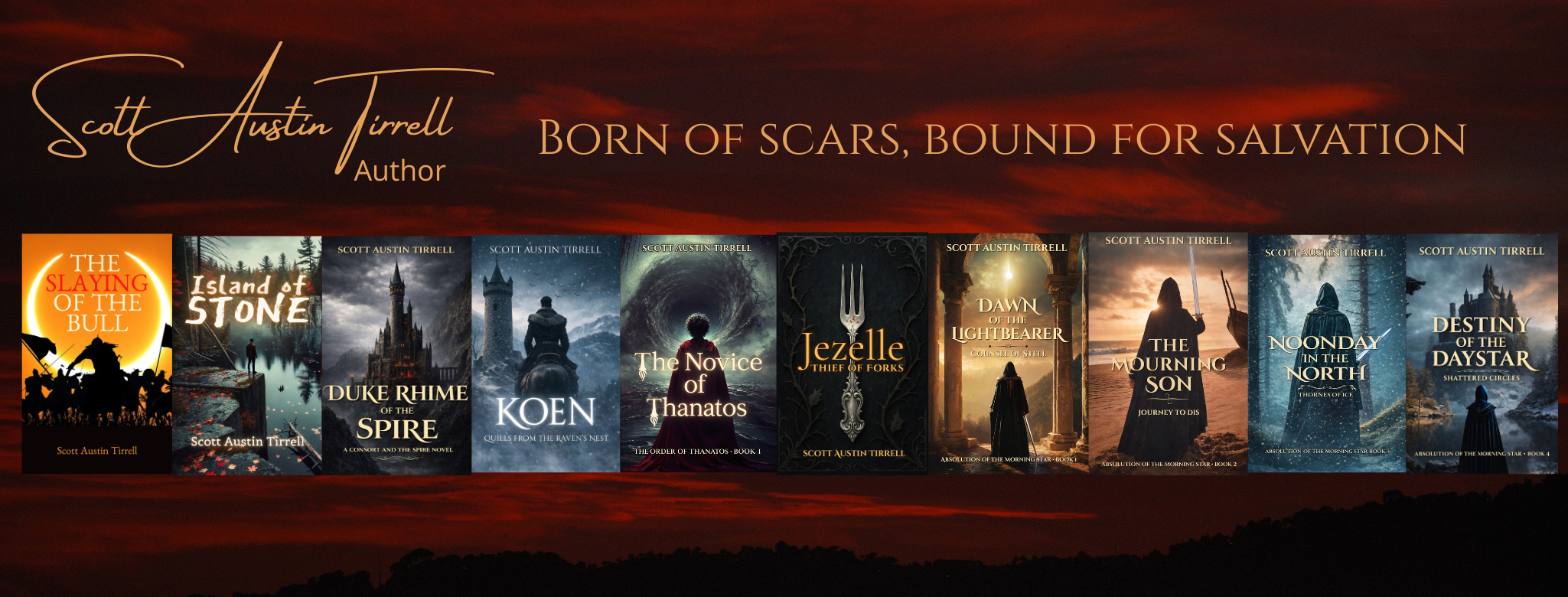
I suppose there is a life lesson here some place. We dwell on the past and try to predict the future while the present, with its infinite choices, speeds by. We barely notice the beauty and wonder unveiled before our eyes every waking moment as we explore this choose your own adventure story until suddenly, we’re at the end- unfulfilled and wanting. I came to this epiphany while writing my latest book, Dawn of the Lightbearer, and it became my favorite writing experience. Life is full of fabulous tales that unroll beyond our control. Sure we may steer some of the course but can’t stop a wave or a gust of wind from moving our boats. We have an idea where we want our lives to go, but we know that we don’t have complete control of our destiny. If that is life, should it not also be in writing? Thus, that’s exactly how I wrote Dawn of the Lightbearer and continue to do so with Son of the Mourning. I mark some destinations on my map, create some characters, and let them live life. If they make it where they planned to go, great, but if not, the reasons why become as intriguing as the events in my own life that have redirected my course. Suddenly a new mystical vista appears on the horizon, ripe for exploration. I look back to my planned destination, shrug, and head into the unknown.
Cheers!
Discover more from Author Scott Austin Tirrell
Subscribe to get the latest posts sent to your email.

Scott, this is all so true and I applaud your bravery! This post was illuminating and I can totally relate! Thank you for sharing this 😉
LikeLiked by 1 person
Thanks! I’m glad you enjoyed it.
LikeLike
I don’t consider myself a god, but I suppose some may. I often start out with a basic outline and then let details flow in as i conduct research and change scenes. I hear you, neither path is easy. 🙂
LikeLike
Dear Scott,
when I was writing fiction I planned every chapter in detail. That took most of the time writing the book. Having planned everything in detail I just forgot about it in the process of writing. But I needed this plan for feeling secure to forget about it. It sounds paradox but life and every good story is paradox, isn’t it?
A plan helps you not to repeat or having to refer to some fact you should have mentioned before.
Actually, in relation to the world I design as an author I am God, of course.
Thanks for sharing your ideas about writing. That’s very much appreciated
Klausbernd
The Fab Four of Cley
🙂 🙂 🙂 🙂
LikeLiked by 1 person