
I know, I know. It has been forever since I wrote a blog post. Two weeks is an eternity in the blog space, but it went by in a wink for me. Last time, I talked about how detours suck (they still do). Well, the signage was poor, and I got completely lost. It all started with creating a religion for the Absolution of the Morning Star series. It quickly turned into a two-week wander through the weeds of bronze age polytheist religions. You may ask yourself, how could such things happen? I can only say, this is the path of a writer.
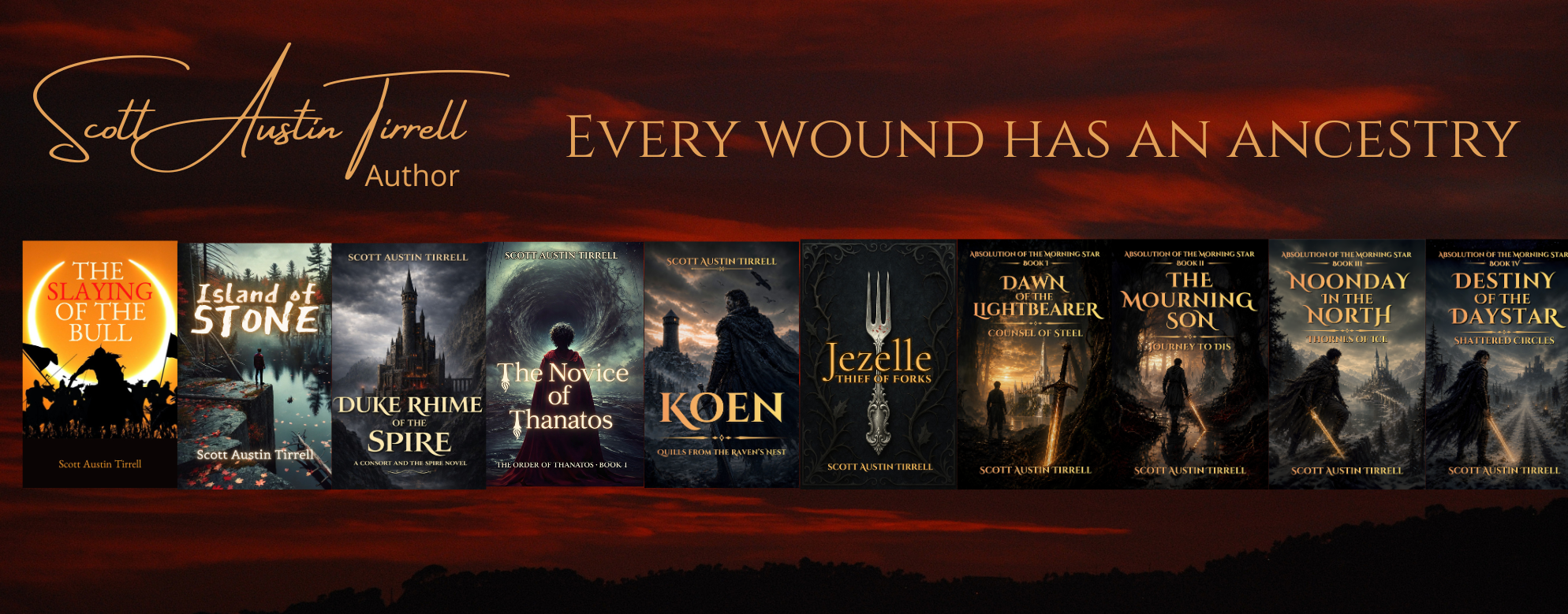
If the references in the titles of the books in this series (Dawn of the Lightbearer and Son of the Mourning) leave you scratching your head, a key component of my story is Lucifer. There, it’s out of the bag. Before you start freaking out, it is not the “Lucifer” that has become synonymous with Satan or the devil in the Christian faith. We are talking about the Seraphim Lucifer, the great light-bringer, morning-star, shining-one, or bringer of the dawn- a diety that pre-dates Christianity and was also known as Phosphorus (light-bringer) and Heosphoros (dawn-bringer) by the Greeks. That doesn’t sound so bad, right? Lucifer is an angel that has gotten a bum rap over the years and all because of a mistranslation from Greek to Latin in the 4th century.
Lucifer was never Satan. But I won’t bore you with all that (if interested, read this). It’s a story that goes against much of what most Christians were taught and probably not one they want to hear. I’m not interested in controversy. I’m most interested in a good yarn. I’ve been very conscious not to make the Absolution of the Morning Star series a Christian fiction (Christ never existed in my world of Lucardia). This tale is a fantasy. But I do want to play with the notions of religion because they are such a fundamental part of human existence. Lucifer has an intriguing narrative and needs a bit of absolution. To do that, I’m going deep into the past. We’re talking before Christianity and before Judaism. Back to when Isreal got its name as the worshippers of El, its transition from Polytheism to Monolatrism to Monotheism, and the rise of the mysterious deity, Yahweh. What if, at this point, the story took a different turn. Well, that is where the Absolution of the Morning Star finds its home.
So, I know where home is, but I’m lost on my way to get there. I wrote over 250,000 words before this became a problem, with 150,000 of these already in print. Thankfully, Dawn of the Lightbearer‘s story won’t change because of this meandering. However, what I’ve written for Son of the Morning will change. Here, I delve into Erikson Gray’s mysterious path, where the past plays a vital role, and the world’s religion is critical. I know I’ll get there eventually. The process of creating depth is tricky, but ultimately, it will be worth the effort- I promise.
So, that is where I am- working my way through the weeds until I find that light that will guide me back home. It’s frustrating now, but it is part of the adventure- the juicy part of all the unknowns and discoveries. All life is a story, and I’m climbing to the climax. The slide down the other side will make it all worth it. When I am comfortable in my home warming up by the fire of another finished book, I know I won’t be able to wait for my next adventure- and I hope you’ll join me.
Cheers!
Discover more from Author Scott Austin Tirrell
Subscribe to get the latest posts sent to your email.

You’re pushing the envelope with this–a worthwhile endeavor.
LikeLiked by 1 person
I love those wanders but do understand the angst of coming out the other side to realize weeks have passed!
LikeLiked by 1 person