
I know. I’ve been delaying this next part of my story. I’ve hinted, but I keep avoiding the point. It was a bit of a traumatic experience, so talking about it is difficult because of the ordeal and, more importantly, because it doesn’t make me look incredibly bright. I’ve tried to offer plenty of excuses, but ultimately, it comes down to my error, my inexperience, and my stupidity. Yes, it is time to talk about my first few days in China.
It was a time that I learned a lot about myself and the world at large. More importantly, it showed me how quickly things could go downhill if you didn’t make the necessary preparations. Looking back on that time now, I laugh. It makes for a great story. But then, it was the scariest moment in my young life. It probably still tops the list the more I think back at that moment. It is not like I would have died, at least I hope not, but as you will see, it certainly ruffled my feathers.
As I mentioned in my last post, the Japanese teachers and I arrived at the university at about 9 pm. Although China has a thriving nightlife, this is still relatively late for Dàbáilóu’s restaurant, and I should stress that it is Spring Festival time. We were ushered into the empty restaurant and seated around a large table with a lazy Susan at its center. There is fire, noise, and movement in the kitchen, and it smells great. Yes, food! I’m famished, but I have also been traveling for two days straight, and my stomach doesn’t know what the hell is going on. It is looking for the typical things a western stomach looks for when it needs some comfort, which is not going to be what it gets here this night.
Around the table are me, Yao Ming, the driver (I swear the resemblance is spot on), the helpful English student, and about six Japanese teachers. As I was supposed to arrive the day before, I don’t think anyone expected a young American to be at the table. Remember, I am new off the plane in China. Sure, I’ve traveled to the country before, and I’ve seen some interesting, authentic Chinese dishes, but the chefs were clearing catering to the Japanese pallet that night, so no Kung Pao Chicken. Secondly, being the only ones in the restaurant, I’m sure the chefs were eager to get home, and quite possibly, only the lowest on the Chefs’ totem pole was in the kitchen. Over the next few years, I had hundreds of absolutely fabulous meals in Dàbáilóu’s restaurant. This was not one of them.
It was a long time ago, so I don’t remember what they served precisely. I do know it was lots of strange things I was not familiar with- soups with seaweed, bits of meat that were mostly bone, cartilage, and connective tissue, fish with heads, cold jellied meat tureens, hell there were probably chicken and pig feet, some failed attempts at Japanese food, all sorts of strange things. Confronted with that meal now, I would relish it as any Chinese, but then, yuck! I’m not lying- It was probably one of the worst meals I had in China. What a welcome, right?
I was queasy from my journey, tired, and didn’t have anyone to talk to in this group. The Japanese knew a few English words, but we certainly couldn’t have a conversation, so it was awkward with many hand gestures. I smiled and nodded a lot and picked at the food a bit. I tried to look more confident and less disgusted than I was. I probably toasted some, as is the custom. Then it was time to retire. I had months ahead of me to eat, and I was wary of getting sick so soon on my journey. Looking back now, I should have eaten more, a lot more.
Now, I brushed over a critical point above, and I want to focus some attention on it now. It was the Spring Festival time in China. The day I arrived was February 7th, and the Chinese new year was February 9th. I don’t think I knew that then, and I certainly didn’t comprehend what it would mean to arrive at the university at this time. If you aren’t familiar with the Spring Festival or, more generally, the Chinese New Year, saying it is a big deal is probably not doing it enough justice. Think Christmas, Thanksgiving, and New Year’ all rolled into one super holiday and then times that by four. The whole country stops what they’re doing, no matter how important that may be, and then goes home to spend time with family. What does that mean? We are talking about the most massive migration of people on the planet. That’s 400+ million individuals going home for the holidays all at once, more than the US’s entire population. China has a huge migrant worker population, and all these people are given a scant few weeks off. Unsurprisingly, they are all eager to get back to their homes and family. It is hard to explain the importance of this holiday or its magic unless you experience it. For many Chinese born in the countryside, the only way to survive is to work in the cities, but the Chinese ID, otherwise known as a Hukou, binds them to their birthplace. It is not like the US, where you can just pack up the whole family and move someplace with more opportunities. The life of a migrant worker is hard, and living conditions are often far less than ideal. So the family usually has to stay back in the village where their Hukou allows them access to resources, and for children, that means school. Many must leave their families behind (for children, this is often being cared for by grandparents) as they venture hundreds of miles away for work. Spring Festival is the one time in the year that you get to go home, and it is an incredibly important time for all Chinese.
I know what you’re thinking. Scott, you’re delaying again. We want to hear about this terrible event you keep alluding to. Ha! Don’t worry. I’m getting there. What I’m trying to say is Dàbáilóu is empty. I don’t mean just a little quiet. I literally mean empty. I wouldn’t have been surprised if there were ten people total in the whole five-story building. All the staff? Home. All international students? Home. All the other foreign teachers? Traveling or home for the holidays. Hotel guests? Why would they be here? They were all celebrating this most festive time of the Chinese year with their family.
So, the English student takes me to my room, hands me my key, says goodnight, and then leaves. Before entering the room, I look down both ends of the empty halls and shrug. I close the door, and that was it. I was now living in China. No orientation, no information packet, no communication at all on what to expect or do. Just a quick meal, and then wipe your hands clean of the foreigner. I sat on the bed and thought to myself. What now?
I had been to Dàbáilóu before during my college travel tour, so I knew what to expect. It was a 3-star Chinese hotel room, nothing fancy, and very practical. Probably not a place you would want to stay for vacation, but for an early 20’s male, it was good enough. It had two beds, a desk, a couple of chairs, a TV, a cabinet with some drawers, a little fridge, and a container to hold boiled water (something pretty unique to China), a cup, and three tea bags. There is also a scary bathroom with a toilet (thank god it is not a squatter), shower, and sink. I would love to take a shower, but at this time, Dàbáilóu only had hot water two times a day, one hour in the morning and one hour at night. At this point, it was after 10, so I missed the hot water time. Ugh.
So let’s recap. In case you forgot, I have plenty of US dollars, but only 5 RMB. I’m missing one of my suitcases, and of course, it is the one that has all my food (I have no idea what is going to happen with that). I just had a very unsatisfying meal, so I am already hungry. I am in a hotel virtually by myself with no idea what’s going on, what the next steps are, or if anyone will tell me what to do. I assume that someone will show me around, but as of right now, it doesn’t seem like that’s going to happen. The only food I have is a container of Tums, three very stale tea bags, and a pitcher of boiled tap water (pause for a moment and look back at my last post about the water).
You might be seeing where I am going here. I don’t know this yet, but generally, I’m F*****. I have no food, no money, speak no Chinese, and I am pretty much by myself. At this moment, I’m not panicking. I tell myself everything will work out. They probably assume that I’m tired (which I am) and want to get settled in. So I do that. I get situated. Get ready for bed, watch a bit of Chinese TV, and then go to sleep.
As I lay there, I rationalize. Someone will come to check on me tomorrow. I can let that person know about my money situation, and they will help me. I can tell them about my suitcase issues, and they will help there too. They will introduce me to others, and they will take me under their wing. They wouldn’t just have me travel all this way and forget about me, right?
Day one arrives. I slept, but not much. Chinese beds are very hard. They’re usually an inch of foam (if you’re lucky) on a wood plank. They believe this is good for you, and maybe it is, but I’m not used to it yet, and I’m stiff. The pillows are stuffed with barley, so think about sleeping on a bag of rice. Funny enough, I eventually got so used to this that I still use a barley pillow now more than a decade later. Anyway, the good thing is, I was up early so I could take a “hot” shower. After letting the water run for 20 minutes (sorry, mother nature, but I am in desperate need of a shower), I finally get a bit of lukewarm water. I will eventually learn that the best time to shower is at night and as soon as the hot water hour begins. If you are even a half-hour late, you will have a cold shower. Both the bed and the bathing were very different from my experience, but I got used to them like most things in life.
So, I’m up and ready for the day. I sit on my bed and look at the door. Any moment they are going to come and get me, right? Maybe offer me some breakfast? I hope. No one ever comes. By noon, the growling of my belly forces me to venture out. I don’t see a single person in Dàbáilóu other than the guard at the front desk who doesn’t speak a word of English. I explore the first floor and find a string of offices with names and English titles, the administrators that run this foreigner hub. I see a familiar name, Mr. Liang. It is the person I communicated with back and forth before arriving. I knock on the door. Nothing. The building is a ghost town. Even the restaurant is closed. Everyone is home and enjoying the holiday. It is Chinese New Year’s eve. No one is thinking about the poor starving American. I go outside and explore a bit. The campus is very quiet. People are around, but not many.
I would have explored more, but I didn’t want to miss those that must be coming to welcome me to Hebei University. So I return to my room and wait. No one ever comes. It gets dark, and I start to get scared.
I should mention here that Hebei University said that they would provide me with a computer and internet during the contract signing time. There is no computer in the room. Only a telephone that I can’t figure out how to use. So I have no way of communicating with the outside world. No way to let my parents know I’m in China safe, and certainly no way to try and get some help.
Day two goes pretty much the same as day one. It is Chinese New Years’ Day, and again, no one is around. I don’t even know what happened to the Japanese teachers. Now, I am starting to panic. I haven’t eaten in two full days. I try to tell myself to stay calm and think this through. There has to be a way to get out of this, but I’m getting a bit lightheaded and not thinking particularly rationally. As if it were a queer celebration of torturing the American, there were plenty of fireworks during this time. They were constant and almost seemed I was in a war zone.
Day three. Again, nothing. I’m scared shitless now. We’re talking curled up in a ball and crying, terrified. What did I get myself into? How am I going to get home? What am I going to do? I don’t know if you’ve ever gone for three days without food, but it is not pleasant, especially when you don’t know when you will eat again. I crunch on some Tums and make myself some tea. After finishing the tea, I chew on the bag. You start to get desperate. I take my 5 RMB and venture out to find anything to eat. I don’t know the area well, and I can’t find anything open. I am getting pretty weak at this point and give up. I go back to my room and sleep.
Day four. I’m beyond desperate. How can I be starving in a city of one million? Am I a complete idiot? I get dressed and go around and start knocking on doors. I have to find someone. I go down the hall, and I knock and knock. I get to the first floor and start knocking on the offices of the administrators again. I remember I was at Mr. Zhang’s door. He was the big boss who ran the whole international program. If he had opened the door, it wouldn’t have done me any good. He didn’t speak English. But luckily, a very rotund Chinese man with a crew cut and glasses spots me knocking pretty heavily on the big boss’s door. He nervously asks if he can help me. Thank God! Someone speaks English! I almost give the man a huge hug and a kiss!
Come to find out, the gentleman is Mr. Liang. I explain my predicament to him. He seems very concerned. Perhaps someone was supposed to offer me more guidance? I don’t know. I probably should have been angry at this point at my treatment (of course that is probably a privileged American way of thinking), but I am well beyond caring about all that now. I am just happy to find someone I can communicate with. Better yet, this person can help me. Come to think about it now. It probably had to do with my late arrival. If I had come when I was supposed to, it would have been three days before the holiday, and maybe things would have been different. It probably would have been everyone’s last working day before the time off. I will never know for sure.
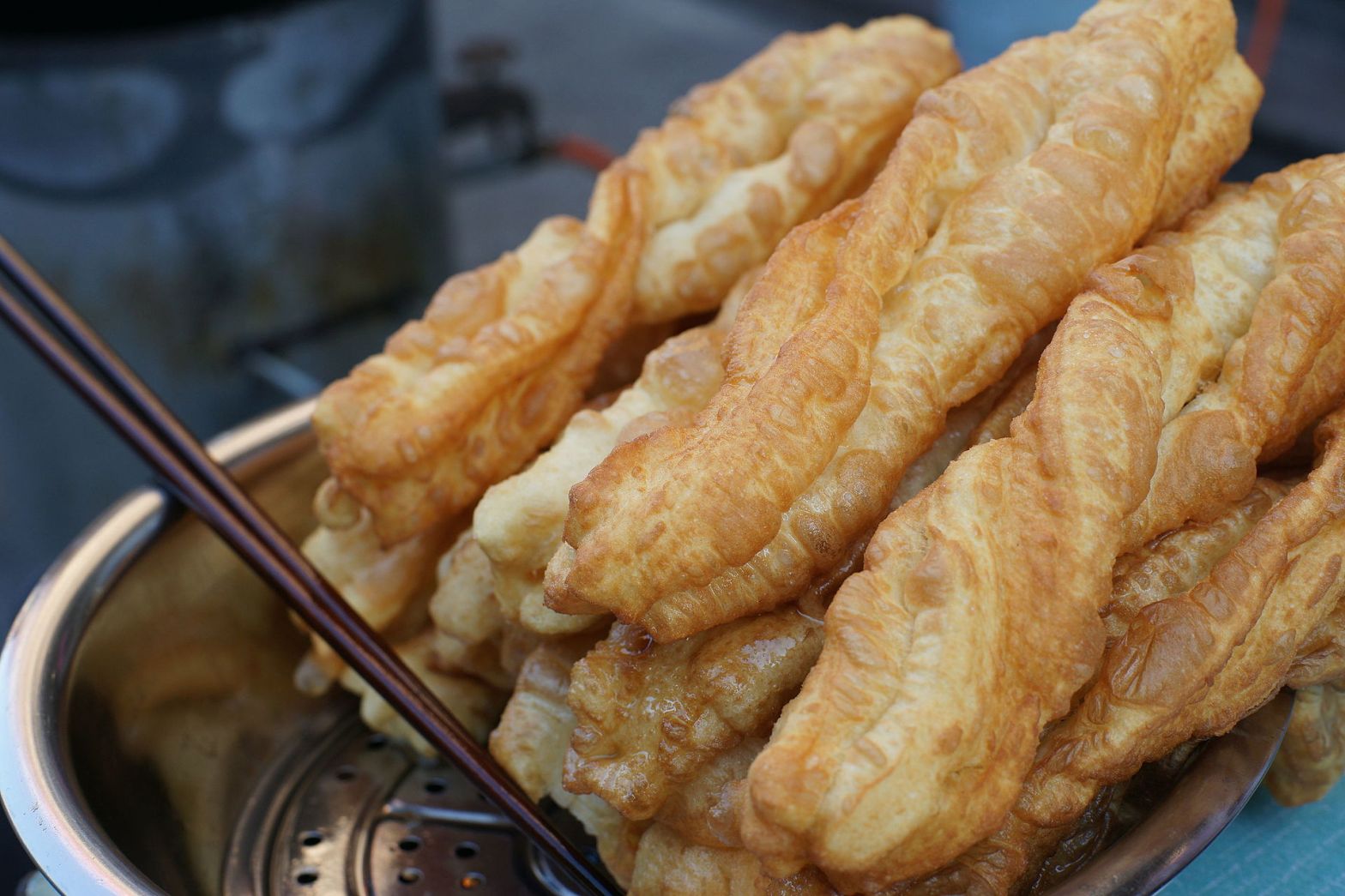
Anyway, he brings me into Dàbáilóu’s restaurant, which, is now open of course, and he buys me breakfast. Guess how much it cost? That’s right, 5 RMB. If I had been thinking more clearly that morning, I could have walked into the restaurant and bought my own damn breakfast and not looked like a complete fool knocking on doors desperate for help. Anyway, I still remember that meal like it was yesterday- fried dough sticks called yóutiáo (which will always have a special place in my heart), a couple of hard-boiled eggs, congee with pickles, and some stir-fried veggies and tofu. After three solid days of absolutely no food other than Tums and tea, it was heavenly.
Just like that, it was like someone flipped a switch in heaven. Mr. Liang arranged for someone to take me to the bank to exchange my money. Little did I know that there was only one bank in Baoding that could do that, the main Bank of China branch, and it was a 20-minute drive away. I would never have found it on my own. My suitcase arrived the next day with everything intact, including my food. People started to filter back from their travels, and I made many new friends. Although my new computer hadn’t arrived yet, they let me use the office computer, and I could let my very concerned parents know that I was ok.
Were my adventures over? Oh, certainly not, and I still have some yarns to share, but things did significantly improve, and I learned some precious life lessons. Was it all my fault? No, I don’t think so, and later I took it upon myself to help Hebei out with an orientation program for new teachers. But on the other hand, was I entirely blameless? Definitely not. I was naive, cocky, and yes, stupid. I made way too many assumptions and was filled with my own American self-worth. I learned that you should never depend entirely on others. The only one that will truly look out for you is you. That isn’t to say that others won’t help you, but if you can prepare yourself, then why not do that. Prepare for the worst and hope for the best, I always say. When you travel internationally, do your research, don’t pack important things all in one place, and, most importantly, exchange your money beforehand. Was this experience traumatic? Yes. Would I change how it played out? Probably not. It was an experience that didn’t kill me. I learned a lot, and it still gives me a good laugh.
The next stop? Learn how to teach a classroom of 50 students on the fly.
Cheers!
Discover more from Author Scott Austin Tirrell
Subscribe to get the latest posts sent to your email.

Looking back, it could have been a lot worse. However, at the time, hungry, alone and not knowing what was happening, I can see it must have been very scary.
LikeLiked by 1 person
Definitely coming back for more.
LikeLiked by 1 person
OMG I would have lost it. I did learn early on to pack necessitates in a carry on bag. I want to read more about your experiences.
LikeLiked by 1 person