
I was now married and living in China. The ensuing months had been a whirlwind and we lived in a newlywed dreamworld for a time. To celebrate, we took a wonderful trip to Tianjin, the port city that feeds Beijing. We joined a local tour group that was comprised mostly of workers from a Baoding factory. They were a rowdy group, and I was, of course, the only foreigner on the antiquated bus. It was a long cramped ride on bumpy back roads. My long legs don’t fit well on a Chinese bus, so it was a little painful, but the scenery was worth it.
For our first stop, we visited a wonderful park used to film Chinese movies and TV shows and it was certainly the China you see on the screen. There were woods and a beautiful bubbling river. Crash, bang, boom! The workers discover a squirrel up in a tree and subsequently try to kill it with rocks. Why? I don’t really know. They likely had never seen such a woodland creature before. Perhaps they felt threatened and needed to submit dominance? *Shrug* Luckily, none of them could throw worth a darn, so the squirrel escaped, a little frazzled, but unharmed.
We then stopped at a colossal pearl emporium. If you’re not familiar with traveling in China, all tours will end up at one or more of these random places in the middle of nowhere peddling some Chinese specialty, be it jade, silk, cloisonne, local foods, lacquerware, etc. They herd you in with hundreds of other tourists under the guise of showing you how they produce these wares, give you a quick demonstration, provide you with all sorts of tips on buying the real quality goods, and then push you out into a store. You stumble out into the bright lights of the displays dazed and confused, and then are immediately bombarded from all sides by very eager salespeople.
You can’t get upset at this forced consumerism as the tour guides tend to make most of their salary from commission from these places and it keeps the price of the tours low. Anyway, it is interesting to see the skills and process, and it provides a chance for foreign tourists to obtain those essential Chinese goods they want to bring back to impress their friends. The markups are marginal in foreign dollars, and for the inexperienced, you can count on the quality. I, too, bought from these stores when I was a tourist. But, I was a local now and wouldn’t be caught dead buying marked-up pearls when I knew I could get them cheaper just down the road. I had learned those lessons from bitter experience.
In the actual city of Tianjin, my wife and I had some great seafood. We bought the freshest grilled squid I’ve ever tasted right off the boat from a calloused-hand fisherman. It was spicy, sweet, with just a bit of smoky char. We then hopped on a fishing boat and rode out into the murky bay. The fishermen hauled-in whatever they could catch in their nets and then cooked the seafood right there on the craft. It was mostly mantis shrimp (my favorite and something scarce in the states) and various small fish, which they stir-fried with their local fish sauce and served with mantou (steamed white buns). It was scrumptious, although probably full of heavy metals and who knows what else. The water in that bay wasn’t the cleanest- the risks you take when you’re young.
Our trip to Tianjin was our first big adventure together outside the province, and although it was only a day trip, we count it as our honeymoon. As I write this post, I’m looking at a picture of us taken that day that sits in a special place in our living room. We were so young. Our honeymoon wasn’t that typical huge glorious trip that most others partake in, but that was ok with us. We have traveled around the world since, so we’ve made up for it ten times over. At the time, it was the best we could do. We were poor. I will explain why below.
The honeymoon was over, and the reality rushed back in quite quickly. We worked at the university and made decent Baoding money (our combined take-home equated to roughly upper-middle class for the city). The university provided our apartment (now that they finally let us live together), so we didn’t have to worry about those costs. The problem was I still had my student loan payments to worry about back in the states, and this was in American dollars. All told, it amounted to about $300 a month. My monthly salary at the university was 3,500 RMB. Sounds like a lot? It was for Baoding, however, with a 7 RMB to $1 exchange rate, it amounted to only $500. So two-thirds of my salary had to be saved for this bill. My parents agreed to make the payments while I was away, but they expected I would reimburse them on my return. My wife and I could dip into this nest egg for emergencies, but really it was already spent. Like many couples, our first argument was about money. I wanted to keep on living the bachelor’s life, and my wife felt otherwise. She made a valid point. I couldn’t just have fun in China anymore. I needed to grow up and start bringing home the bacon.
My teaching load at Hebei University was about 15 hours a week, which meant I had a lot of free time. I also had a much-valued skill- I was a native speaker of English. It was time to find part-time jobs. Now, technically this was illegal. Hebei University was my Chinese work-permit sponsor, so I only had permission to work for them- talk about bonded servitude. But, working under-the-table part-time jobs was a way of life for us foreigners, and the money was just too good to pass up. Sure, there was the risk of getting caught and perhaps losing our visa, but as I’ve said before, there are many laws in China but no rules. In other words, there are a lot of things on the books but virtually no enforcement (at least for the important things like basic traffic safety, I digress). Baoding’s going hourly rate for teaching English by a native-speaker was 100-150 RMB an hour. This meant that just taking on 5 hours a week of part-time work, I could make back more than I was losing paying the loan. It was a no-brainer at the time (disclaimer: if you are thinking about teaching English in China now, be careful, much of what I say may no longer be the case).
I had three part-time jobs while in China, each with its own story and peculiarities. The first came through a referral from a friend. He had lived in China for several years but left after my first semester. From what I know, it was a coveted position that had passed through several hands before me. Generally, it was a two-part job. The first would be teaching the CEO and upper management of a local joint-venture oil prospecting company called Sercel-Junfeng. Serecel is a French oil company, but they conducted their business with their Chinese partners (Junfeng, the remains of a state-owned enterprise or SOE) in English. The job included instruction on business English and conventions, reading and explaining email correspondence from the French side to make sure the Chinese side understood correctly, and proofreading email correspondence from the Chinese CEO to his French counterparts.
My first meeting with the CEO was strange. He had an assistant that seemed to make all of his day-to-day arrangements. This gentleman was a bit seedy and seemed more like a criminal than an assistant in a reputable Chinese company. When we first met, I was concerned that I had gotten myself involved in something illegal. I don’t know how to explain it other than I always felt this guy was being dishonest (my wife felt the same). This gentleman also spoke about his boss like he was some sort of celebrity or even a god. He was terrified that I would somehow offend the CEO and was meticulous about the details of our future interaction. It made the introductory meeting with the CEO more stressful than it needed to be.
The first meeting itself was in a gymnasium in some sort of Chinese upper echelon country club. They brought me in and had me sit on a bench next to a basketball court where I waited until the CEO finished his workout. It was a strange sort of power game that you eventually get used to as part of the “face” culture of China (I will explain “face” in a future post). I had no idea what to expect as I watched some very bad basketball. After all the back-and-forth with the assistant, I felt like I was about to meet a crime boss. The man that I did encounter was the complete opposite. He was friendly and incredibly down-to-earth. We had a quick exchange, and that was it. We clicked. They called me a few days later, offering me the job.
It was exciting work and gave me a taste of Baoding’s upper class. The factory was about 20 minutes outside of the city proper, but they would send a black sedan with a driver to pick me up several times a week. I felt so important riding in the back of that car, and the job was rather prestigious. I became an integral part of ensuring the joint-venture remained successful, and they treated me like part of the senior management. I got to know the CEO, CFO, and board of directors well and would count them as friends. Unfortunately, we lost touch over the years. I tried looking up the CEO recently, but it appears he has moved on. He did have a fascinating story. He started in the company as a lowly engineer when it was still an SOE. He then led the workers’ unionization and eventually they (the workers) bought the company from the state. The joint venture deal then paid back the workers. When he began this mission, he spoke no English and basically taught himself the language, which allowed him to broker the joint-venture deal with Sercel.
The second, and much more lucrative part of this job, was tutoring this CEO’s teenage daughter in English. Eventually, this became my primary work. The CEO would pick me up and bring me to his home, we would go over a few of his emails, have a discussion, and then I would tutor his daughter. They paid very well- 100 RMB an hour for the tutoring, and 150 RMB for the business-side stuff. Generally, I would make 250-300 RMB at a time.
My second part-time job was teaching in an after-school middle school. What’s that, you may ask? In China, regular school runs about the same length as in the US, but then most will join a private school after the official school ends (and stay until about 10 pm). The purpose is to get just a few more points than your peers. I can’t stress enough how competitive things are in China. To succeed in life, you have to study hard and always outdo your neighbor.
The school I taught in was not a top-tier after-school, so the students were a bit of a handful. None of them wanted to be there. Getting them to focus on a language they didn’t want to learn was tough. I did the best I could, but it was clear that most wouldn’t pass the rigorous college entrance exams, the sole reason for which they were in this class. The few who did get high enough scores wouldn’t be going to the schools that would get them the jobs that would justify the tuition dished out by their parents. This work pushed my presentation skills and encouraged me to engage more in my teaching, valuable lessons that help me even today in my current job.
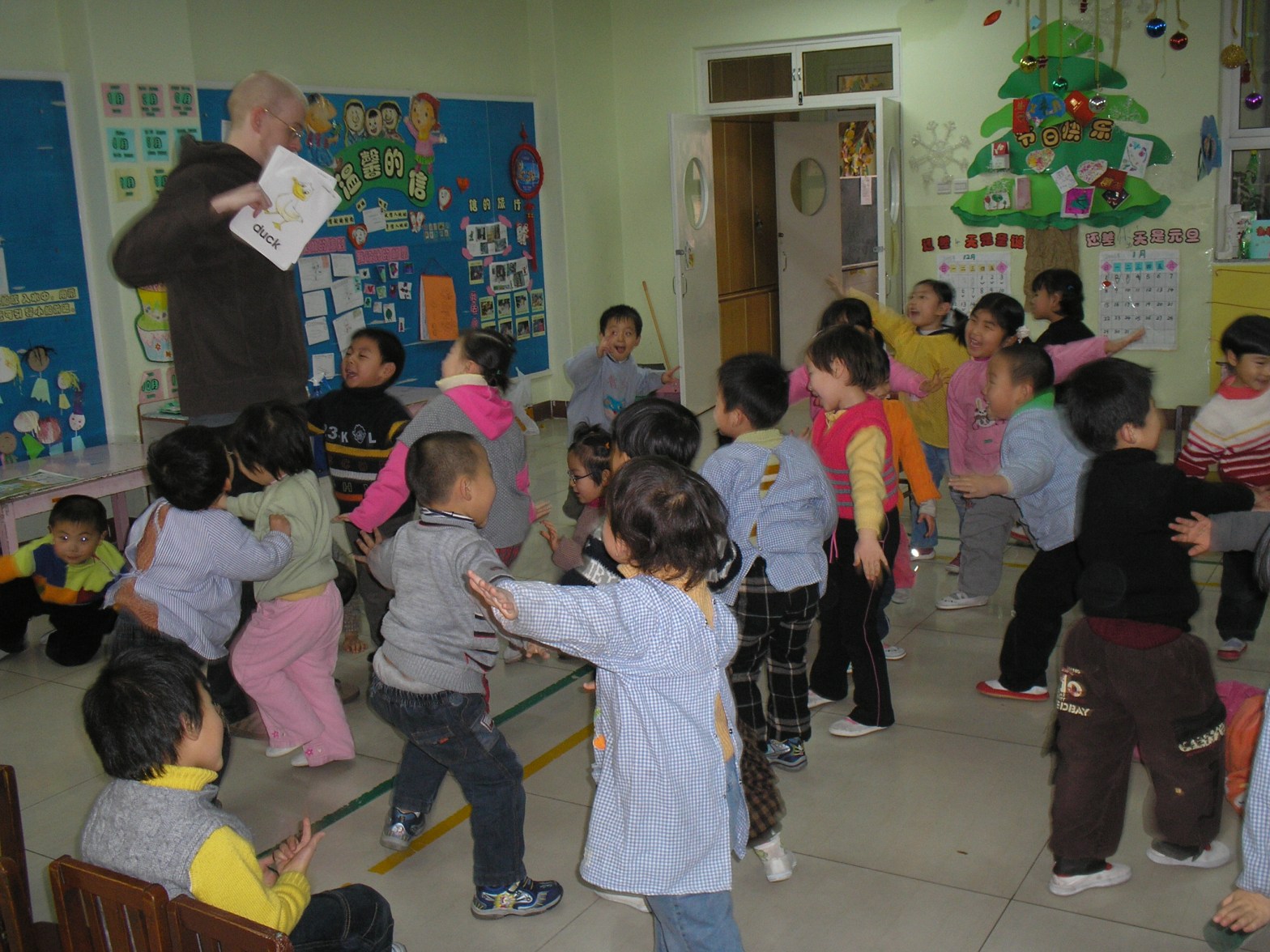
Lastly, my third part-time position was the strangest and the toughest. Yes, more formidable than teaching CEOs and even more challenging than wild adolescents who didn’t want to learn. They would test my patience, require all my teaching tools, bring me pain, and shake my confidence to the very core. For our first meeting, I remember walking down a long dark hall—their dreaded racket echoing down the corridor, shaking my very soul. Evidence of their presence was everywhere. It was in the mud outside, on the walls of the hall, and their smell was in the air. I came to the door, the frosted glass of the pane shaking from their movement and life. The panel opened, and the room fell silent- a bone-chilling nothingness. Before me, 60 eyes lay staring and little smirks of mischief spreading. True, the 30 kindergartners who filled the room were adorable, but let me tell you, looks can be deceiving. The picture above is proof of the experience (we are learning about ducks).
When I entered China, I had no teaching experience, but I had less experience with children. I was the youngest in my family, not just my immediate family but also my extended family. That wouldn’t change until my nephews were born. None of my friends had younger siblings, either. I just never had the chance to interact with children, yet here I was in a room full of little bodies, all of which spoke a different language and didn’t understand that I couldn’t always understand them.
I turned to their teacher to say something, probably about how nervous I was, but she’s gone. So now, I am alone with 30 Chinese Kindergartners. Could this be any more of a nightmare? What do I do? I look down at the “textbook” in my hand. It’s full of animals, fruit, and other such things, but it has no instruction on managing a class full of toddlers. What is the first thing that happens? A little boy stands up as if chosen as a delegate by the others. He walks up to me with a smile on his face and punches me right in the balls. I kid you not. That about sums up that entire part-time job experience. I am 6′ 2,” and they were all about 3 feet (except for one girl that was just huge), meaning they were at the perfect level for the attack, and, once the devils got that first response from me, they were eager to see it again and again and again. Ugh, I shiver at the thought even now.
You would think that they would be afraid of this massive white giant stranger, but they were not. With my red hair and big feet, maybe they thought I was a clown. I don’t know, but once they sensed your fear, they were relentless. Why suffer the torture? Well, it paid incredibly well, of course, and those little rascals did grow on me eventually. We made it work in the end, and it was a bit cathartic to act like different animals and such for an hour (although certainly embarrassing at times). Actually, in time, they helped me learn Chinese. Strangely enough, we had about the same vocabulary, and that low barrier no judging interaction was helpful. I could practice simple words and concepts as I tried to teach them English. So it wasn’t all bad, and I probably learned more from them than they learned from me.
With three part-time jobs on top of my university salary, we started doing pretty well financially. For comparison, my total take-home pay was more than a tenured Chinese professor at the university, even after paying the student loans. We weren’t rich, but we were comfortable. I was also only working a total of about 20-25 hours a week, leaving plenty of time to explore, play, and write. The jobs gave me a chance to interact with all of China’s society levels, and in sum, the experiences were very enriching. Now, I’m actually glad I had the burden of those loans. I can’t believe I’m saying that, but I may not have ventured out and had these beautiful experiences without that gentle nudge of financial distress (and my wife’s tapping foot, of course).
Huh. I guess the difficulties of our current times force you to look at the bright side of things. Zhen qíguài (so strange)!
Cheers!
Discover more from Author Scott Austin Tirrell
Subscribe to get the latest posts sent to your email.

I literally binge- read all the posts of yours that I missed! I couldn’t resist! It’s wonderful..
Beautiful!!🤩🤩
LikeLike
Thanks so much for you kind words. I’m glad that you enjoy! I have plenty more stories to tell, so keep an eye out. Cheers!
LikeLiked by 1 person
Looking forward to that
LikeLike
One of the more painful posts to read – my eyes are still watering at the thought of the kindergarten…
LikeLiked by 1 person
Interesting people, new places, great food – what an adventure!
LikeLiked by 1 person
Interesting read, Scott. You are adventurous!
LikeLiked by 1 person