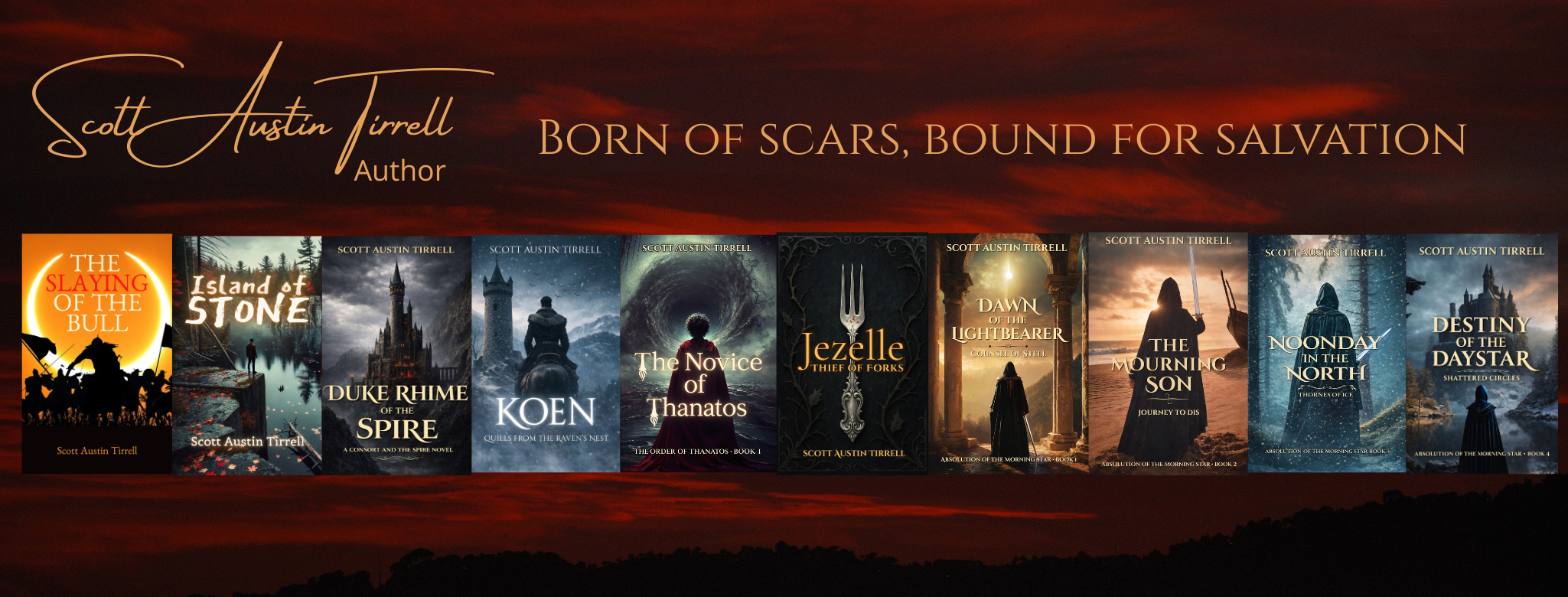

Noonday in the North, book three of my Absolution of the Morning Star series, is moving along nicely. Currently, I am at 44,890 words, so probably about a third of the way through the writing. Not bad for about two and a half months of work. The saga continues as Erik makes his way from the ruins of the underground city of Dis and ventures north to the Devilwood forests and the former princedom of his father. The mysterious Followers of Eosphorus have stepped from their shadows, Artemus, Moonsail, and Ishton make a new friend, and real magic reappears in the lands of Lucardia.
These past few weeks have been a bit slow, only writing about 500 words a day. Mostly this is because of my day job, the bane for most writers. It is a hectic time in the real world, and the 50-70 hour weeks tend to drain the creative juices. I’m also delving into some back story for the Jötunn, a mysterious race of giants in my world. I didn’t intend to travel down that road, but it’s the direction the muse took me. For those that have read book one, Dawn of the Lightbearer, the unfortunate Crenec is one of these giants. And for those that have delved into book two, The Mourning Son, we meet Po, who becomes a substantial character and friend to Erik.
I’m well aware that giants are a trope in fantasy. I may be relatively new to the genre, and naively don’t always know what’s been done, but this I know. But I have an excuse. Lucardia, my world, is a fantastical place, but it finds its roots in the history of the old testament. Now, if you’re not religious, let me tell you, giants play a substantial role in the Abrahamic religions. There are, of course, the Nephilim mentioned in Genesis, the result of Angels getting a little too familiar with the ladies. If you’ve read my books, the Nephilim are my antagonists- angel-human hybrids that wield some of their fathers’ power. But in both the Hebrew and Christian bibles there are also the Anakites, Emites, Amorites, and Rephaites. The Gog and Magog tribes, which appear in the Hebrew Bible and the Quran, were also of great size. If you read any of these religious works, you begin to sense that tribes of giants surrounded the Jews and were very much a bane to their existence.
But giants are not just creatures of Abrahamic religions. There is something more substantial going on here that seems to have a home way back to the Proto-Indo-European migration sometime around 5,000 BCE. During the Copper age, linguistic evidence suggests a splitting of human civilization in the forest-steppe zones of the Pontic-Caspian Steppe (somewhere around Kazakhstan, and yes, this is where my character Caspia and the faith he created gets its name). One branch of this migration went east to India, another south to Greece (then Anatolia and the Middle East), and a third west to Europe. Yes, this is a gross simplification of human migration over thousands of years, but for the sake of this post, it gets the job done. With these peoples, they brought stories of battles between gods and giants. In Greek mythology, this became the Titans (which would influence the entire Mediterranean), in Indian tradition, the Asuras who battled the Divas, and in Nordic culture, the Jötunn. Arguably, all three are the same mythical creature, and it brings me back to the Jötunn of my world.
As you can see, tying the Jötunn into the history of Lucardia is no easy task, heck there is 7,000+ years of it, but as giants play such a substantial role in my world’s mythology, they deserve a bit of time in the light. In Lucardia, they are a dying race with ties to the Nephilim. Historically, giants are often at odds with the gods, so having them defeated seems right. As punishment for this ancient transgression, the once-proud symbols of strength are now beasts of burden under the yoke of the humans. There’s more to this tale, but I don’t want to spoil anything here. Noonday in the North will be coming along shortly. Dawn of the Lightbearer and The Mourning Son are available now on Amazon. Check them out. You won’t be disappointed!
Some have asked me where I get my ideas. It is a question I think many authors hear. For me, it’s looking into the past for inspiration. Five thousand years of written history (and thousands more unwritten) offer a wealth of ideas. When I started writing Dawn of the Lightbearer, did I know I would be researching Nordic mythology and its links to a lost Proto-Indo-European civilization? Of course not. Did I think I would create a religion based off a Serphim trapped in a sword? Please. But that is part of the joy of writing fiction. If you let go and follow the muse, you never know where it will take you.
Cheers!
Discover more from Author Scott Austin Tirrell
Subscribe to get the latest posts sent to your email.

What a fascinating post! I’d say your historical snippets do far more than “get the job done”!
LikeLiked by 2 people
Thanks, so much! As they say, truth is stranger than fiction and history has a lot to teach this fiction writer 😉
LikeLiked by 1 person