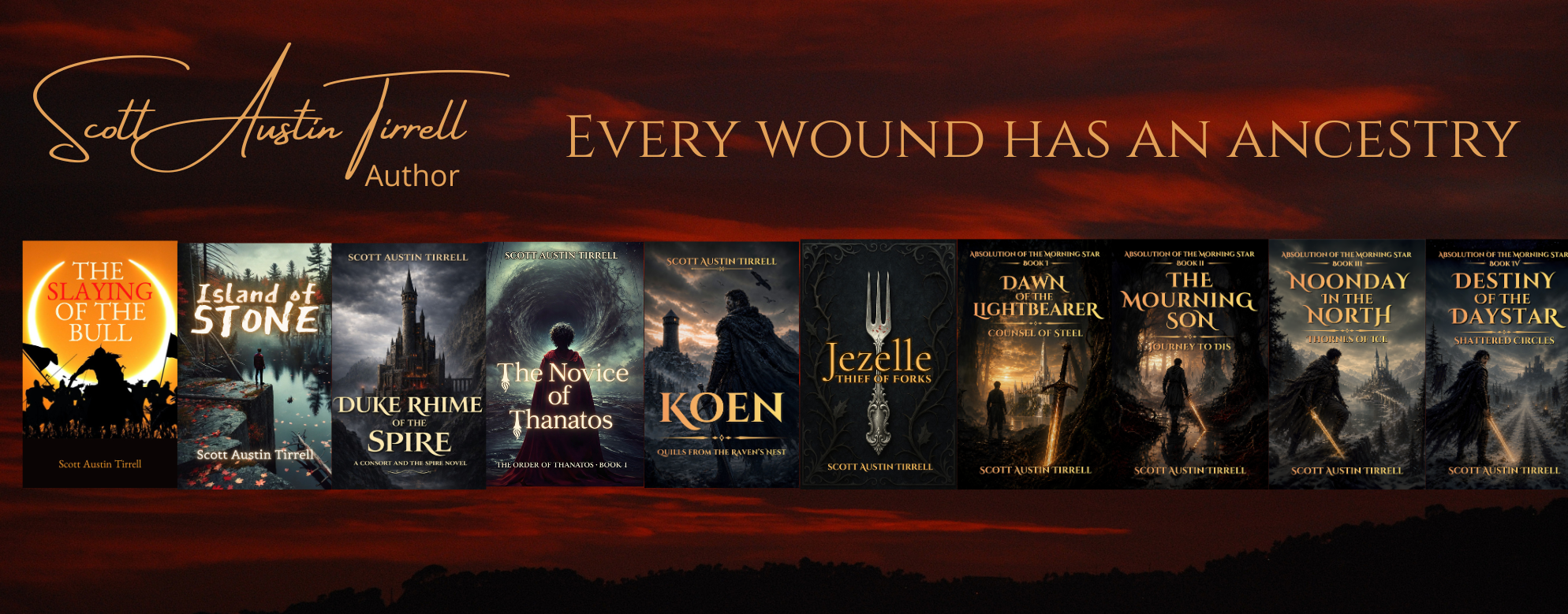

I like to think I’m a fighter, but sometimes, you must accept failure. I wouldn’t necessarily say any of my books are a “success,” but some are doing reasonably ok. They’re selling here and there, people seem to like them, and I’m seeing growth. That is all you can ask for as an Indie author, right? But one of my books, The Slaying of the Bull, never got off the ground. It is my lowest-selling novel; no matter what I do, I can’t get it to move. Thus, I’ve essentially given up on it, and its sequel lies dead in the water at one hundred well-researched pages. I don’t know all the reasons for its failure, but I know some, and I thought I would share those with you now.
The Slaying of the Bull is a historical fiction set in 1241 during the first Mongol invasion of eastern Europe. I know from experience that I’ve lost most of you already. This is the first reason for failure, not understanding the market. But bear with me. It follows the trials and tribulations of three main characters. There’s Brother Humbert, a monk in the Dominican Order (a real person), King Bela IV of Hungary (also a real person and a direct ancestor of mine), and a fictitious orphan named Isa as they face the terror of the Golden Horde under Batu Khan (real).
Even in academia, the Mongol invasion of Europe is not a well-researched topic, at least in the English language, which opens the door to quite a bit of artistic license. 1241 was long ago, and we know little from the period, especially on the eastern side of the European continent. What we do know is mainly fictitious in its own right- the product of the clergy’s fruitful imaginations and plain old church propaganda. That isn’t to say that The Slaying of the Bull didn’t take research. The story spun around my mind for 20 years, probably took me two solid years of actual writing, and the project, with all its research and re-writes, stretched over a decade from start to finish. I even traveled to Budapest to get a feel of the landscape and culture of Hungary.
The Slaying of the Bull was a work of passion. I found the Mongol expansion in the 13th century fascinating, but no more so than when this central-Asian culture clashed with western-civilization. As a forgotten piece of history, many don’t even realize how close Europe came to falling under the yoke of the great Khan. The Mongols defeated the largest standing European army (the Hungarians) at the Battle of Mohi, opening the door to the entire continent, but a stroke of luck saved the west from further slaughter, i.e., the death of Emperor Ogedei Khan in late 1241.
Although this death stunted the drive of the invasion, that isn’t to say that there weren’t plenty of horrors. Estimates are tough without reliable population figures, but as much as 40% of the Hungarian population died through slaughter, famine, or disease. The Mongols used every tactic and understood the power of psychological warfare. The blades slashed all if murdering an entire city would gain them an advantage. If they had enough food, then they burned crops. And if a castle prevented a strategic advantage, catapulting some diseased corpses over the walls was a viable solution. The Mongols of the Golden Horde make for a terrifying villain in their brutality, but because they were real, it only adds to the horror. I mean, their name alone sounds like an evil organization from a Bond film.
This group of competent and brutal warriors stood on the threshold of expanding the Mongol Empire to the Atlantic. Kievian Rus, Poland, Bohemia, Moravia, Silesia, and Hungary were all decimated, and Vienna was next. If attacked in full force, The Holy Roman Empire, which was embroiled in conflict with the Papacy, would have fallen, and Rome would be next. Nothing stood in the Mongol’s way. Then, they dissipated back into the Steppe.
I thought this tale would seduce readers with its truth, grand scale, and mysterious nature as much as the topic had enraptured me. My first book, Island of Stone, was doing pretty well, and I assumed The Slaying of the Bull would do better. I was wrong. I had tried to publish the book traditionally and was told there was just no market. I didn’t believe them and soldiered on via the Indie route. About a month after publication, it received a one-star review from a troll who felt it bordered too close to fantasy for her liking, which I would argue is not the case. Still, The Slaying of the Bull never recovered. It took a direct hit in the first moments of battle and sunk. It didn’t even have a chance.
Those I know who have read The Slaying of the Bull have loved it, and the dreaded one-star didn’t kill the book entirely- a few positive reviews trickling in after. More importantly for me, it currently has the distinction of being my wife’s favorite book. I know that seems like a biased opinion, until you meet my wife- if she didn’t like it, she would tell me. It made her believe that I may be on to something with this writing shtick (she hasn’t had the time to read the Absolution of the Morning Star series, which I hope will take the title, but we shall see).
Some friends and family have confided in me that The Slaying of the Bull was a hard book to start, but once they delved into my tale, they did not regret taking a chance on a historical fiction set in the 13th century. Yes, this may sound like a compliment, and in any other world, it would be, but it is not what an author wants to hear. We know that the barrier to entry is very high. Competition is huge. So, if someone is hesitant to start a book, in most cases, they ultimately won’t- or, in the more likely scenario, they will pass for something else. Ugh.
So, why did it fail? For starters, some love history, and others hate it. Right off the bat, that eats into readership. Historical fiction only makes up 3% of the fiction pie. It seems that the real will always lose out to the fantastical in fiction, which is why I’ve switched genres. Those who love history also spend much time reading non-fiction and expect the same strict adherence to the facts in their historical fiction. I am not saying The Slaying of the Bull is not full of facts, but the world of the 13th century had a lot of unknowns and mysteries, and my imagination capitalized on that, though it is not a historical fantasy. Poor market research, demanding audience, bad roll-out, and generally my inexperience with everything publishing doomed the book. It hurts to say that, but I must be truthful. There is no time to feel sorry for myself when plenty of new adventures are eager for the page.
Then, there is hope. All it takes is one success, and maybe, just maybe, The Slaying of the Bull will find its way to the limelight. When that happens, I already have one hundred more pages of the story ready to go, and a part of me can’t wait. In the meantime, I still have three and a half books in the Absolution of the Morning Star series to keep me busy.
Cheers!
Discover more from Author Scott Austin Tirrell
Subscribe to get the latest posts sent to your email.

As someone with a novel in the same boat (though published a few yrs ago my novel Skol hasn’t had 10 readers), I sympathize, and I was curious – so I went to Amazon and read some pages – I wonder if the fact that you have a reputation as a fantasy writer [hope that’s accurate] might have confused some readers. Maybe a bit more stress on this as real history might have helped? Maybe something on the first page to make it unmistakable?
Then there is the strange fact that not one novel title in 10 grabs the attention of book buyers. When my mother read my book The Birdcatcher, she said: “Why didn’t you call it something that would make people want to read it?” – “Easier said than done!” I replied – but I’ve since vowed that I won’t publish another book until I have such a title for it.
We indie authors do have an option that commercial people don’t. I once completely re-wrote The Birdcatcher – loved every minute of the revision too – cut 30 pages – but I didn’t think of changing the title, which may have been a mistake. If you change enough of the text, why not? I should add – sales didn’t change even though the 2nd version is a better book.
Your book has some good reviews an obviously a good story. I wouldn’t give up on it.
LikeLiked by 1 person
Thanks for your insightful comment and nudge not to give up on my baby. Your suggestion is a valid one and I will look into adding an author’s note or something. After it was clear that the Slaying of the Bull wasn’t the success I thought it would be, I completely rebranded and shifted towards fantasy. My current work is actually a result of the trials and tribulations of trying to write historical fiction. I loved every minute of researching and writing the Bull, but ultimately it directed me to my true calling. I can still include my love of the medieval period, but not have all the constraints of keeping in in the real. The relative failure of the Bulll was all a great learning experience, even when it hurt. The book is out there forever and maybe one day I will continue the story, but for now, I’ll milk it for some life lessons and move on.
LikeLike
Timely Scott, I am currently reading it. I am finding it interesting. It would be a great movie. Take care and keep on keeping on. Joyce
LikeLiked by 1 person
Thanks, Joyce. I hope you enjoy it!
LikeLike