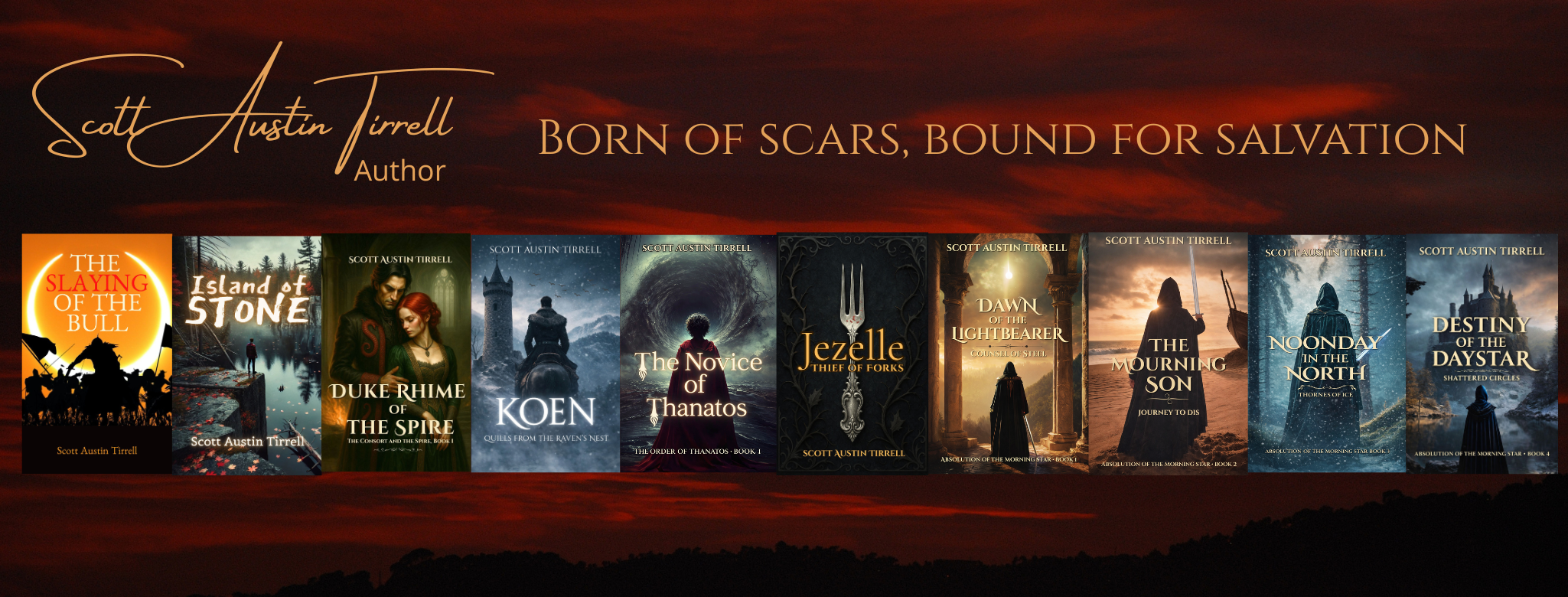

It’s heartbreaking to receive a bad review, but it’s even worse when you realize they’re right. Pride in my work makes this post hard to put down, but as artists, we must accept criticism and squeeze what we can from it to improve our work. In other words, rotten apples make the sweetest cider (sorry, I’m in the autumn mood). I won’t go so far as to say that I agree entirely with the criticism. I firmly believe that no book should get a single-star review unless it is incomprehensible. The effort I put into The Mourning Son is worth more than a lazy dichotomy rating, but sometimes those with the intention of hurting know precisely where to press because that is where we are weak. In that pain, there is truth.
Dawn of the Lightbearer, book 1 of my Absolution of the Morning Star series, flew swiftly onto the page largely as it appears now. I had just finished Slaying of the Bull, a historical fiction, and the step into fantasy was refreshing. I had no boundaries of historical accuracy, and my imagination went wild. The pace of its writing also kept up the action. I knew it would be a series, but I didn’t know exactly where it would go, so that left the gates open. As a writer, it was bliss to write. Book 2, The Mourning Son, though still a joy, was not as easy. Suddenly, the free flow of the Lightbearer needed some direction, and The Mourning Son ultimately took twice as long to write. It also grew dense, and the action slowed as a result.
I also pushed The Mourning Son out too quickly. The Lightbearer moved so smoothly that it made the “normal” writing pace of The Mourning Son seem like I was always behind. It created an unrealistic sense of urgency to get the sequel out, which was compounded by me stupidly setting a deadline through Amazon KDP’s pre-order function. A book needs to sit and either age or fester. I read through The Mourning Son about six times from beginning to end in succession during the editing process, each time losing a bit of my sight. I sometimes skipped over paragraphs or whole chapters, failing to note why I was doing so. If it were too rich for me, the author, for the reader, it would be mud.
So, what to do about it? Luckily, I am self-published. If The Mourning Son were allowed to enter the world via a traditional publishing house, I would be stuck with a book destined for the dollar store. But I have control, and I can adapt. As I just finished the first draft of Noonday in the North, book three in the series, I was at a perfect place to re-read The Mourning Son. I needed to do so anyway to ensure continuity between the books, but I also could see the story with a new eye. What does that mean? I cut thirty pages, or about 7,500 words, from the book. Whenever I felt the story start to sink into the mud, I just cut it out. As I now know where the story is going with a third complete book written, I realized that I had a lot of unnecessary detail and backstory. I also had a secret weapon, my wife. Strangely, she was also reading The Mourning Son at the same time as receiving the single-star rating. Going back to school to earn her MBA while working full-time has kept her busy, but she finally got around to reading the book, and her feedback was gold and timely. She has a fantastic eye, and I, of course, trust her judgment. She knew where I needed to focus, which came down to three key chapters.
Is the book saved? Who knows. I suppose we’ll let time tell. But is it better? Undoubtedly, yes. The pace is much improved. I’ve written many books, but I’ve never written a sequel before, so I can’t pretend I’m an expert. All I know is that I have an epic story to tell, and I can’t stop now. I’m sorry to those who read The Mourning Son and felt it was lacking. Know that it is better now, and I hopefully learned my lesson. Noonday in the North has sat for several weeks, and I am entering the editing phase with a clear vision. My wife will read the book before it’s published as well. It may delay its release some, but it will be better as a result. Know this- I will strive to keep the mud off my boots and rekindle the action of the Dawn of the Lightbearer.
Cheers!
Discover more from Author Scott Austin Tirrell
Subscribe to get the latest posts sent to your email.

Good luck!
LikeLiked by 1 person
Yes, it’s good to take the positives from a review if you can, but when you get a bad one, ask yourself what the reviewer has ever written. No matter how bad a book may be it’s the result of someone dreaming and working hard and deserves a certain amount of respect.
LikeLiked by 1 person