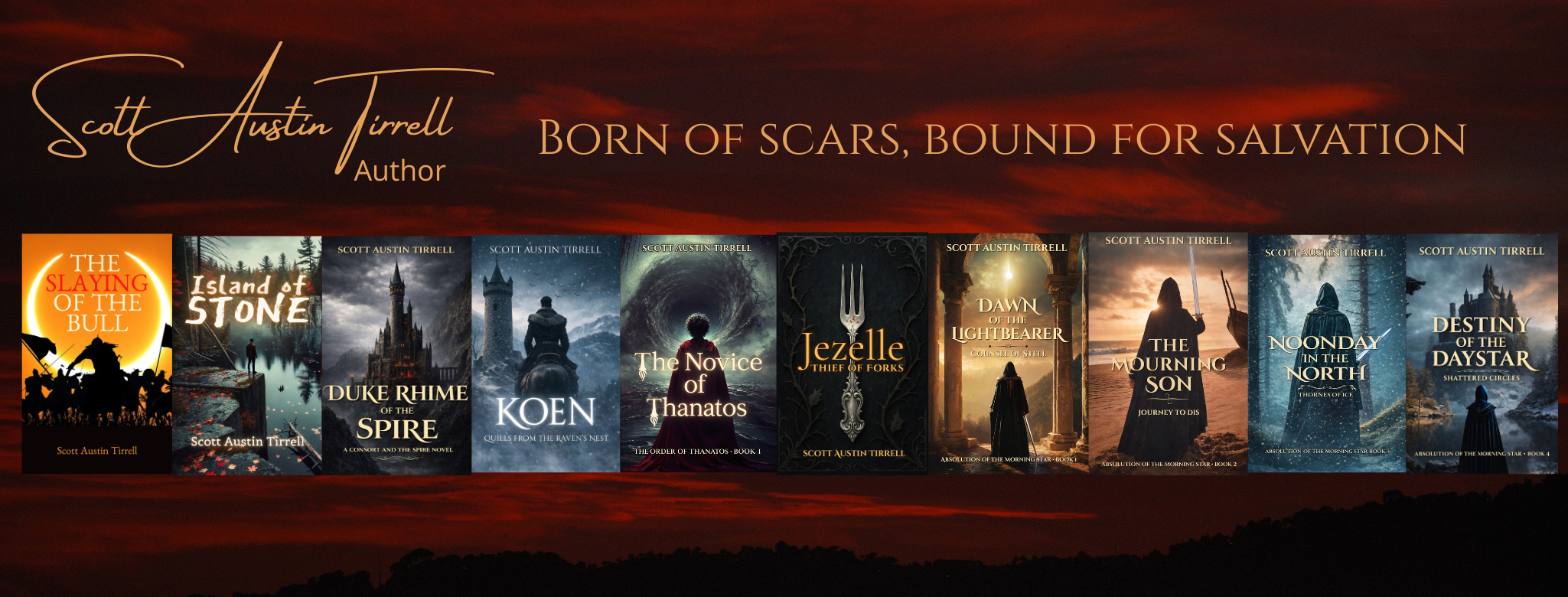
Noonday in the North, book three of the Absolution of the Morning Star series, is out and doing well. I’ve jumped into working on Koen, a book still in the Absolution of the Morning Star’s world but a stand-alone prequel. I finally surpassed the 10k mark a few days ago. It usually takes some time for a story to get going, but I pushed through that haze last night and have the next few chapters already in mind.
Koen takes place twenty-eight years before Dawn of the Lightbearer during the three-year disappearance of Koen the Gray, Prince of the Northlands, and Erikson Gray’s father. What bogged me down was a witch, but not just any witch, a crone of the Nyth Cigfran.
What is the Nyth Cigfran? It means Raven Nest in old Lucardian. The Nyth Cigfran caused all sorts of trouble in the pre-history of Lucardia. At war with the mages of the Earth Dwellers, the Nyth Cigfran schemed a terrible plot to produce a magical weapon more potent than the world had ever seen. Using womanly wiles, a great witch named Naamah enticed the Seraphim from heaven and created a race of hybrids- the Nephilim. Eventually, the Nephilim, being immortal, outlived their Nyth Cigfran mothers. They became aware of their power and took their place as gods among the humans. That was until the humans rediscovered the truth of the Nephilim’s past and decided to rebel, thus leading to the great mage Caspia’s own machinations with heavenly beings, the Great Beholding, and the basis of the Absolution of the Morning Star series. If you want to read more about that, I have completed three of the six-book series, and their chock-full of lovely lore to nosh!
But back to the witch. The Nyth Cigfran are legends in Lucardia but are thought to have fizzled out thousands of years ago during a failed endeavor to bring forth the Morrigan- the all-powerful phantom queen. But a witch is hard to get rid of, as evidenced by actual history, and the Nyth Cigfran live still, lurking in the shadows plotting their reascendance. They play a significant role in the Absolution of the Morning Star series, and I hope Koen will provide an avenue to some of their backstory. Koen the Gray quests for these long-lost witches and finds one in a temple in an unknown ruined city, deep in the Wastelands of Lucardia. She is named Raenmaeld the Salter and needs to be a nasty old crone.
I know. Witches have been done to death in fantasy, and I’m trying to do something a little different while still adhering to the wonderful qualities of a dark sorceress. No easy task. Thus, I sat and pondered, trying to visualize this lady. Was she old or young, ugly or beautiful, thin or fat, evil or good? There are all sorts of witches, and Lucardia has its fair share, but I wanted to create one here that was complex and impactful to give the readers of this novel something to fear. Even I don’t know for sure whether the Nyth Cigfran are good or evil. I do know that they are among the many players that make Lucardia a turbulent place. On the surface, Raenmaeld drifts toward evil, leading Koen to question whether he should follow her pointed path, but there is a hint of a mother’s scolding hand- firm but nonetheless caring for Koen’s greater betterment. It is clear that Raenmaeld can see the future, but how far can she see, and to what end? I had a lot of questions, and thus my characters milled about the threshold of her chamber and waited.
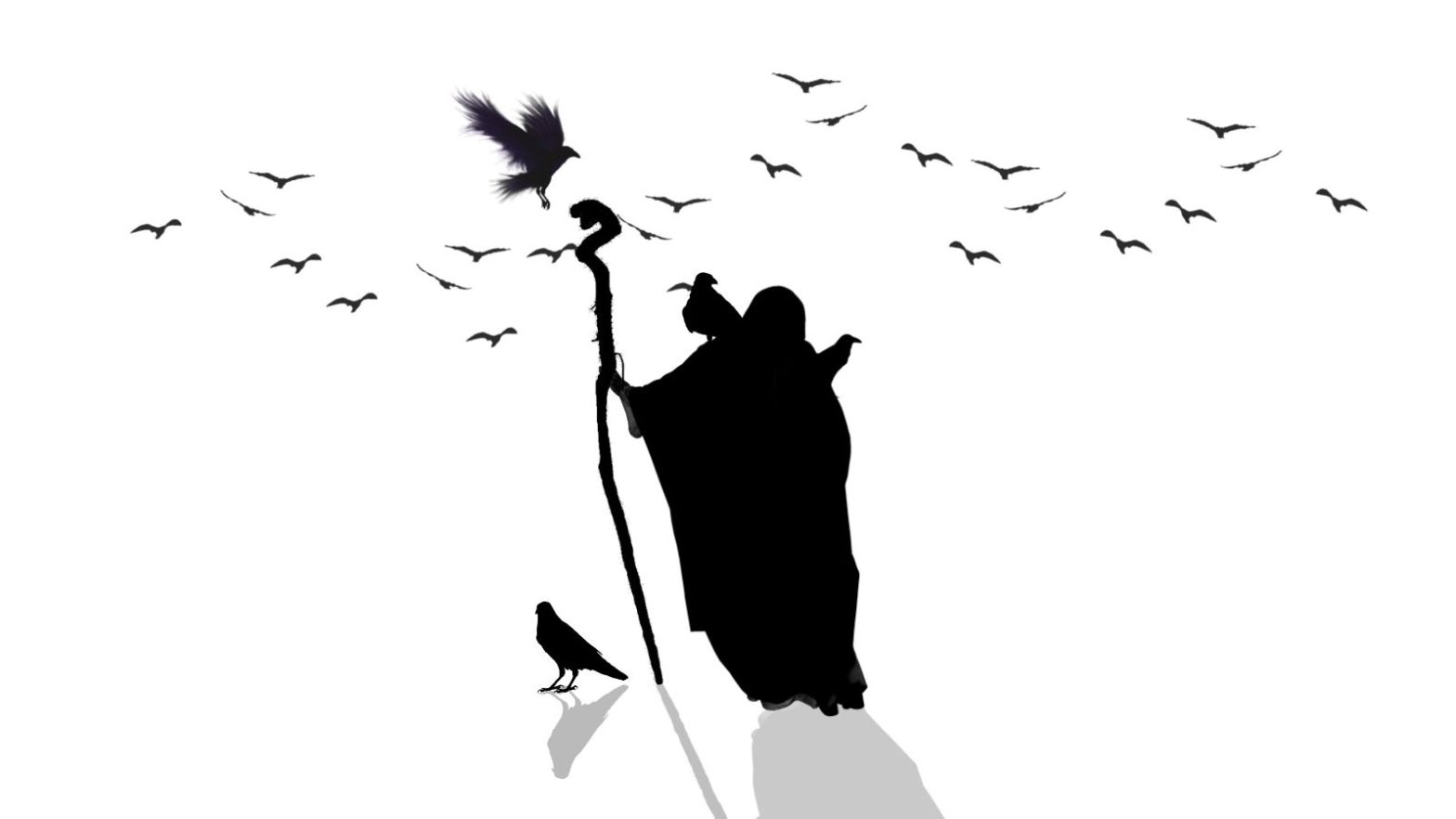
As I wrote and deleted, wrote and deleted, the ah-ha moment finally hit me. Of course, the Nyth Cigfran means Raven Nest- Ravens! The temple suddenly transformed from a tower to a giant dovecote with ravens as its tenants rather than doves. At the center of a circling storm of back birds sits old Raenmaeld the Salter, listening to the whispered gossip of the carrion birds and receiving their trinket gifts, which she uses to read the future. Black feathers fall around her like ash, and her clothes are streaked white by the bird’s quick digestion. She is the queen of these harbingers of death, and if you’ve read any of the Absolution of the Morning Star series, you know that ravens and crows are never far from sight in Lucardia.
I’ll leave it at that, as I don’t want to get ahead of myself (or give too much away). Needless to say, the character Raenmaeld the Salter joins my world and shall add another spice to the pot! Though, I am only on chapter four of what will probably be a thirty-chapter book. The Nyth Cigfran have a long way to crawl from the shadows of my mind in both this book and the rest of the Absolution of the Morning Star series. I can’t wait, and I hope you can’t either.
Cheers!
Discover more from Author Scott Austin Tirrell
Subscribe to get the latest posts sent to your email.

The word ‘witch’ derives from ‘wicce’ – old German (Saxon) for ‘one who knows’. The knowledge in question was that of the powers that animate the world, and of how to bring them to do one’s bidding. It included the powers resting in living things (such as plant and animal lore), as well as those of ‘spirits’. A witch was neither ‘dark’ nor ‘light’, except in what they did with their knowledge: whether their goal was to increase discord or harmony. What brought fear of witches was the thought that they could bypass any mundane defence by using the more eldritch of the powers, that can even walk into a victim’s dreams. Even a ‘good’ witch could turn their power against a man they decided was evil. This latter served to unite men (good and bad) against all who could flout mundane ‘power’ [power of arms] and who served no authority but their own. In the end, witchcraft couldn’t be wiped out, but the knowledge could be lost and corrupted. It was thought that wizardry was somehow different to witchcraft – one more ‘male’ and the other more ‘female’, one ‘pure’ and the other touched by pagan religion – but they were the same. The word ‘wizard’ merely means ‘wise in the Art’. Merlin and Morgana used the same Art, but Merlin submitted himself to mundane power, whilst Morgana sought freedom from it, and even to subdue it. Neither was especially pagan. Or so the legends go.
LikeLiked by 1 person
Thanks for these juicy gems!
LikeLiked by 1 person