I only experience writer’s block when trying to think of ideas for these blogs. So why not talk about that and kill two birds with one stone? Let’s do this!
I’ve mentioned writer’s block before. If you blog about writing, it is hard not to talk about the demon we all fear. Namely, I’ve shared that the best remedy for me is to keep writing even if it all ends in the bin. Not all ideas need to be good, and sometimes you have to weed wack through all the bad ones before you find the gem. Will this blog be a dandelion or a diamond? Who cares? I’m keeping that demon at bay as long as I’m writing.
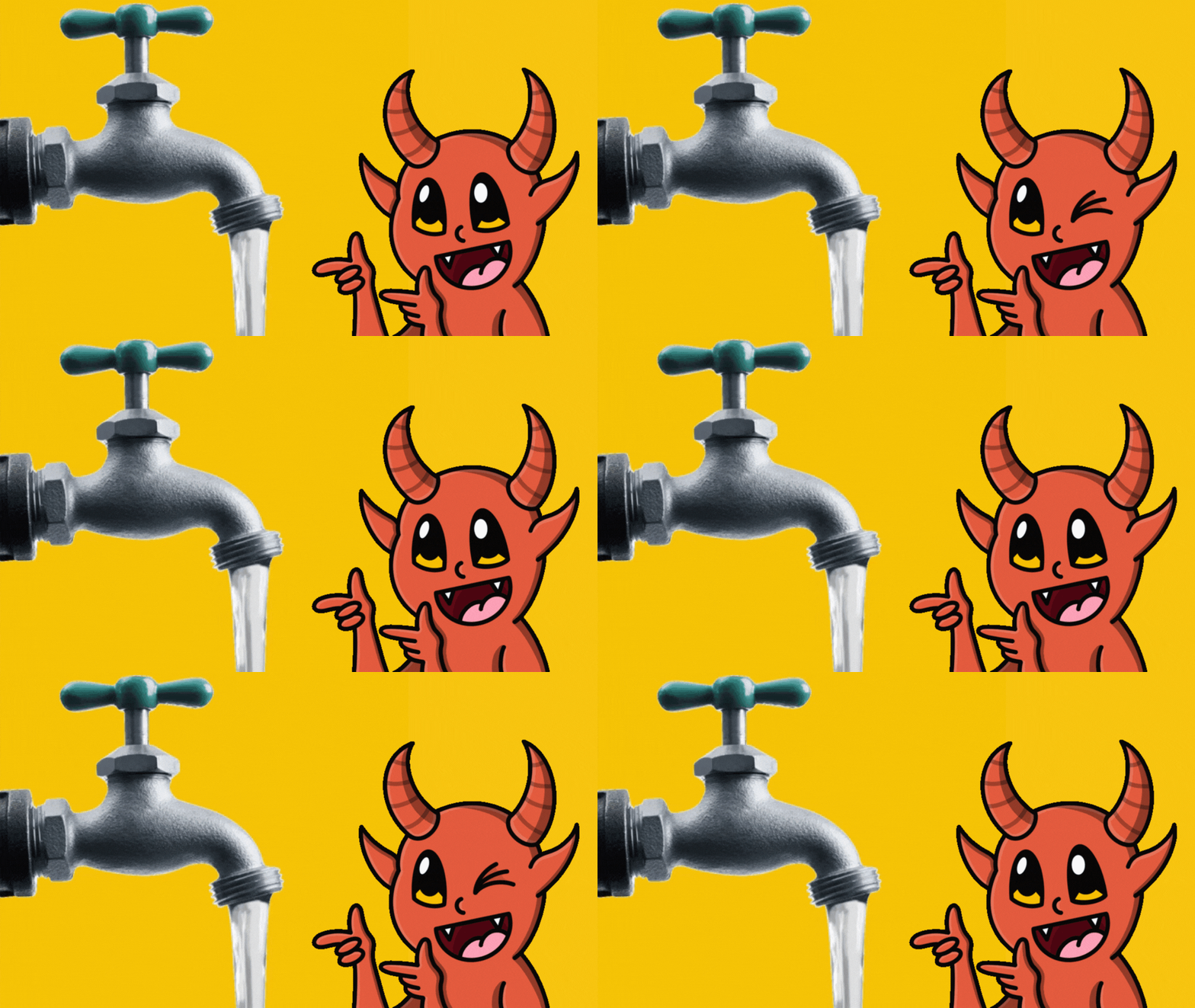
For the most part, I have avoided the doldrums of the block. I tend to have the opposite problem when working on my books. In other words, the faucet won’t shut off. I stop writing every night at 7:50 pm whether or not I am ready to stop. If the spigot is flowing, it makes it challenging to resist gulping, but it is actually for the best. Hemingway coined the phrase, “Only stop when you are going good,” and it’s a great piece of advice. Stopping before you’ve completed your idea is a good way to keep the writing momentum. It ensures that you have a place to start next time and guarantees space to stress test that idea to see if it’s any good.
From personal experience, this method seems to work. Often the most challenging part of writing is getting started. Writing is work, no matter how much we enjoy it. Did you know that, on average, your brain consumes 400-500 calories a day? Those that use their minds rather than relax can burn 200 more calories daily just by thinking. That might not seem like much until you realize that running a mile only burns 80-140 calories. So writing is work, and our bodies are geared towards calorie conservation, not expenditure. This means that our minds tend to search for easy paths. But after those first few moments of looking for anything else that could take away our attention, we fall into the zone, and before we know it, we have 1,000 words (my daily goal). Though, I will say this method is not the best for sleeping. Nothing gets that brain percolating more than turning off the light with an unfinished idea waiting for the page. But sometimes, we must sacrifice our current self for our future self. Sitting down the next day with a starting point is refreshing; perhaps laying awake without distractions is just what I need to prevent a clog while burning away that dessert.
What I tend to do is stop writing mid-flow. I then do the dishes before heading into the shower. These two brainless activities tend to increase the flow, but that’s good. I then rush from the shower, sometimes still wet, and jot down all that materialized as a reminder for the next day. Stephen King says that if you have to write it down, it is not an idea worth remembering, but I’d rather have the assurance that it’s captured in its fundamental state so I can hit the ground running with the little time I can devote to writing. It would be different if I could sacrifice an entire day to the craft like he can. I then try not to actively think about these ideas until the next day when I take my nightly walk with my wife. By the time I sit down to write, it gushes, and I’ve made my daily goal in the two hours I’ve got for this hobby.
But back to these blogs. They are a different kind of beast. When I started writing them on April 3, 2020, I aimed to write one daily- the classic novice mistake. It was COVID, and there was much new free time, so it seemed possible. That lasted exactly a month and a half. Now, if I write a couple each month, I’m happy. Generally, once I publish one, I start thinking of ideas for the next, and it takes a whole week or more for something to float to the surface. Yes, my drivel takes a week of fruitless effort to think up an idea. A Google search or using AI can give you all sorts of ideas, but if they pop up in a search, they’ve already been done to death. Do you really want to hear my take on creating memorable characters, the art of world-building, or mastering dialogue (those or ChatGPT’s first three suggestions)? Probably a million authors, more successful and talented than me, have already spewed out their wisdom for you to nash. Read them, not me.
I love you all, and I am humbled you take the time to read anything I have to say. I promise you, I will keep writing if you’ll keep reading. I slave over every word but also know that writing blogs is not my cup of tea. Sometimes, I feel like I’ve made a triumph when I press publish, but most of the time, I am just relieved that I can now focus on my long-form writing. If anything, this journey has taught me I’m a marathoner rather than a sprinter. I’ve never been able to concentrate my prose enough to write a true short story. Whenever I’ve tried, it blossoms, and a novel begins to form, sometimes an entire series. I know the traditional route for fiction writers is to start with short stories and publish them in magazines. They then transition to a themed collection before finally moving to the novel. It is a way to build credibility and an audience. But when I decided to try my hand at creative writing twenty years ago, it was instantly a novel. These blogs are a happy medium and a good exercise for condensing my thoughts and prose. Hence, the reason I am still here.
Well, I’ve made it. I started this short journey with a blank screen and a blanker mind. In an hour, I materialized above. Is it any good? That’s ultimately up to you. Personally, I feel it’s passable. It’s certainly better than nothing, and if you want to fight that dreaded demon, nothing douses their fire more than a spewing faucet.
Cheers!
Discover more from Author Scott Austin Tirrell
Subscribe to get the latest posts sent to your email.

I am still reading
Joyce
Sent from my iPhone
LikeLiked by 2 people
Thanks, Joyce. I apreciate your support! I hope you are well.
LikeLike
Is it any good? It was Scott – it’s always interesting to see how other writer’s operate, but there must be 20 or more of your ideas I’d like to discuss. I’ll just comment on one.
Nice to see your scepticism of Stephen King – as talented as King is, he was spoiled by producing a bestseller with his first book. He’s an unreliable adviser to most of us since he can write something incomprehensible and get it published [The Gunslinger for example]. And as for “if you have to write it down, it’s not worth…..” – well……..I’ve forgotten many good ideas, and only remembered a few years later because I wrote them down.
LikeLiked by 1 person
Thanks, Alan! Please don’t feel limited on the ideas you’d like to discuss, I’d be happy to chat about all of them, so feel free to fire away or email me at https://scottatirrell.com/contact/. I agree with you on King. I also won’t say he doesn’t have talent, but unfortunately, a generation of authors appeared at the right place at the right time and have dominated the market for almost fifty years. He is the “King” of that group. King wrote whole books he can’t remember writing, so I am skeptical of his advice on the notes too. I write everything down even if I never look at it again. The process of writing helps solidify the idea in my mind and helps me move on to other thoughts. I do a lot of my thinking through writing. It is probably why I am a writer 😉
LikeLike
I like your idea of stopping when the writing is going well, which ensures you’re eager to start next time. I didn’t take the short story route either; the few I’ve written were spinoffs from my novels or written as exercises. I sometimes struggle to think up blog topics, but I manage to produce something once a week. I think of blogging as a form of writing to deadline, even though I set the deadline and no one really cares if I don’t meet it.
As for ideas, the best ones are those lost forever because you didn’t write them down!
LikeLiked by 1 person
Thanks for your comment! You’re more disciplined than me. When I set my own deadlines, I have a remarkable ability to talk myself into missing them 🙂 Though, I am getting better and trying to get one out a week.
LikeLiked by 1 person
I’ve been posting once a week for so long that skipping a week feels like quitting. 🙂
LikeLiked by 1 person
I have one thought about writing down good ideas. Marcus Aurelius wrote down his ideas and they were pretty good.
LikeLiked by 1 person
I guess the concensus is that King is wrong and authors need their notes 🙂
LikeLiked by 1 person
Yes. When in doubt, take notes. When certain, verify with notes.
LikeLike
Who knew of the brain using 200 calories? Maybe that’s why you never saw a fat philosopher? 😉
I write down my ideas for my other blog and books (Ceeteejackson.com) and find it hard to sleep if I think of getting up early the next morning to do some writing. I know I should just get up and do it, but … 😀
LikeLiked by 1 person
I guess our bodies exist basically to get nourishment for our brains. I guess if you’re writing well, it is ok to slip in a snack 🙂
LikeLike
Blogging is definitely a completely different skill set than writing a book. I’m a blogger through and through, and a reader. I’ve had a lot of people ask me if I was going to become an author. I just laugh. It is like comparing a SEAL to a police officer because they both carry guns. Once you know the specific purposes of each job, then you realize how silly the comparison is. But I’ve given up trying to educate the masses on the difference between a blogger and an author. Which is why I just laugh now 🙂
LikeLiked by 1 person
Thanks for your comment! A few years back, I did a blog series on my experience living in China. People seemed to like it, and many said I should turn it into a book without realizing how different the two mediums are. It would have been a lot of work. Not only would I need much more material (I was already digging deep into memories almost 20 years old), but what I had already written was not geared to that venue. I basically would need to start from scratch, only being able to use the blogs as a rough outline. I agree blogs and novels are two different beasts.
LikeLiked by 1 person
Hi Scott
Most of my life I was a professional writer (books & filmscripts). A professional writer’s day is quite different. I started at ten in the morning first contacting my editor and then my agent. Afterwards an interview or a talk to a befriended author or publisher and by noon I started writing to five as a daily routine. Then reading an hour or talking to my PR lady and the next day the same routine. When it’s the time to write you just write and when it’s five I just finished. It doesn’t matter how I felt.
Wishing you a happy weekend
The Fab Four of Cley
🙂 🙂 🙂 🙂
LikeLiked by 1 person
Thanks for this insight!
LikeLiked by 1 person
Write on, Scott!!
LikeLiked by 1 person
Re writing things down – I once woke up at 3am with the realization that I had ‘the answer to everything’ – when I woke up in the morning I’d completely forgotten it.
I’m intrigued by this idea of stopping the writing in midstride – I’ve always tried to reach an end of a chapt, or an idea, or at least a paragraph completed. But I can see how this would fuel you to come back, and maybe let you hit the ground running. I’m going to try it.
LikeLiked by 1 person
Yes, those times are the worse. Sometimes they find their way back into the mind, but most of the time we must lament the loss of the next best seller. I used to keep a notepad and flashlight by my bed. After waking the wife a couple times, that had to stop. I now do my best to get my thoughts down before lights out and try my very best not to think about my books until daybreak. Both the bane and the blessing of a writer is the flow of the facet 😉
LikeLiked by 1 person
Enjoyed! And happy weed whacking! Now back to my writing! 😁
LikeLiked by 1 person