Who is my audience? I’m ashamed to say I haven’t had the time to dwell on this question a whole lot. So let’s get into those weeds now, shall we?
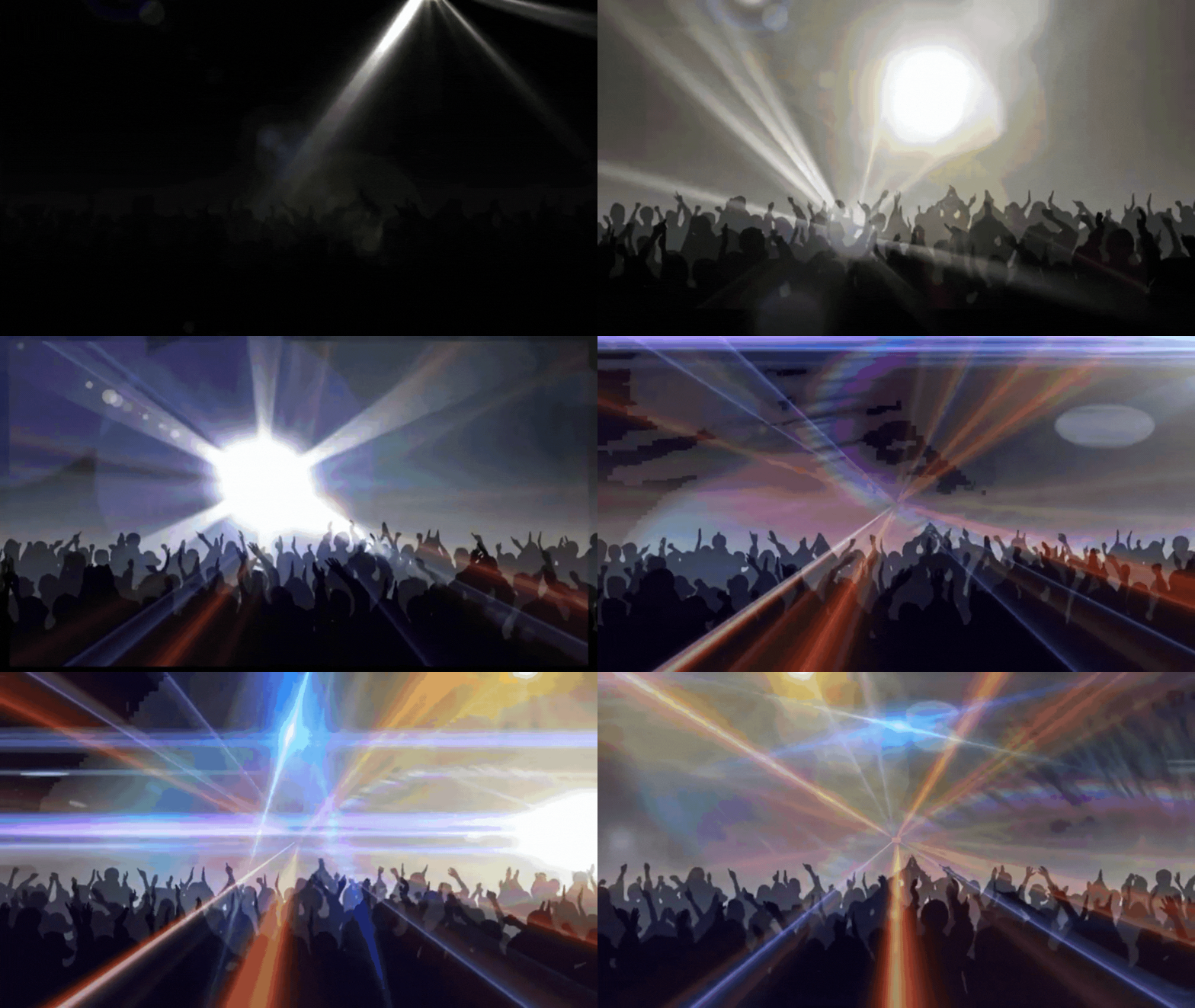
Pondering this question, I discovered I don’t “really” know who I’m writing for. My audience is silhouettes washed out by the bright lights of the stage. I’m on the platform doing what I do, not thinking about the thoughts, feelings, and aspirations of the small crowd watching me. Most importantly, I don’t know if they are leaving my show satisfied (or even making it through the entire show). I can be having the performance of my life or completely bombing. Who knows? Right now, I’m just having fun bee-bop and scatting along in my fantastical world. But If I want to succeed in this craft, I need to ask for house lights to be turned up and pay attention to the faces in the room.
Yes, it’s true. I’m not writing for an audience. I write what I want to read. It seems selfish, I know, but with all the things competing for my attention, I’ve needed to write what brings me joy. But it’s not getting me sales. At least, not yet. So either I need to pick an audience and completely change my style to tailor it to their desires, or I need to find the group that digs my world and do everything I can to get their eyes on my show. That sounds more appealing to me. Changing my style to make bank feels a bit soul-crushing to me.
But first, I need to start by identifying what it is I am writing. No, I don’t mean the genre. That is just the box, not what I am placing in the box. What is it that I put in every book I write? I’ve written in thriller, mystery, horror, adventure, sci-fi, historical fiction, fantasy, etc. What is it that I pack in every time?
Well, for one, I am not an “action” writer. Yes, yes, yes- there are many types of action, but I mean action movie type of action here. Some put out books jam-packed with a roller-coaster of heart-thumping suspense. I’m not one of them. I find writing action tedious, and I struggle with it. Don’t get me wrong, my books have plenty of action, but please know those parts are the hardest for me to write. There are only so many ways to describe a sword fight (historically accurate sword fights were over in seconds, not minutes) or a chase- they run, slip, run, fall, etc. You can shift the details around and play with angles. You can choose different verbs and adjectives and mess with the stakes, but ultimately, you are describing something that authors have expressed since the beginning of time. I always feel like I’m repeating myself or copying someone else’s work, even if it’s subconscious. But I know readers like action. Novels are supposed to be entertaining, and few want to spend 500 pages engrossed in cerebral dialogue, dwell on every detail of a piece of architecture, or hear a thousand years of history.
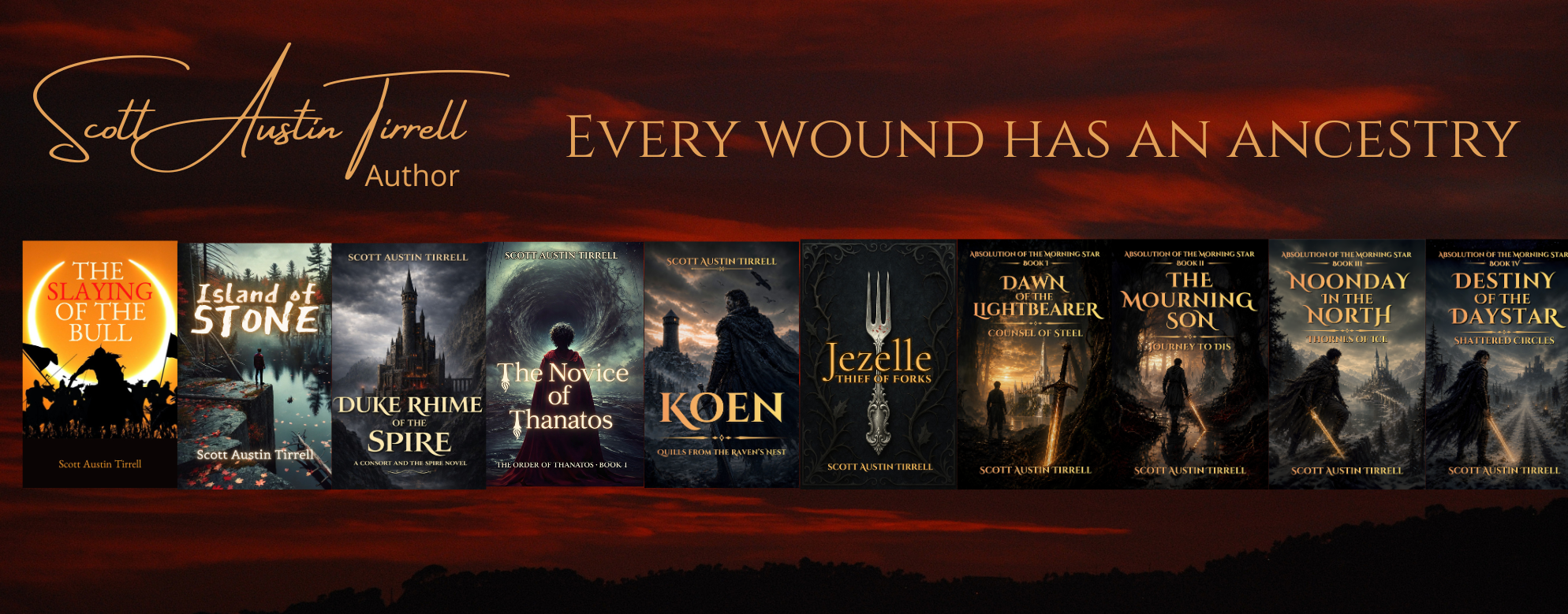
I guess I’m saying I tend to tilt toward the crowd who loves to be immersed in a world rather than the adrenaline-seeking action group. One of my reviews of Dawn of the Lightbearer captured it wonderfully: “Focusing more on stories within the world of Lucardia, rather than the usual sword action (though there is some of that too!), this is a different take on the fantasy epic.” I gravitate towards the group that wants to escape into a world. Yes, the world-building group is loyal as they can read a story repeatedly even if they know everything that will happen because they love the world. But if you want to make a coin, you need the action-craving crowd, too, who get their thrill and move on to the next book. The best place to be is an author that finds the right balance between the two. I’ve managed this better in some books than others. As I write, I always tell myself, “Don’t forget the action, Scott.” I think I managed a delicate balance in Koen, but only time will tell.
I also love witty conversation. When I write an action scene, a paragraph takes the whole night, but when I write dialogue, give me a couple of hours, and I will have a thousand words and wonder where the time went. There is poetry in conversation. Often, it dances with ebbs and flows. It is where the characters take on their own life and become just an observer. That feeling is the reason I write. I’m also a shy, soft-spoken guy who tends to get his words jumbled in real life. In writing, I can be articulate and always say the right things at the right moment. It’s the closest I’ll ever get to being that cool cat that always knows what to say.
Then there are ancient mysteries. They enthrall me. I love known history, but I adore lost history. When I stumble upon ruins in my travels, I can’t help pondering how the structure got to that point. Who were the people that lived there? Why did they build it? And where did they go? Monolithic structures, statues of unknown gods, and strange, unreadable texts all push my buttons. The known history of Lucardia stretches a thousand years, beginning with Sathanas the Wrathful, the first uniter of Lucardia. But a thousand years is a very long time. Think of what the world was like in 1023. Over the millennium, details get lost, whole civilizations spark to life, thrive, and then vanish. The mystery of that is just neat.
A good conspiracy, political intrigue, and struggles over power are the heart of our civilization. Dune is one of my favorite books, mainly because of the first half and the plots against House Atreides. So much of history is the machinations of people trying to amass what they don’t have, gain more of what they do have, or keep what they have from going away. When I wrote Dawn of the Lightbearer, it started as a boy finding a sword. I muted much of the politics until we discover who this boy is. Suddenly, a whole world of delicate balances of power appears, and we go from a simple story to something epic. Lucardia is a newly united realm. What is at stake? Everything. We call the 900 years of economic, intellectual, and cultural decline after the Roman Empire fell the Dark Ages. We know now that it wasn’t all that bad, but it still left a substantial impact.
You can’t have a fantastical world without religion. I am not remarkably faithful, but I love religions, and they’re closely related to politics, especially in the medieval period. I hint at the Caspian faith in Dawn of the Lightbearer, but Lucardia’s major religion truly comes to light in The Mourning Son. It is my interpretation of Iron Age Judaism, soon after the appearance of the single god, Yahweh. But worshipping a single god is new to Lucardia. Polytheism is a distinct memory, and many old ways remain. Yahweh has striped his divine family of power, but they relinquish their hold reluctantly. Like any ruler whose power is threatened, Yahweh is a ruthless and spiteful god. The empire that worships him mirrors this insecurity.
But religion is not all about the good, and the darker sides of life intrigue me. I’ve written about this before, and it’s no secret I’m attracted to the macabre like a moth to flame. The supernatural, paranormal, and occult are where I thrive. My worlds are filled with all the things that go bump in the night. I throw a bit of horror in there, too, but I’ll take a ghost story over a slasher film any day. The dead play a big part in my books and will soon play an even more significant role in the Absolution of the Morning Star series. The dead are lingering in Lucardia, and no one knows why, but by the end of the series, you will know the reason.
I grew up in nature and would rather hike in the woods than do anything else, including writing. Making a living requires living in the city, which I’ve come to terms with, but escaping to a babbling brook with the wind blowing through the trees via writing has become integral to my mental health. Thus, long journies through varied landscapes find a home in all my books. Not much happens to a character if they just sit at home. They have to get out into the world and step into places unknown to truly come to life.
Lastly, I like to test my characters. Only by stripping away everything and leaving them naked and alone in a wild and mysterious world of creepy crawlies and bad actors do you see the strength of the human will to overcome. Some live long and uneventful lives. That’s fine, but something tells me you wouldn’t want to read about those people.
So, those are the components that find a home in all my books. In my next post, I hope to discuss strategies I’ve embarked on to find an audience interested in this mix of things. I don’t know if they’ll work. If my past endeavors are any proof, probably not, but it’s worth a try. I’ve honed into what my show has no offer. Now, it’s time to market it to those who want to see it. Wish me luck!
Cheers!
Discover more from Author Scott Austin Tirrell
Subscribe to get the latest posts sent to your email.

I’ve always been suspicious of the advice to know who one’s readers are. The only way that can happen is if those readers communicate with the author, either directly or through reviews or social media. Those people are likely to be only a sample of all those who buy your books.
Ultimately, we may end up writing for those few people who actually reach out to us and tell us they love our books. Otherwise, they are only (as you put it so well) silhouettes washed out by the bright lights.
LikeLiked by 1 person
I am trying to pick one person in your life and write to them. There is some consensus that it’s a good method. We’ll see if that works.
LikeLiked by 1 person
Worth a try!
LikeLike
A creator writes from the heart but is guided by well-researched demographic study. Good luck.
LikeLiked by 1 person
Hopefully, my psychology degree will come in handy here 😉
LikeLiked by 1 person
Unfortunately, there is a common misconception among some people that art should cater solely to the masses (Art for the Folks). However, I believe this is incorrect as art is meant for art’s sake; it is a tool that empowers us to create. I appreciate your writing skills and look forward to reading your books once my current situation settles down. Wishing you a wonderful week ahead.
LikeLiked by 1 person
Thanks for the comment! I wouldn’t go so far as to say it is a misconception, just a difference of opinion. I am just as wary of creating art for art’s sake, especially when the medium is telling stories. The audience doesn’t have to be large, but there does need to be an audience, as stories should be heard. Expressing yourself to the ether has a place, but it is not something I am interested in. I’ve cried out into the void plenty, but I’ve never felt any sort of satisfaction in that. I’ve read that it is best to choose one person in your life and write to that person instead of trying to write to the crowd. I’m trying that. My wife has the most on-point criticism I’ve faced, so I’ve been trying to write to her. We’ll see how she likes my current WIP to see how it works.
LikeLiked by 1 person
You are lucky, Sir, I would say. 😉🤙
LikeLiked by 1 person