
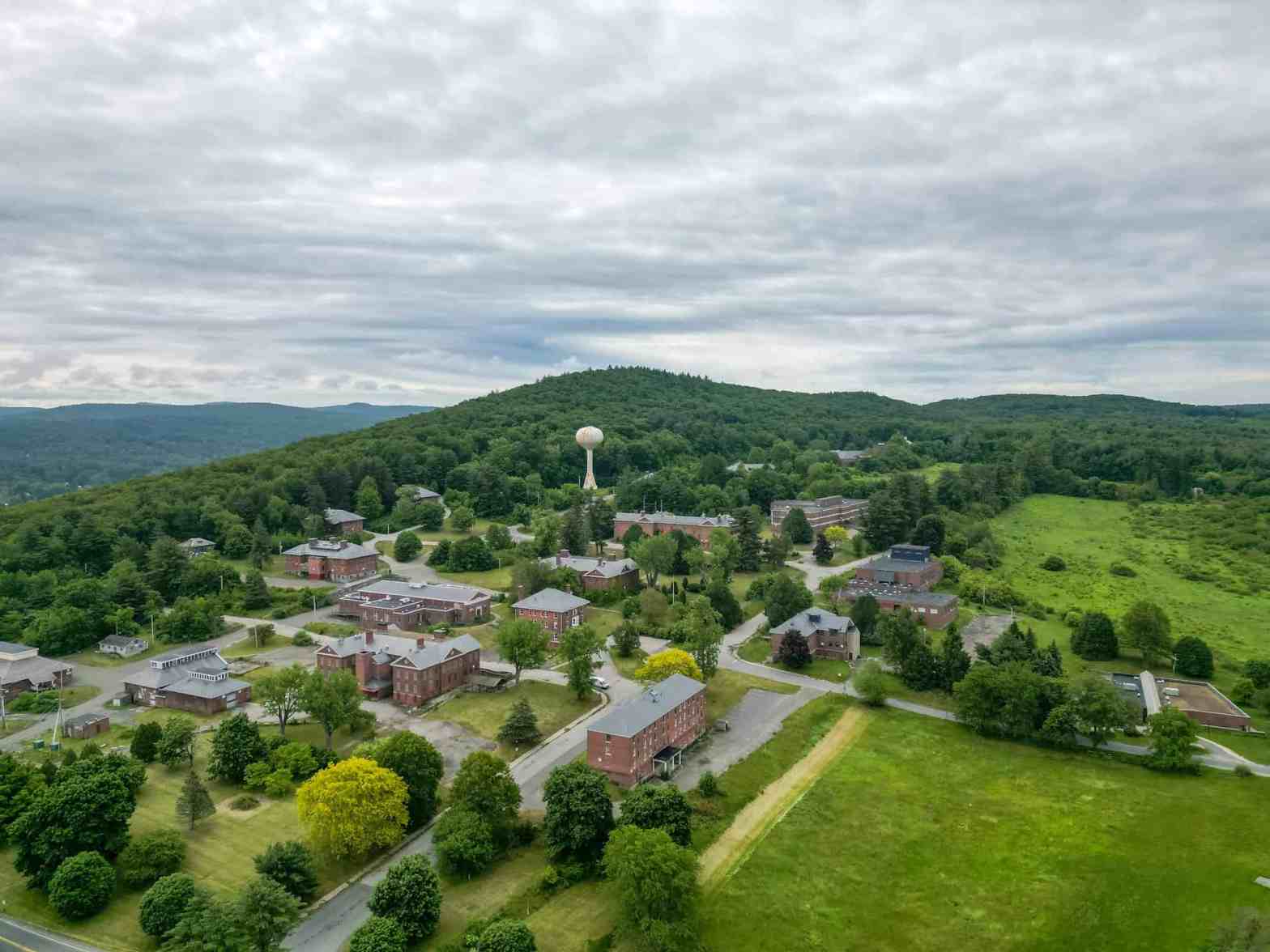
The other night, I woke from a nightmare, my sheets wet with sweat. I was lost within a derelict campus, chased by moaning spirits. All around were tall brick buildings with dark, windowless eyes, watching me with malintent. It was a frightening ordeal, to say the least, but what made it worse was I knew this place. It was real.
Growing up, I lived about a mile from Monson Developmental Center (MDC), a 649-acre state hospital. It is now defunct, closing in 2012, but it was still active my entire childhood, teenage years, and into my young adulthood. At its height in the late 60’s, it housed 1,700 patients. By its closing, that number had dwindled to just 34 as the state moved away from large state hospitals in favor of smaller regional facilities. By the time I was an adolescent exploring on my bicycle in the late 1990s, the state had already abandoned much of the 84-building complex. MDC was a self-contained micro-city with a farm, power station, and cemetery, offering me and my friends many places to explore and get into mischief.
Established in 1854, MDC had a long and sordid history, spurring many torture rumors and ghost stories. It started as an almshouse for poor immigrants from the Great Famine of Ireland and then transitioned into a school for wards of the state in 1866. In 1898, it became a state hospital for people with epilepsy and finally transitioned to a facility for the developmentally challenged in 1965. For a time, the superintendent was Dr. Everett Flood, an early advocate and reported tester of eugenic sterilization. It is important to note that for much of MDC’s history, it was New England’s sole research hospital for epilepsy, where electro-shock therapy, lobotomization, and various other forms of invasive neural surgery were desperate treatments for the untreatable. These archaic methods phased out with the advent of new and effective anti-seizure drugs in the 1960s. Still, there are pervasive stories of zombie-like patients standing motionless in the hospital’s farm fields and screams emanating from the brick buildings well into the nighttime hours. All state hospitals pre-1960s have these stories, but my research points to some of these things being true at MDC. My own urban explorations occurred well after those dark times, but there were still cages and other restraining devices in the basements of some of the older buildings. Clearly, at points in MDC’s history, it was not a pleasant place to be. An old report I found online from 1912 shows that in a single year, there were 52 deaths. The trustee reports from the 1960s are filled with complaints of underfunding, understaffing, and unsafe conditions. Even at the best of times, large state hospitals were difficult places, but when resources were scarce, scary things could happen.
MDC is still a place of many mysteries, and every once in a while, I find myself scouring the internet to uncover bits and pieces of its history, as was the case after my nightmare. I stared at the Google map of the complex for hours and reminisced of lazy summers exploring the surrounding woods and finding secret places. I remember sneaking through the underbrush, ignoring no-trespassing signs, to descend into the bowels of dilapidated buildings that would fuel my nightmares decades later. It wasn’t a safe or particularly smart thing to do, but how else do you bide your time in a town of 7,000 before the advent of the internet and video games?
MDC has sat empty for over a decade, ringed by barbed wire and cameras and watched over by a cadre of private security guards. All the main buildings are boarded up tight, and the outbuildings have been left to disintegrate into ruins. The state promised to redevelop the campus, much like it did with Danvers, MDC’s bigger brother (made famous by the movie Session 9), but MDC has been open for bids since 2014 to no avail. Its remote location, the abundance of asbestos, mercury, and lead, and the hospital’s protected historic buildings have made those plans largely unviable. So, it sits and freaks everyone out with its shadows, whispers from the past, and its slow decay into the New England countryside.
The state has grown very protective of the property. When I was young, you could venture just about everywhere and sneak into some of its abandoned older buildings with little effort. Now, to step foot anywhere on the property will get you arrested. Even the cemetery, with its long line of numbered stakes, is non gratis unless you have prior permission from Monson’s police chief. It is a shame for someone with so many memories of the campus and the surrounding wilderness.
Behind MDC is a small mountain that makes up much of the view from my parent’s kitchen window (you can see it behind the water tower above). Atop this granite mound are great views of the quaint valley that makes up much of Monson, Massachusetts. I spent a great deal of my childhood upon this perch. Every year, from the ages of 13 to 21, my friends and I would huff up that mountain into those enchanted woods and camp as a test of bravery. Once, we pitched our tent during the tail-end of a hurricane, where the canvas flapped against the poles all night, and at moments, we thought we would be carried away off the mountain. The last camping trip, right before I left to live in China, was during a winter snowstorm where a bottle of Yukon Jack was the only thing we had to keep us warm. Some of my best memories are from those days. As we grew older, we even got rid of the tent and slept out under the stars with coyotes baying in the distance and with the lights of the vast state hospital complex just visible through the trees. At dusk, when the woods were the creepiest, we would venture down through the backside of the MDC property where the oldest buildings stood, and test our blossoming manhood.
Unfortunately, the most accessible egress to our old camping spot is a fire access road on the MDC property that is no longer accessible to the public. Now, I only have my nightmares, and as I dig into what the place has become, the images do nothing to ease my fears. But it’s an inspiration that has appeared in my writings more than once. One day, I hope to share the chill of its old brick buildings with a more substantial tale set within the complex. If it can make me wake with wet sheets twenty years later, I am sure it will be a thrilling read indeed.
Cheers!
Discover more from Author Scott Austin Tirrell
Subscribe to get the latest posts sent to your email.

I remember that facility. Like all state facilities there are many awful stories.
Joyce
LikeLiked by 1 person