By camping trip number four, we weren’t kids anymore. I was almost 17 years old, had my driver’s license, and worked two jobs, bringing in a decent income for my age, which granted me significant independence. We had just finished our junior year and would soon be seniors. It is a dangerous time for a teenage boy. The hormones overwhelm common sense, and stupidity takes hold. We were no exception. Luckily, we all made it to the other side relatively intact- though the singeing of arm hair and the loss of an eyebrow or two was common. The year before, we introduced the campfire to the mix. This year, we had to take it up a notch!
At some point in this period, we got into model rocketry. It ignited a miniature arms race in Monson as we pushed each other for more ridiculous and outlandish representations of the form. We were a creative bunch and built some wonders along the way. Failers became more fun than successes, and we had plenty of spectacular disasters, too. One beauty was the BFK, named after one of our classmates. It stood more than six feet tall, and we launched it during an end-of-the-school-year party. It was too long to support itself and shredded apart mid-air while also catching on fire. Luckily, it went out soon after touchdown. It was a relief seeing that it landed on a neighbor’s roof.
Generally, the size of a model rocket engine that does not require certification runs from A to F. Each jump in the letter doubles the power. Thus, it takes two A engines to equal the power of a B, two Bs to reach a C, and two Cs to equal a D. D engines are regarded as mid-power and can have up to twenty newtons of thrust. At the time, they were the largest readily available engines we could get and were our gold standard—a decent-sized rocket atop a D engine could reach about 1,200 feet. The fuel is compressed into a solid cardboard cylinder and is ignited by an electric charge. The solid fuel allows for a sustained thrust without exploding. There is then a timed delay and a smaller bit of fuel pointing in the opposite direction to blow off the nose cone and release the parachute if it were a reusable rocket.
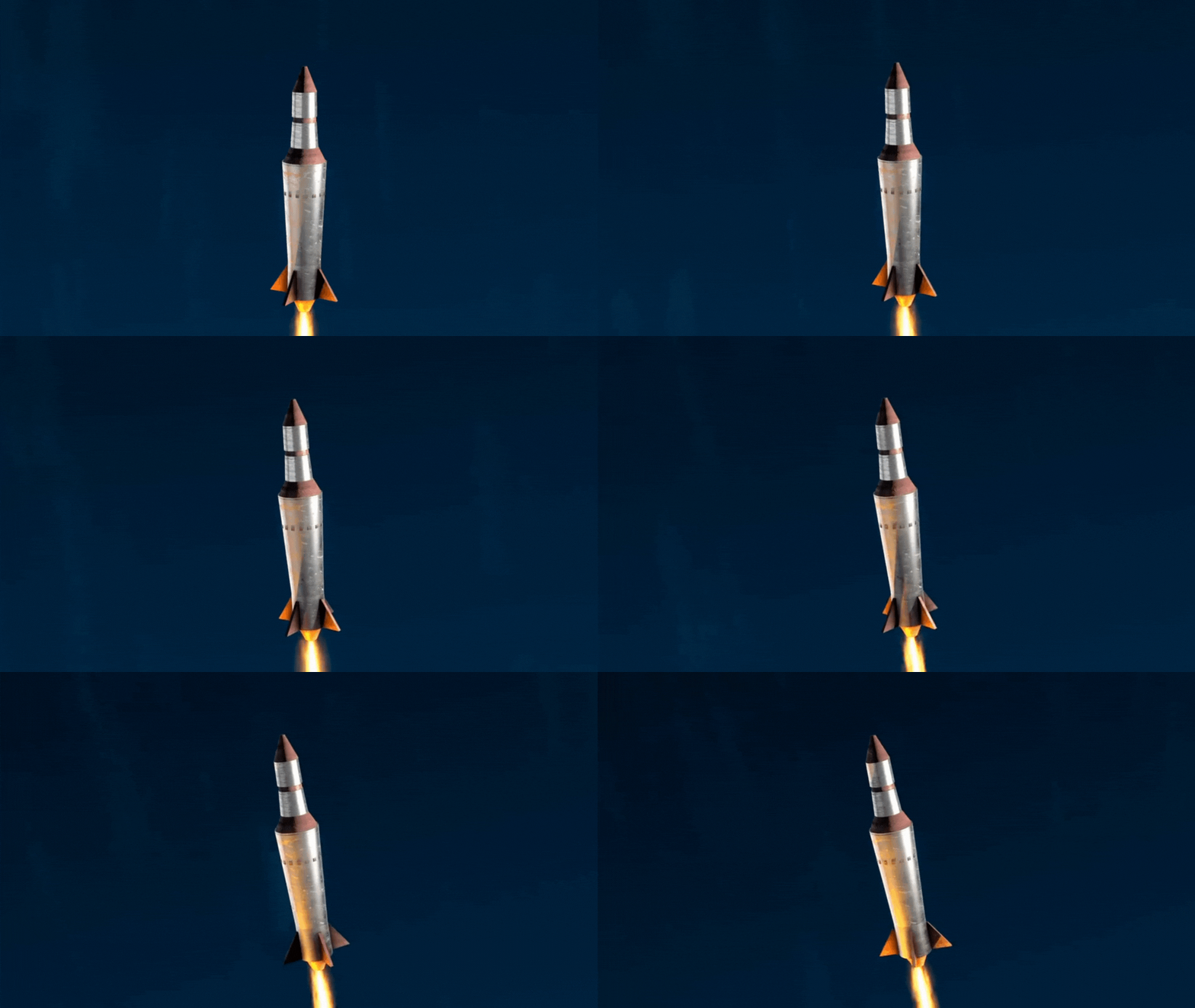
That year, we brought up two beauties of our own creation for the camping trip. One was the “Mir Buster,” primed for its maiden voyage. For those too young to remember, the Russian Mir space station was the first continuously operating long-term research station in action from 1986 to 2001. At this time, it was still orbiting Earth, though fraught with failures and near disasters. The rocket that would be its doom was about three feet long, made of stiff cardboard, with two sets of wooden fins and an aluminum nose cone for extra penetration. Just so those Russians could see it coming, we painted bright red. The Mir Buster was the brain-child of my friend Nate, who admittedly had no experience building such devices. Nate’s older brother obtained a coveted F engine for the Mir Buster, the largest engine we had ever seen. Even with this colossal engine, it wasn’t likely to reach the Mir, but it was still a heavy, ridged, and most undoubtedly dangerous missile.
The second rocket had no name because we didn’t expect it to survive. We took a cheap pre-made rocket designed to hold an A engine and stuffed a D engine in its place. That’s eight times the size it was intended for. We then planned to shoot this rocket horizontally off the mountain to see how far it would travel before losing steam.
Both these rockets broke several of the “golden rules” of model rocketry that would instantly expel us from any club or team. It was going to be great!
The Mir Buster was up first. The thing weighed a ton for a model rocket. Our typical construction material consisted of paper towel rolls or cheap plastic. Nate had made this beast from thicker 1/4-inch stock with the addition of wood and metal. Even with the much bigger engine, we had no idea if the thrust would be enough to get the monster off the ground, but we were dying to find out. Everything was set and primed. The red Mir Buster looked menacing upon the rickety plastic launching platform. We loaded some fresh batteries into the igniter, which generally lasted two to three launches before needing changing. We stood a distance away and looked at each other. The anticipation was palatable. There was a good chance it wouldn’t launch, seeing the igniter was rated only up to a D engine, but we were hopeful. It was only fitting to give the launch honor to Nate as creator. We counted down, and Nate pushed the button. The light went on, but nothing happened. We checked everything and tried again- nothing. On the third try, the batteries were dead. We reloaded and tried once more without a countdown.
Hot gas shot from the end with the usual hiss. The Mir Buster lifted off the pad for about five or six feet (just about head height) and tilted over. The effect was instant. No longer pushing against the force of gravity, it shot straight for us. Some of us ducked to the ground, feeling the hot gas pass overhead. Others fled, the rocket chasing them through the woods. It traveled about thirty feet and embedded itself in the crux of a tree, demonstrating its flesh-penetrating potential. In the haze of sulfur smoke, we slowly stood, eyes wide in the daze of near death. The missile was a traitor. Instead of shooting down the Mir, it almost busted us. We burst out with laughter and hoots and hollers. It was incredible! I slowly walked up to the smoking carcass and tapped it with a stick. With one last act of defiance, it let out a hiss and was dead. The Mir Buster remained in that tree for years after, a memorial to its first and last flight.
With adrenaline pumping, we immediately went to work on the second blast-off of the night. The ignition went much the same- several failed tries, and then WOOSH! I am not being theatrical here. We were just dealing with a cheap igniter that ate batteries like no man’s business. Once ignited, the petite beauty roared off the pad, trailing a twisted snake of smoke. We thought for sure it would sail for miles, but it didn’t make it more than fifty feet before the force of the engine surpassed the integrity of its cheap plastic, and the tiny rocket exploded in a magnificent fireball. I do not exaggerate here. When bragging about our exploits, we discovered that others on the ground saw this late afternoon explosion, which instantly became a badge of pride.
Other than our adventures in pyrotechnics, the camping trip was relatively uneventful. We did have a little fun setting our campfire that night. We had found a road flare and unpacked the powder into a Tupperware container. It made for an outstanding fire starter, although a very bright one. We slept out under the stars and had our usual share of shits and giggles. There may have been a marshmallow fight shot from wrist-rocket slingshots, a ghost story or two, and more deep contemplations of the opposite sex.
The next day, the mood was melancholy. Perhaps we knew that our childhood fun was quickly ending as this would be the last camping trip for a time. By our senior year, we were all driving, and it seemed more fun to do other things. I also started working full-time at the Post Office to make money for college. Some of us would get girlfriends, and life generally got complicated. There would be other camping adventures on that mountain, but the next wouldn’t happen until after I graduated college five years later.
Thus, I needed to lighten the mood, and I brought a little surprise that was perfect for the job. I feel strange sharing these stories now. My family enjoys my blog as they learn all sorts of naughty secrets from my childhood. To my defense, Monson is a small town. You had to get your fun where you could find it. It has been twenty-five years since that fateful day, and the statute of limitations has expired in terms of the law, but I am not so sure about my mother’s wrath. Anyway, I suppose I can share this now.
Model rocketry is an innocent enough hobby until you realize the “engines” are comprised of sulfur, charcoal, and potassium nitrate, otherwise known as black powder. In Massachusetts, you need a FID to purchase black powder; to obtain a FID, you must be 18 unless you have a parent’s consent. But anyone can walk into a Walmart and buy a mid-power Class D rocket engine. If you cut open that cardboard tube, remove the solid fuel, and carefully crush it into dust (just don’t use metal for this), you’re left with a sizeable amount of black powder. Through this aeration, the rocket engine’s controlled burn becomes an explosive. I had read this method in a certain “handbook” circulating around the new-fangled internet at the time. I know. The above may sound nefarious, but the recipe for black powder has been around for several hundred years and is relatively easy to make at home- it is only three readily available ingredients mixed in a 75/15/10 ratio. No special knowledge or equipment is required- just mix and boom!
All jokes aside, I understand that, for a teenage boy, the applications for this could quickly become unlawful. Luckily, we were not malicious kids and kept the danger to ourselves. All told we could have been doing worse things, and our experiments in pyrotechnics were all relatively tame. Anyway, I crushed several engines into powder, adding some other ingredients that will go unmentioned. You know, for flare. I then packed this into a toilet paper roll and sealed the ends with wax. We traveled down to a clearing with our little bundle of joy in hand. I lit the roll and ran. The ensuing explosion became a thing of legend. It scorched the memory of me running from a fireball with a massive grin on my face into the minds of everyone there that day and gave me considerable street cred. What a finale it was! Stupid, yes, but luckily, nothing came of it except the smell of burnt hair.
As I mentioned above, the next two camping trips happened years later. I will combine them in my next post as they happened the same year, one in the fall and the other in the winter. They would mark two considerable transitions in my life, one sad and the other exciting, but we’ll discuss that more next week.
Cheers!
Discover more from Author Scott Austin Tirrell
Subscribe to get the latest posts sent to your email.

I’ve enjoyed all these camping stories, Scott! Looking forward to the finale.
LikeLiked by 1 person
I’m glad you enjoy!
LikeLiked by 1 person
It’s a wonder any of us survived our adolescence!
LikeLiked by 2 people
I remember shooting rockets with my brother. Fun with questionable safety at times. 😵💫
LikeLiked by 1 person
Thanks for sharing this idea Anita
LikeLiked by 1 person
A buddy of mine launched a couple small rockets with me back in the day. Rocketry was just something we experimented with so we never took it to the level you guys did. Funny, I never thought about it until this interesting post brought back memories.
LikeLike