
I’ve often found that the stories we love most don’t just entertain—they haunt us, linger in our thoughts, and leave behind whispers that change how we see the world. As a writer, I aim to create something that resonates that way, leaving readers questioning, reflecting, and occasionally losing a bit of sleep (in the best way possible). Absolution of the Morning Star began with a simple idea—a moment where power and destiny collide in ways that shape individuals and entire realms. I represent this collision by the symbol above- the great Sword and Sun, the heraldry of the Caspian Faith.
The Great Beholding: Where Destiny Turned
At the heart of Lucardia’s mythology lies the Great Beholding, a pivotal moment that wasn’t just a clash of good and evil or a simple divine intervention. It was humanity’s desperate bargain—a pact made in the face of annihilation to secure survival at any cost. The mage Caspia saw it as his chance to save humanity and seize control, attempting to bind Lucifer’s essence within the sword Lightbearer. However, this act was only partly successful, leaving humanity in a fragile position and Caspia relentlessly pursuing his ultimate goal: to unsettle the balance of power in heaven.
The Caspian Faith teaches that Caspia’s plea to Yahweh led to Lucifer’s self-sacrifice—a sacrifice meant to save humankind from the Nephilim, ancient beings of dark power. Yet, as one of my characters warns in Noonday in the North, “We are not merely saved by this symbol, but imprisoned by it.”
One of the core ideas I wanted to explore in the series is how something seemingly pure, like the light of salvation, can cast the longest and most complex shadows. It’s a question I find myself wrestling with: What happens when the tool that saves us becomes the very thing that could undo us?
Rediscovering Lightbearer: A Path of Uncertainty
Erikson Gray’s journey with Lightbearer isn’t just a tale of fate—it’s one of rediscovery. In Dawn of the Lightbearer, Erik first finds the sword and, with it, an awareness of its seductive whispers and potent promises. Their fate becomes intertwined when Erik’s hand grasps the hilt, and the weight of destiny feels both invigorating and dangerous. Erik is pulled toward the sword despite his wariness as if his soul were already bound to it. But Lightbearer’s eagerness smothers him, creating doubt, and Erik may have cast the sword into the sea if left unchecked.
But fate isn’t straightforward. After a fateful shipwreck, Erik loses not only his past but also his growing cautiousness of Lightbearer. When he stumbles upon the sword once more, the whispers he had once been suspicious of now carry more weight in the absence of his memories. With nothing left to remind him of the sword’s dangers, Lightbearer begins to sink its hooks deeper into his fractured mind, its influence no longer countered by his initial skepticism. By the time Erik pulls through his amnesia, Lightbearer has secured its place in Erik’s counsel, its seductive promises becoming harder to resist in the face of growing peril. This is where his journey takes a darker turn, and the line between ally and adversary begins to blur.
Light and Shadow: A Thin Veil
What I find most compelling about Lucardia is the constant tension between what is perceived as light and what lurks beneath that façade. The Caspian Faith, a living force in this world, binds both the devout and the disillusioned, the faithful and the doubting. It is the backbone of a realm constantly teetering on the brink of change. But faith, much like power, can both build and break.
In many ways, Erik’s story is a metaphor for that struggle. The sword in his hand isn’t just a weapon—it reflects his innermost fears and desires. Lightbearer’s influence is as much about the external world as it is about the internal one, showing that sometimes, the most brutal battles are the ones we fight within ourselves. As Erik’s journey unfolds, Lightbearer’s whispers become not just seductive but a reflection of his own ambitions and doubts, making every choice a perilous step between heroism and ruin.
A Tale of Transformation
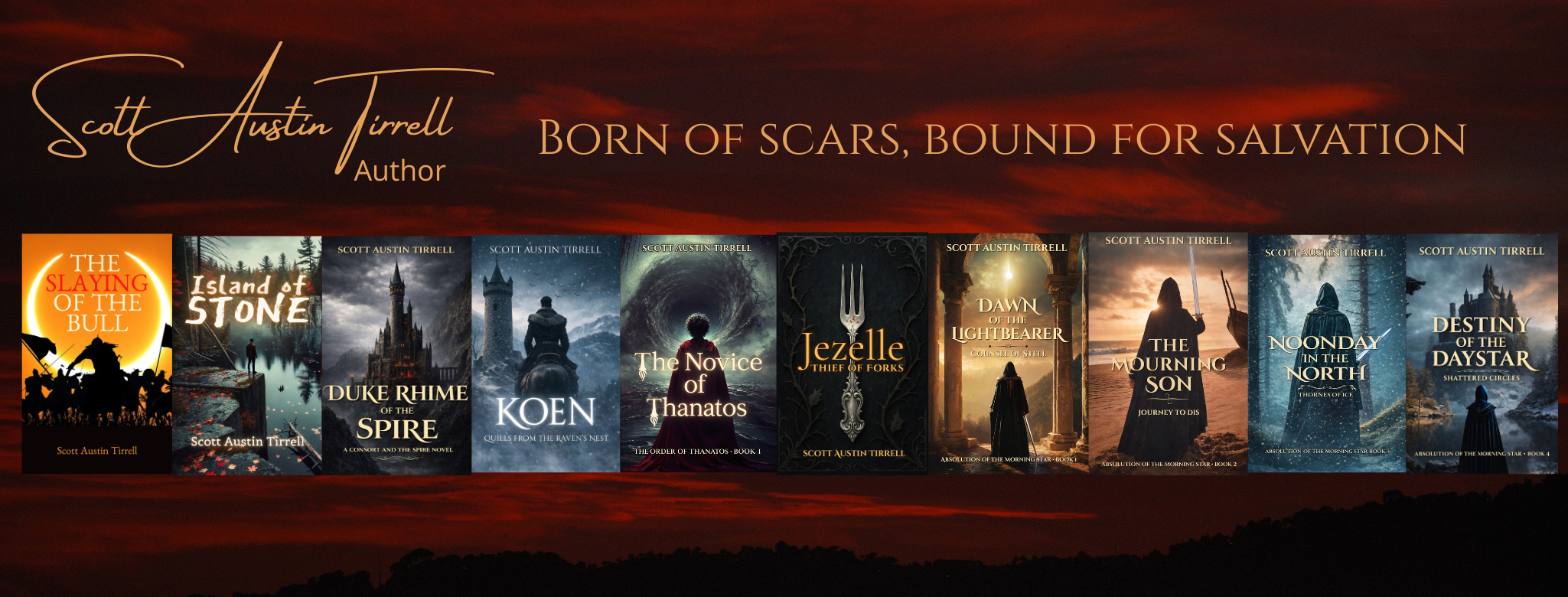
For those new to the series, The Mourning Son isn’t simply the second book in an ongoing saga. It’s a turning point where innocence is tested, faith is questioned, and alliances fracture. Erikson Gray’s journey is about the thin veil between heroism and villainy and how easily it can be torn. Some may find the transition between the first and second books jolting, which was intentional. I wanted to shift the focus from external battles to Erik’s internal struggles as he becomes lost in the maze of his mind, symbolized by the underground city of Dis.
My goal has always been to take readers on a journey that isn’t just about swords and magic but about people, choices, and the echoes of those choices. In Absolution of the Morning Star, I want you to feel that weight—the same way Erik does when he holds Lightbearer, hearing its seductive whispers promising greatness but leading him closer to ruin.
What Lies Ahead
As I continue shaping this series, I hope readers will see a piece of themselves in Erik and the other characters. We all carry burdens, whether swords, secrets, or the scars of our past decisions. The challenge isn’t just to survive them—it’s to embrace the shadows they cast and find a way to move forward.
What’s next for Erik and Lucardia? You’ll have to keep reading to find out. Destiny of the Daystar (book 4) will be out in January. But one thing is sure—Erik’s decisions will determine not just his fate but the fate of a realm poised on the edge of change, which will not be as you expect.
Thank you for joining me on this journey. If you’re new to Lucardia or have been with me since the beginning, I’m excited to hear your thoughts, theories, and questions about the Great Beholding, the nature of power, and the legacy of Lightbearer.
Until next time, keep exploring those shadows.
Cheers!
Discover more from Author Scott Austin Tirrell
Subscribe to get the latest posts sent to your email.

Those are very deep themes, and probably a bit controversial for a young adult market at the moment. It seems to me there’s a fair bit of concern about how introducing adult themes ‘too early’ might lead to dysphoria (rejection of cultural norms). Personally, I believe that encouraging a young adult to think about the foundations of their own society – and not merely go along with the conditioning – is a good thing. In my own days, I loved similar themes in Michael Moorcock’s tales of the life of his anti-hero, Elric of Melniboné. Good job.
LikeLiked by 1 person
We become more wise when we realize life is more than just a journey, it is an odyssey.
LikeLiked by 1 person