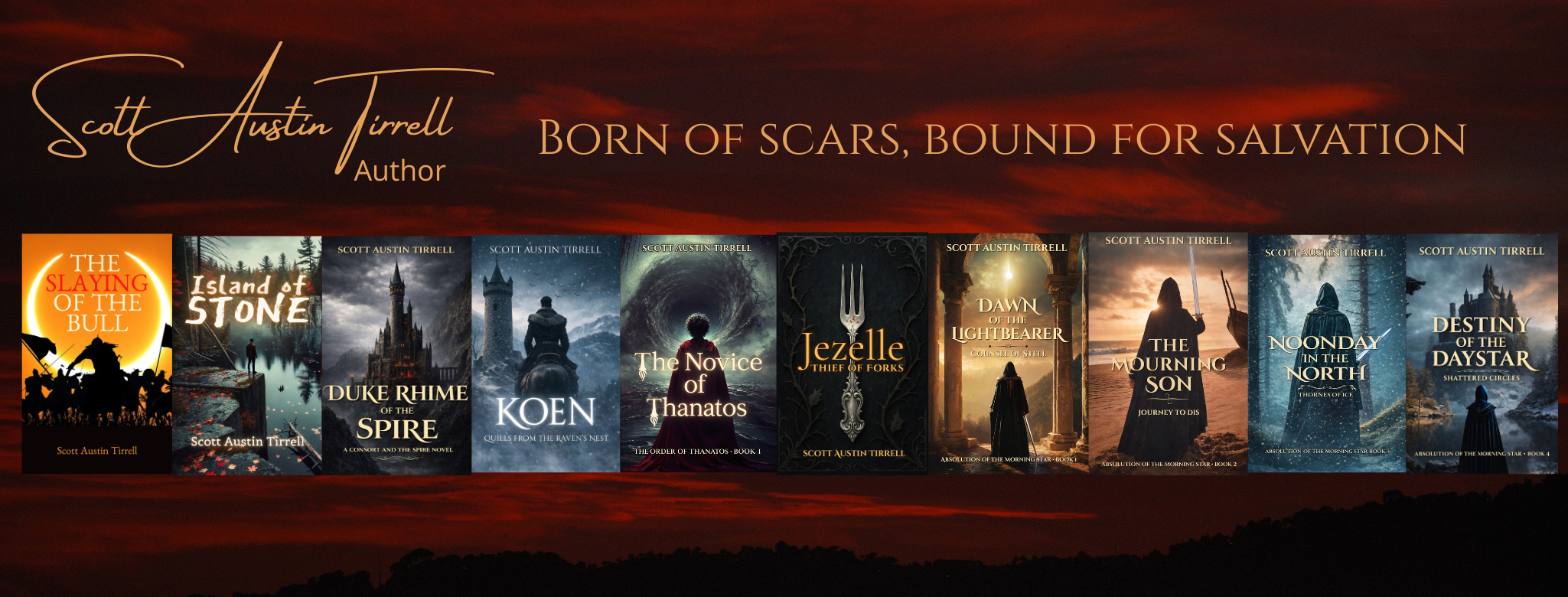

As a writer of dark, epic fantasy, I often find that the seeds of my stories take root in the fertile soil of history. The Absolution of the Morning Star series, particularly Destiny of the Daystar (releasing January 7th, 2025), and the series’ prequel Koen: Quills from the Raven’s Nest (coming Spring 2025 from Grendel Press), are deeply influenced by humanity’s past triumphs, tragedies, and revolutions.
Lucardia may be a fictional realm, but echoes of empires, religious upheavals, technological breakthroughs, and cultural clashes from our own world shape it. Let me take you behind the curtain of my creative process and show you how history has inspired the tales of Erikson Gray, Vesper Zulikaarme, and Koen the Gray.
The Rise and Fall of Empires
In Destiny of the Daystar, the once-unshakable Lucardian Empire faces its greatest trial as internal rebellions and external pressures crack its foundations. Similarly, Koen highlights how empires often rise through ambition and fall through betrayal. These narratives reflect historical cycles of unification and disintegration.
- The Unification of Lucardia: Vesper Zulikaarme’s conquest of the Twelve Kingdoms to forge a single empire mirrors Charlemagne’s unification of the Carolingian Empire. Vesper’s dream of uniting warring factions under one banner comes with costs, as seen in the catastrophic burning of the Zulikaarme Kingom’s capital, Brae—a tragedy inspired by the fall of Constantinople and the introduction of bombards to medieval warfare.
- The Cracks in the Empire: In Destiny of the Daystar, the usurpation led by Prince Ivar echoes the dynastic disputes that tore apart the Frankish kingdoms in the early medieval period, such as Chlodoric, son of Sigobert the Lame, who murdered his father to seize the throne, earning him the title “Chlodoric the Parricide” in 509 AD. The splintering of Lucardia serves as a reminder that the same ambition that unites can also destroy.
Religious Schisms and the Role of Faith
Religion is a cornerstone of the Lucardian universe. It provides hope, commands loyalty, and incites rebellion. With its Sword and Sun iconography, the Caspian Faith is as much a tool of imperial power as a spiritual force that divides. A small and relatively unknown religion during the Twelve Kingdoms period, it comes into prominence under Vesper, who transforms it into a powerful state religion pushed upon the entire realm.
- The Great Beholding and Historical Parallels: The imprisonment of Lucifer within the sword Ljós Leggja in The Great Beholding mirrors stories like Prometheus bound by Zeus or Loki chained by the gods. It also draws on historical instances where religious symbols became tools of control—such as the Crusades’ use of the cross to justify conquest.
- Splinter Movements and Dissent: The Red Cloths, a splinter group introduced in Noonday in the North and who come into prominence in Destiny of the Daystar, represent heretical movements like the Protestant Reformation. Their quest to free Lucifer challenges the Caspian orthodoxy, much like Martin Luther’s theses questioning the Catholic Church. In Koen, the tensions between his Caspian theology and the ancient traditions that still fester in the lands of his journey set the stage for Koen’s desperate quest for a miracle, forcing him to confront his faith and fate.
Technological Innovation and the End of Chivalry
One of the most striking moments in Destiny of the Daystar is the rise of arquebusiers—soldiers wielding early firearms—who play an integral part in the opening chapter of solidifying Ivar the Reformer’s hold on Lucardia. Historical turning points, such as introducing gunpowder in European warfare, inspired this shift.
- The Battle of Battenridge: The Knights of Norn’s charge against Ivar’s forces and the outcome echoed the Battle of Nagashino, where samurai cavalry met their match against well-placed musketeers, or the Battle of Cerignola of 1503, where firearms played a decisive role in European warfare for the first time. The Battle of Battenridge highlights how technology can upend centuries of military tradition, leaving even the mightiest armies vulnerable to innovation.
- Pragmatism vs. Valor: Ivar’s use of arquebusiers and disciplined pikemen marks a new era in Lucardia that values strategy over chivalric ideals. This echoes the decline of knightly dominance in favor of professional armies, much like those that emerged in the late medieval period.
Cultural Clashes and Forgotten Histories
In both Koen and Destiny of the Daystar, the divide between Lucardia’s Northlands and southern regions reflects the tension between preserving tradition and embracing progress.
- The Northlands’ Resistance: The Northlanders, with their long ancestry and ties to the First Uniter, parallel the Celts resisting Roman expansion or the Scots defying English rule. Their guerrilla tactics and spiritual practices highlight the resilience of Indigenous cultures in the face of imperial assimilation.
- The Forest People and the Price of Progress: The Forest People’s struggle to protect the Old Contorted Forest from the Field Folk’s ambitions mirrors the destruction of sacred lands during colonial expansion. Their near-extermination by Sathanas, Lucardia’s first emperor, and subsequent incursions serve as a haunting reminder of the costs of progress.
Heroism in the Shadows
The protagonists of Koen and Destiny of the Daystar are shaped by their historical parallels—figures who stand against impossible odds, often paying the ultimate price.
- Koen the Gray’s Sacrifice: In Koen, the titular character’s search for a miracle to produce an heir mirrors the struggles of historical figures like William Wallace. His tragic arc underscores the cost of fighting for what you believe is right, even when the odds are against you.
- Erikson Gray’s Burden: In Destiny of the Daystar, Erikson carries the weight of his family’s legacy and the fate of Lucardia. His journey through a fractured empire reflects the struggles of those who rise from obscurity to shape the destiny of nations, often at significant personal cost.
What These Books Mean for You
If you’ve ever been captivated by the sweeping drama of history—the rise of empires, the clash of cultures, or the battles that changed the world—then The Absolution of the Morning Star series and its prequel, Koen, will feel both familiar and fresh. These stories are not just about swords and sorcery but about the human experience: our ambitions, flaws, and relentless drive to leave a mark on the world.
As we march toward the January 7th release of Destiny of the Daystar and the anticipated debut of Koen: Quills from the Raven’s Nest in the spring of 2025 through Grendel Press, I invite you to delve into the world of Lucardia. Whether you’re a fan of epic battles, intricate politics, or the intimate struggles of flawed heroes, these books have something for you.
So, what do you see in Lucardia? Which historical echoes resonate most with you? Let me know in the comments, and let’s explore the rich tapestry of history and fantasy together!
Cheers!
Discover more from Author Scott Austin Tirrell
Subscribe to get the latest posts sent to your email.

You have certainly done your homework, Scott. This is thoughtful and ambitious. Best of luck!
LikeLiked by 3 people
History and trends are often made more clear through the interpretation of books like yours.
LikeLiked by 1 person
I’ve never been much interested in world history, but I see now how it can fuel writing. It’s my personal history and my family histories that fuel my writing for the most part. It was a long read, but worth it.
LikeLiked by 1 person