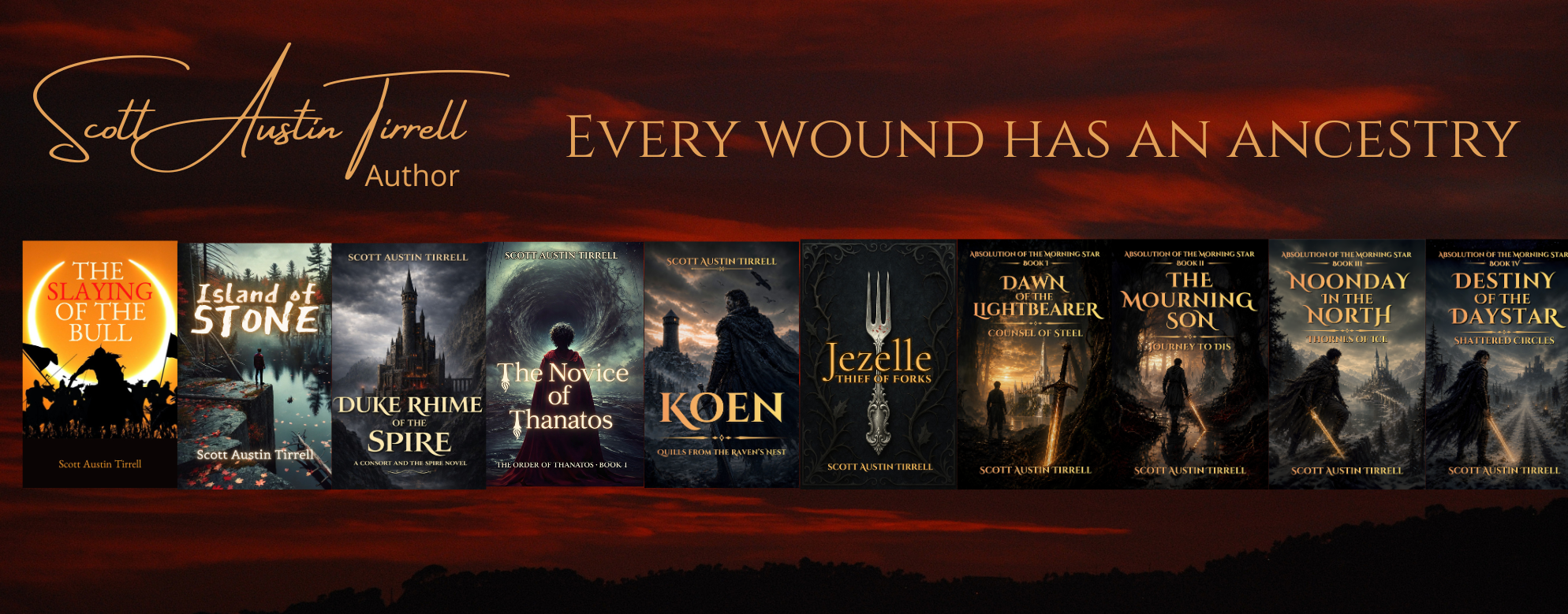

As the release of Destiny of the Daystar, book 4 of my Absolution of the Morning Star series, approaches (January 7th!), I ponder why I’ve chosen the last five years and ~2,500 pages to tell Erikson Gray’s tale.
Some stories aren’t just books—they’re pieces of your soul, fragments of something more extensive you’re compelled to build, even if the world never sees the whole picture. For me, the Absolution of the Morning Star series is that project—a sprawling dark fantasy epic that has grown into a legacy I feel bound to complete. But what does it mean to create a “legacy project” in a world where the publishing industry often prioritizes what’s marketable and quick to consume? What drives an author to pour almost five years of effort into something that may not yield immediate recognition or success? And what sustains that commitment when the odds feel stacked against you?
For me, it comes down to two things: the need to tell a meaningful story and the desire to leave behind something lasting.
When I began crafting Dawn of the Lightbearer, I didn’t know it would be a series until about halfway through and realized I didn’t have enough space to capture everything I wanted to say. At that point, I said to myself, oh crap, this is going to be an epic. I knew it would be longer than a trilogy when I mapped it out. I started to sweat- six books. I must be crazy. But I couldn’t stop now. The door to Erikson’s world had opened, flooding my life. By Noonday in the North (book 3), I realized that there were other stories to be told from my Lucardian world, and so Koen: Quills from the Raven’s Nest, The Novice of Thanatos, and now, Duke Rhime of the Spire were born. I had invested so much effort in crafting this world and its history. Departing from it was now impossible.
I wasn’t chasing trends or trying to fit into a specific publishing niche for the Absolution of the Morning Star series. Instead, I was drawn to timeless themes: the duality of power, the cost of survival, and the unrelenting pull of destiny. These weren’t just plot points—they were questions I was wrestling with myself, questions about faith, morality, and what it means to endure in a world that often feels unforgiving. We were in the throes of COVID-19, working from home and isolated from the world for what would become years, and I was searching for purpose. I was also locked in a job I didn’t enjoy, which was progressively worsening. There was just so much to unravel, and I depended on the stories.
Writing a legacy project means refusing to compromise on the scope of your vision. It means accepting that some readers may not find their way to your work until years after it’s complete (if at all) but trusting that when they do, they’ll find a story that resonates. It means pouring your heart into a series that doesn’t conform to bite-sized consumption or trendy genre fads but instead dares to ask readers to commit—to the characters, the world, and the journey.
When I think about legacy, I think about the stories that have shaped me as a writer and as a person. Books like Tolkien’s The Lord of the Rings, Clive Barker’s Imajica, Le Guin’s Earthsea, or JRR Martin’s Song of Ice and Fire weren’t just stories—they were monuments. They left a lasting impression not because they were written quickly or with market trends in mind but because they were deeply rooted in something real: the authors’ beliefs, philosophies, and their exploration of the human condition.
With Absolution of the Morning Star, I want to create something similarly enduring. I don’t just want readers to enjoy the series—I want them to wrestle with it. I want them to think about Erikson Gray’s choices, about the weight of power and the cost of faith, long after they’ve put the book down. That’s the kind of legacy I’m aiming for: a story that doesn’t just entertain but leaves a mark.
Writing a legacy project is not without its challenges. One of the hardest lessons I’ve had to learn is patience—not just with the story, but with myself. Building an intricate, sprawling series like this takes time. There are days when the work’s weight feels overwhelming when its scope threatens to outpace my energy or my confidence. There are moments when I wonder if it’s worth it when I look at the pressures of the publishing industry or the realities of reader attrition in long series and question whether I should have aimed smaller.
But here’s the thing about legacy: it’s not about immediate results. It’s about the long game. I remind myself that even if Absolution of the Morning Star never reaches the bestseller lists, it still matters. The characters, the world, the themes—they matter. They matter to me and will matter to the readers who connect with them. And that’s enough to keep me going.
At its core, a legacy project isn’t about fame or fortune—it’s about creating something that feels true, something that feels like it was worth the effort, even if it takes years to build. Writing Absolution of the Morning Star has taught me that success isn’t just about numbers; it’s about resonance. It’s about crafting a story that stays with people, even if those people are fewer than I might have hoped.
To me, legacy is about trust. Trust that the work will find its audience, even if it takes time. Trust that the effort you put in today will mean something tomorrow. Trust that what you leave behind will have value, even if you’re not around to see its impact.
If you’re a writer embarking on a legacy project—or even just dreaming about one—here’s what I’d say to you: start, even if the scope feels intimidating. Even if the world tells you, it’s too ambitious or not marketable enough. Start anyway. Write the story that won’t leave you alone. Write the story that scares you because it feels too big, too personal, or too daunting. Those are the stories that matter.
And remember: legacy isn’t built overnight. It’s built one sentence, chapter, and book at a time. Trust the process, trust your vision, and trust that your story will find the readers who need it. Because, in the end, legacy isn’t about being remembered by everyone—it’s about being remembered by someone.
Cheers!
Discover more from Author Scott Austin Tirrell
Subscribe to get the latest posts sent to your email.

So well said, Scott, and so true. Thank you for your insights and your perseverance. You inspire me.
Wishing you a successful and creative New Year.
All the best,
Will
LikeLiked by 1 person
Thanks for reading! Happy New Year and wish you a successful year as well!
LikeLike
Well said, indeed, Scott. This reminds me of how I came to write my own four-book series. Wishing you success (however you measure it) with this monumental project.
LikeLiked by 1 person
Thanks! Happy New Year!
LikeLiked by 1 person
Legacy is also what we leave behind, beyond our physical lives. Legacy is an honorable pursuit.
LikeLiked by 1 person
Wishing you all the best on your upcoming release! A great way to start a new year. 🙂
LikeLiked by 1 person
Thanks and Happy New Year!
LikeLike
Thanks! Yes, it is always exciting to share a new tale with the world.
LikeLike