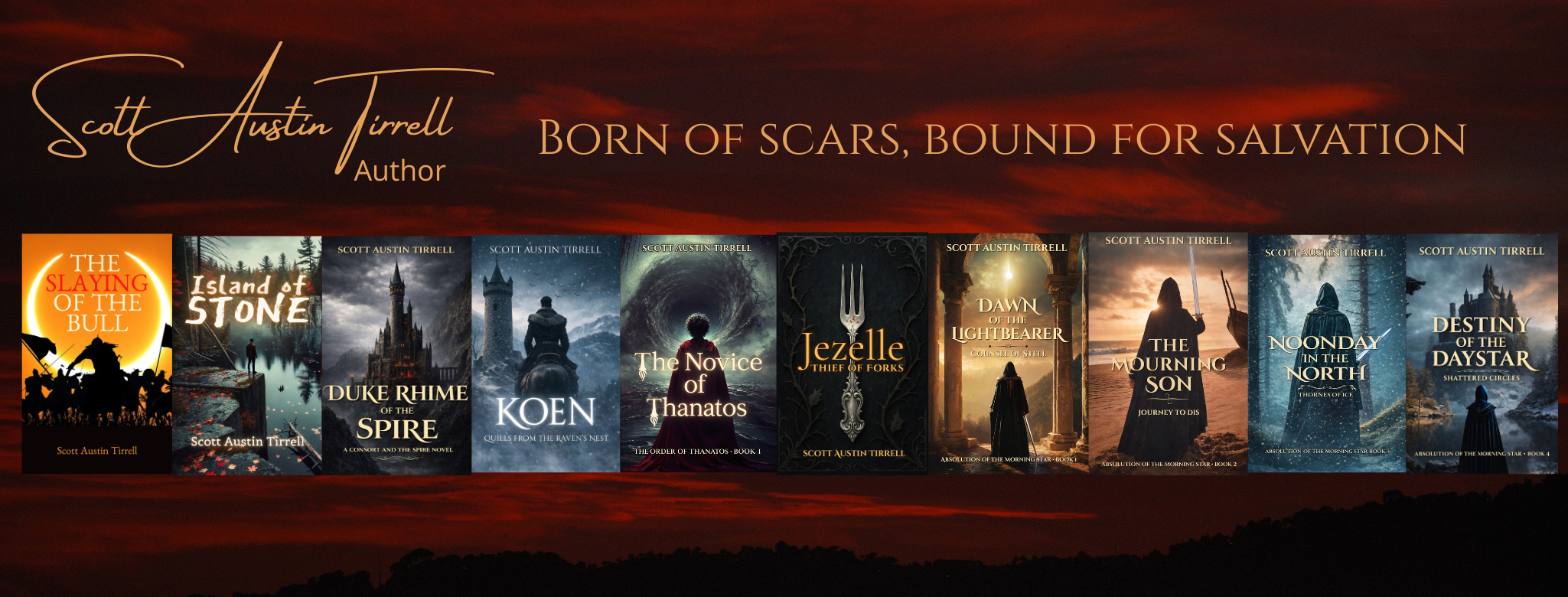

As the release of Destiny of the Daystar quickly approaches (book 4 of the Absolution of the Morning Star, January 7th) and I feverishly write Duke Rhime of the Spire, a book set hundreds of years before the AMS series, I find myself pondering the weight of Lucardia’s extensive history. Oh, stop the moans. I know history is not everyone’s favorite subject, but much can be learned by looking into the past, even a fictitious one.
Lucardia is a land carved by conflict and shaped by the ambitions of its rulers. Its history is a tapestry woven with threads of divine intervention, rebellion, and perseverance. From the brutal campaigns of Sathanas to the mysterious journey of Erikson Gray, Lucardia’s past is a story of unification and division, mortal struggles against the immortal, and humanity’s enduring quest to define its place in a tumultuous world. This is the story of a realm that has risen, fractured, and risen again, always striving toward a destiny that is as elusive as it is compelling.
In this blog post, we will explore the five pivotal eras that have defined Lucardia: the first unification under Sathanas after the war with the Nephilim, the era of the Five Kingdoms, the tumultuous period of the Twelve Kingdoms and their quick fall under Vesper, the post-Vesperian era of rebellion and turmoil, and the current age, where Erikson Gray’s journey begins. Each period tells a tale of transformation, illuminating the cyclical nature of Lucardia’s history and the forces that drive its people.
The First Unification: Sathanas and the Dawn of Lucardia
The story of Lucardia begins in an age of darkness, with humanity’s struggle against the Nephilim—towering, ancient beings born of the union between the divine and mortal. The war between these two races ended in 32 BLE (Before the Lucardian Era) with a fragile truce, but the scars it left shaped the trajectory of human history. Among the victors of this war was Devlian of the Forest People, who received the sword Ljós Leggja from the Nephilim sorcerer Aspar (read The Mourning Son for more of that story). This blade would come to symbolize divine favor, and its legacy would echo through the ages.
In the year 1 CLE (Common Lucardian Era), Sathanas, Devlian’s son, rose to power. Wielding Ljós Leggja, he united the fractured human kingdoms into a single realm and named it Lucardia. His reign was marked by relentless expansion, including a brutal campaign against the Jötunn (human and Nephilim highbreds). By 25 CLE, the Jötunn were punished for serving the Nephilim and enslaved, their power broken under Sathanas’s iron will.
However, Sathanas’s ambitions were not without cost. His attempt to expand into the Sacred Grove sparked a war with the Forest People, leading to the near extermination of their kind. By the time of Sathanas’s death in 122 CLE (yes, Ljós Leggja extended his lifespan), he had solidified Lucardia’s borders but left behind a fractured legacy. He was posthumously named Sathanas the Wrathful, and the seeds of division he sowed would soon sprout.
The Era of the Five Kingdoms
After Sathanas’s death, Lucardia descended into chaos. The decision to pass Ljós Leggja to his nephew Bartholomew rather than his own sons led to a fractious civil war among his heirs. Bartholomew disappeared on an ill-fated attempt to find the banished Nephilim to destroy Ljós Leggja. By 139 CLE, Lucardia had splintered into five independent kingdoms in Bartholomew’s absence, each vying for dominance.
This era, known as the “Dark Times,” spanned over 500 years and was marked by intermittent wars and power struggles. The kingdoms that emerged from this chaos were shaped as much by geography as by politics, with each region forging its identity amidst the ruins of the unified realm. Once a source of unity and power, magic became a focal point of conflict. The Great Mage Purge of 650 CLE eradicated much of Lucardia’s arcane knowledge, leaving scars lingering for centuries.
Hope briefly flickered with the rise of King Rhime of the Spire, a member of the Battenborne family, who declared Lucardia an empire in 700 CLE. His reign was short-lived, however, as his assassination in 702 CLE plunged the realm into another period of division, this time into twelve warring kingdoms.
The Twelve Kingdoms and the Rise of Vesper
The Twelve Kingdoms period was one of uneasy alliances and fragile peace. For over 200 years, the Council of Twelve maintained a semblance of order, but beneath the surface, ambitions festered. During this time, Vesper Zulikaarme was born in 925 CLE, a man destined to reshape Lucardia’s fate.
Vesper’s rise was meteoric. Crowned king under regency at the age of nine, he inherited a fractured realm beset by famine and internal strife. The harsh winter of 949 CLE and the ensuing famine tested his leadership, but his marriage to Constance of the Anworth Kingdom began the process of unifying the Twelve Kingdoms. By 971 CLE, after years of war and political maneuvering, Vesper had triumphed over the other ten kingdoms, including the powerful Battenborne Dynasty, and declared himself emperor. The Lucardian Empire was reborn, with its capital at Highwater.
Under Vesper’s reign, Lucardia experienced a golden age of expansion and prosperity. Yet, his vision of an “Empire of Light” was not without its shadows. The unification came at a significant cost, with entire regions devastated by war. Moreover, Vesper’s sons, each given control over a regional princedom, sowed the seeds of future discord.
The Post-Vesperian Period
The years following Vesper’s unification were marked by growing unrest. The emperor’s attempts to consolidate power led to friction among his sons, culminating in the War of the Four Realms. Prince Sylvanus, Vesper’s third son, rebelled in 985 CLE, seeking to carve out his own dominion. The rebellion escalated when Prince Koen, once loyal to the empire, joined forces with Sylvanus with the might of the Northland tribes.
The war was a bloody and devastating affair. The great battle at Wildwick in 985 CLE saw Sylvanus’s forces retreat to Runemaul, where they regrouped for a final stand. Despite their efforts, the rebellion ended in defeat. Koen surrendered in 988 CLE, only to be executed shortly after. Sylvanus was imprisoned in his own castle, and the empire’s wounds festered even as it nominally remained united.
This period set the stage for Erikson Gray’s story as the cracks in the empire’s foundation widened. The once-mighty empire was now a realm of fragmented loyalties and whispered rebellions, where old grudges and new ambitions threatened to undo all Vesper had built.
The Age of Erikson Gray
Erikson Gray’s journey begins in this fraught and fractured landscape. Born into a world teetering on the edge of chaos, Erikson’s story is one of discovery and transformation. As the heir to a legacy both glorious and grim, he must navigate the shadows of his ancestors while forging his own path.
Erikson’s journey is not just a continuation of Lucardia’s history but a reflection of its cyclical nature. The unifications and divisions, the wars and alliances, the struggles between humanity and the divine—all are echoed in his quest. As Erikson wields the ancient sword he names Lightbearer (Ljós Leggja) and grapples with its whispers, he becomes the nexus of Lucardia’s past and future, its hope and its peril.
A Realm in Flux: The Story Yet Unwritten
The history of Lucardia is a story of resilience and ambition, human frailty and divine intervention. From Sathanas’s first unification to Erikson Gray’s unfolding saga, the land has been shaped and stunted by its people’s dreams and deeds. Yet, beneath the cycles of rise and fall, one truth endures: Lucardia is a realm where the light and shadow of history intertwine, forever seeking balance.
As Erikson’s story continues to unfold, one can only wonder: Will Lucardia find lasting unity, or will it once again be torn apart by the forces that have defined its history? Only time will tell, but one thing is certain—the story of Lucardia is far from over. You can find that saga here.
Cheers!
Discover more from Author Scott Austin Tirrell
Subscribe to get the latest posts sent to your email.

I sense parallels and analogy here.
LikeLiked by 1 person
😉
LikeLiked by 1 person