
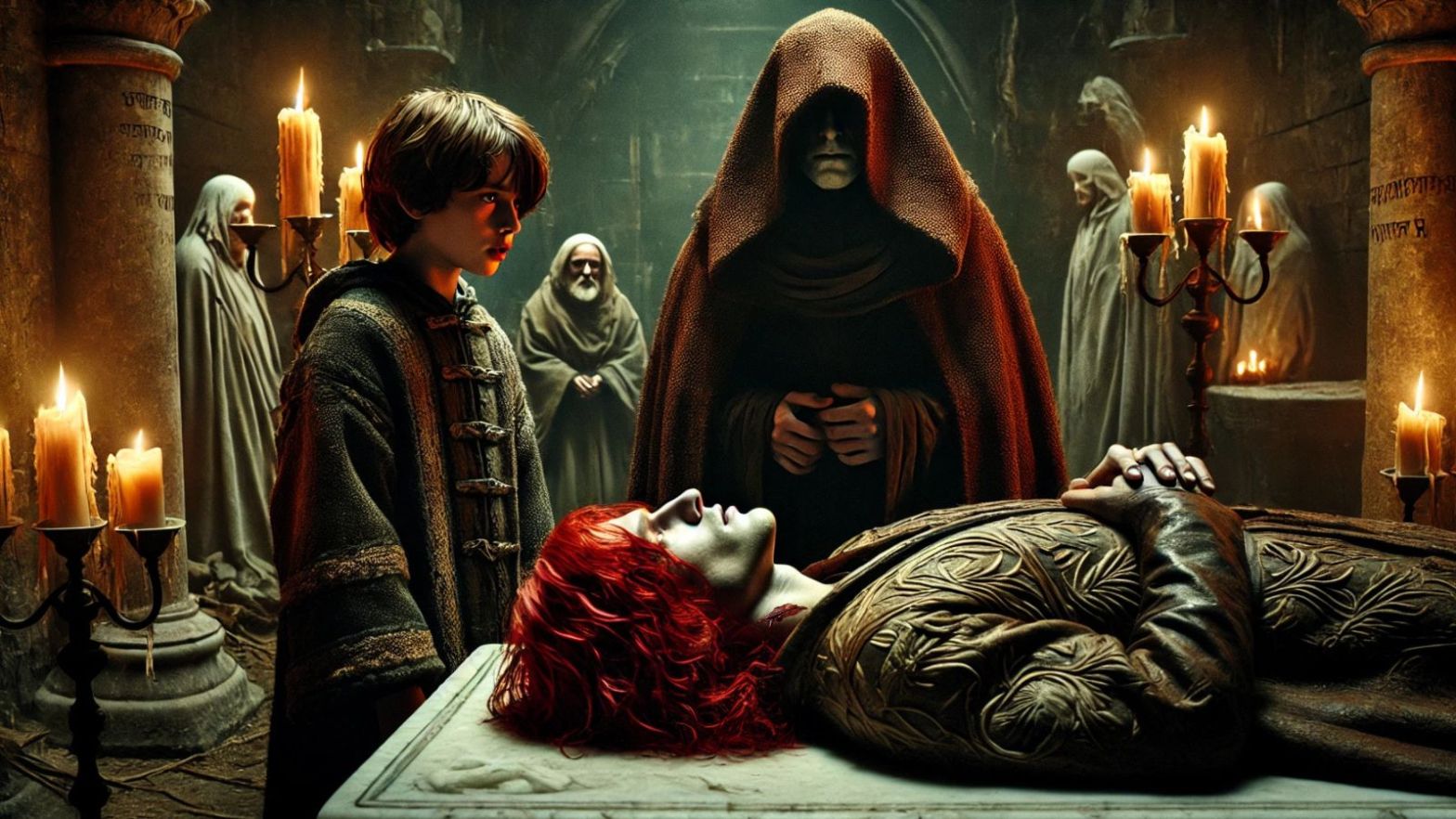
Writing a book about a group of monks who primarily deal with the dead brought me down an assortment of macabre rabbit holes. Some of it was fascinating, and some will plague my nightmares. Although I write fantasy, I write grounded fantasy in the late-medieval period. Patching together the real with the fantastical gives the magic, the mythical, and the wonder more credibility. So when I wrote about Maelor of Flint and his end in The Novice of Thanatos, I wanted it to be believable. But more importantly, I wanted to demonstrate that there was enough work to keep the Order of Thanatos busy.
I must warn you, below is a bit gruesome, but so was the medieval world. The people of those times had a more intimate connection with the dead. Death was always present and presented various problems that required solutions that might sound horrifying to us now.
When a nobleman or knight died on a distant battlefield, transporting their body home was one of these challenges. Before refrigeration, decay was swift, especially in hot climates. To combat this, medieval people developed a process known as mos teutonicus, or “the German custom,” in which:
- The body was eviscerated to remove the organs that decayed the fastest.
- The flesh was boiled from the bones.
- The bones were then carefully cleaned, dried, and sometimes treated with wine or aromatic substances before being wrapped in cloth.
This process ensured that a noble could receive a proper burial in their homeland, a fate that was not only desirable but often dictated by religious and dynastic customs. Famous figures like King Louis IX of France and Edward I of England underwent versions of this process.
In The Novice of Thanatos, the monks perform their own version of this ritual but with a distinctly morbid twist that plays on the notions of an economy around death that are key to my Lucardian world.
Preparing Maelor of Flint: A Monk’s Work in Death
Maelor of Flint was a merchant of means, fat from years of indulgence, who met his end in a botched robbery. Though his life was cut short, his wealth ensured him a noble burial, and the monks of Thanatos prepared his remains for transport back to his home in Shadowrock, a journey of about a thousand miles. To do this, the monks endeavor on a process not unlike the historical mos tectonics, though with an eerie caveat that speaks to the Order’s deeper dealings with the world of death.
In Maelor’s last moments, terms are negotiated, contracts signed, and assurances are given. Maelor dies from his wounds, and the monks escort his soul across the Threshold. Now, the grim work can begin.
Step 1: The Anointing and Purification of the Corpse
First, the monks place Maelor on a tilted marble altar so his head is facing down at an angle. They cut his carotid arteries and jugular veins, and he is drained of excess blood before it can coagulate. They then wash his body in vinegar and sweet herbs—a blend that both masks the odor of decay and serves as a temporary preservative- think of a corpse pickle. This resembles medieval European practices, where corpses were sometimes treated with wine or spices before burial as a way to mask the inevitable odor. The body is then left to rest and settle.
Step 2: Evisceration and the Collection of Valuable Materials
The monks then make a Y-incision familiar to both medieval and modern autopsy practices, peeling back the flesh to remove the viscera—the stomach, intestines, liver, lungs, and heart. Unlike the medieval embalmers, however, they do not discard or bury these organs. Instead, they preserve them in spirits for later use or study. The Order prides itself in its academic pursuits.
The Order of Thanatos wastes nothing. Blood is drained and stored for medicinal or alchemical purposes. The bladder is emptied for use in dyeing and leatherwork. Even the bile from the gallbladder is saved for elixirs. Talismen are collected for magic, and nigredo is harvested for Alchemy. This practice echoes real-world medieval beliefs, in which the bodies of executed criminals were often harvested for medicinal ingredients thought to contain special properties. The Novice of Thanatos goes into greater detail on this, so I won’t spoil that here.
But the monks of Thanatos are also particularly interested in Maelor’s adipocere, or corpse wax—a rare and valuable substance formed when fat saponifies after death. In Lucardia, the monks of Thanatos use this “wax” in candle-making because it produces a smokeless flame. As the Order spends a lot of time writing treatises and doing illumination work, I felt it was fitting that they would be very interested in this substance. There is some historical precedence for this, too, though it seems to be a practice seen more in the 17th and 18th centuries.
Step 3: Boiling the Flesh from the Bones
The most gruesome part of the process is the boiling of the body—a direct parallel to mos teutonicus. The monks dismember Maelor’s corpse and then lower the bits into a great vat of wine, where the flesh will separate from the bones over several hours. This step is necessary for his transport—a full human body is too heavy and prone to decay, but bones alone are light and easy to carry. In life, Maelor weighed about 250 pounds. His boiled skeleton weighs about twenty-five.
Unlike the historical Crusader practice of boiling a body in water or vinegar, the monks of Thanatos use wine. This luxury not only aids in the separation process but serves a second purpose: the resulting liquid is strained, bottled, and sold as a tonic to those desperate enough to believe in its restorative properties. I know this sounds gross, but there is plenty of historical evidence of ingesting parts of the deceased for therapeutic reasons. Sometimes, they knew the source, and sometimes, they did not.
This moment in The Novice of Thanatos is both visceral and haunting. The vat fills the air with rich, greasy smoke, and the monks must skim away the bubbling sludge lest it overflow. For Mishal, the protagonist, this is his first true initiation into the work of the Order—a trial of stomach and spirit.
Step 4: The Cleaning and Wrapping of the Bones
Once the flesh has been boiled away, the monks scrape the bones clean, ensuring they are pristine before being dried by a fire. The bones are then carefully wrapped in perfumed red fabric—the signature of a traveling brother of Thanatos—and secured for transport on a framed backpack.
Maelor of Flint is only one of many who pass through the hands of the monks of Thanatos, but his preparation is a chilling glimpse into the ancient and esoteric world of the Order. Blending history with dark fantasy, The Novice of Thanatos resurrects the forgotten rituals of the past and imbues them with supernatural weight.
For the monks of Thanatos, preparing Maelor of Flint’s body is not a sacred ritual but a business transaction. For them, once the spirit has crossed the Threshold, what remains is nothing more than raw material—meat and bone, sinew and fat. However, it is not the Order’s place to judge those who seek to honor the dead with ceremony; they simply offer their services discreetly and efficiently and profit from the exchange.
But the dead serve more than sentiment. The bones and blood of Maelor and others like him feed the secretive needs of the Alchemists of Ignis, the Guild of White Mages, and the Order itself, whose experiments demand ingredients harvested from the flesh of the departed. The Order of Thanatos, ever pragmatic, knows that the line between reverence and exploitation is thin—and profitable.
For Mishal, each preparation is a reminder that death is not an ending in Thanatos. It is an economy, a craft, a path lined with bones, leading deeper into darkness where morality and mortality blur. It adds to the terror of my Lucardian world, where even death does not lead to freedom.
The Novice of Thanatos awaits if you are ready to walk that path. But remember—once you step into the shadows of the Order, nothing remains sacred.
Cheers!
Discover more from Author Scott Austin Tirrell
Subscribe to get the latest posts sent to your email.

This might be TMI for the general reader. I couldn’t read through the entire passage this early morning.
LikeLike