
After more than two decades of writing, I’ve started wondering what, exactly, my style has become. It’s not something I’ve spent much time defining, and truthfully, I’m still not sure I could point to a formula or philosophy that guides every decision I make on the page. But the question keeps returning—quietly, persistently—especially as I look back on my earliest work and compare it to what I’m writing now, not with pride or self-congratulation, but with curiosity. With the kind of distance you get only after a long, crooked road.
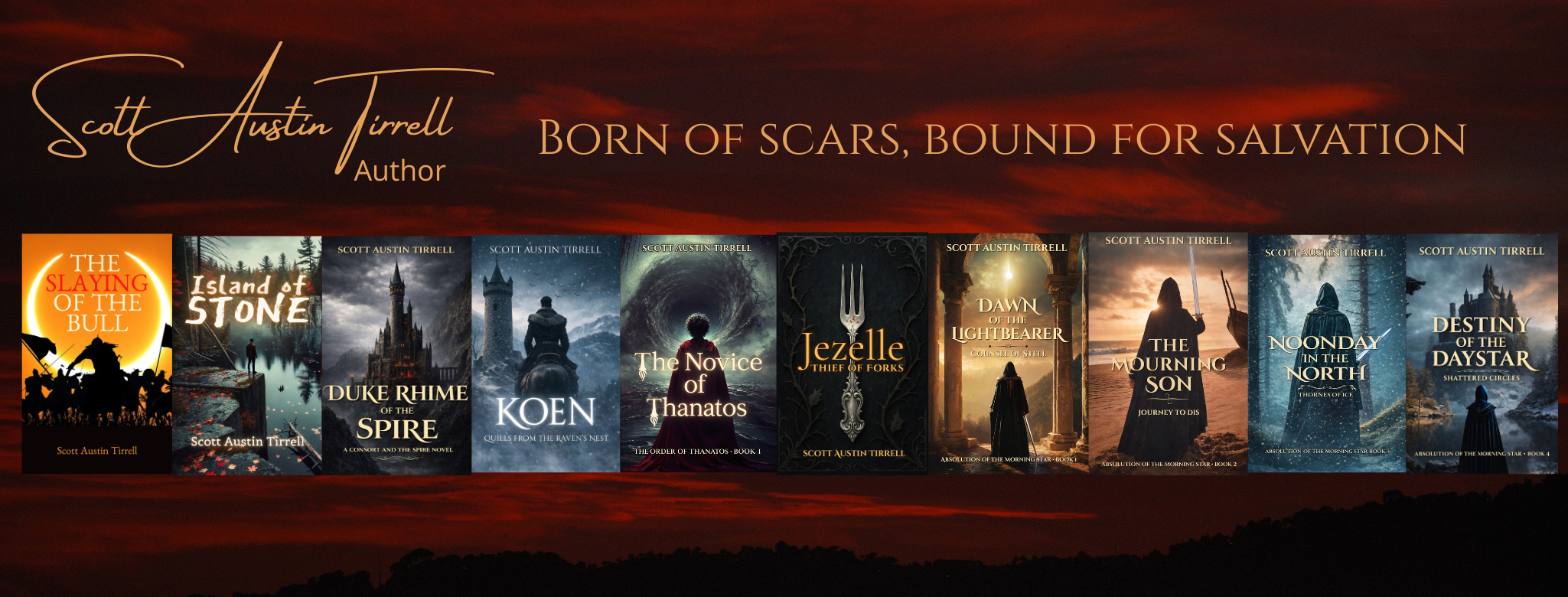
Recently, I completed the first draft of Jezelle: Thief of Forks, a story that’s arguably the rawest, darkest thing I’ve ever written. It follows a child who slips through the cracks of society into something far worse. It’s brutal. Emotional. Unflinching. And yet, in all its grime and desperation, it still carries something I recognize from Island of Stone, my first published novel and a book I wrote fifteen years ago. That book is entirely different in genre, tone, and setting—it’s a bleak, noir-inspired exploration of grief, corruption, and disillusionment (with some fantasy thrown in). But despite the surface differences, there’s a through-line I can’t ignore.
I’ve always been drawn to characters standing at the edge—whether that’s the edge of a city, an emotional breakdown, a choice, or simply the realization that no one is coming to help. Something about the human spirit when it’s cornered fascinates me. My characters rarely enter the page with power. They don’t wear crowns or swing swords blessed by fate. They come with wounds. With debts. With silence. And they stay because they have nowhere else to go.
My writing tends to sit in discomfort. Not for shock value, but because discomfort is honest. It’s where things are revealed. I don’t try to avoid hard scenes. If anything, I walk toward them. There’s always a moment in every story where something threatens to crack—a truth that can’t be avoided anymore, a line that, once crossed, changes everything. Those are the scenes I spend the most time on. I want the reader to feel the quiet horror of a locked door just as vividly as the clang of a sword or the weight of a truth finally spoken aloud.
The atmosphere in my stories often does as much work as the characters. I try to make the setting feel alive—not just as a backdrop, but as a presence that grounds the character in a reality. The way a floor groans. The way the stink of blood hangs in old wool. The way silence stretches too long between two people who’ve said too much. I’m interested in how a place carries memory, and how it presses on the people inside it. I don’t build worlds so much as I let them fester, then see how my characters survive inside the rot.
And those characters—well, they’re rarely clean, be it morally, emotionally, or physically. I’m not trying to redeem them, and I don’t think trauma automatically makes someone wise. It just makes them hurt. And hurting is part of being alive. Sometimes they find something worth clinging to. Sometimes they don’t. But I try not to lie about what survival costs.
I’ve changed as a writer over the years. In the beginning, I wrote quickly and with very little filter. It was all impulse and urgency, and while some of that energy is still there, I’ve become more deliberate. I spend more time listening to the story, figuring out what it’s actually trying to say—not what I want it to say. I guide, never direct. True, I outline more than I used to, especially recently, but my outlines are flexible. I care most about rhythm now—scene to scene, chapter to chapter. I try to build tension not just through conflict, but through silence. Stillness. Dread. I want a quiet chapter to linger in the mind as much as the loudest one.
One thing I’ve learned—and continue to relearn—is that the moments I fear writing the most often end up being the ones that feel the truest. That’s where the real marrow lives. So I’ve stopped trying to write around them. It means I might sit with a scene for days or even weeks. It is damning to my wordcount goals, but it always pays off in the end.
I don’t claim to have it all figured out. In fact, the longer I write, the more aware I become of how much I still have to learn. But if I’ve developed a style at all, I think it lies in the willingness to follow my characters into dark corners and sit there with them until the silence breaks. That, and a stubborn belief that even in the worst places, something fragile can still survive—whether it’s hope, or defiance, or the quiet decision to keep moving forward when everything says not to.
I don’t write faster now. But I write braver. And maybe that’s enough.
Cheers!
Discover more from Author Scott Austin Tirrell
Subscribe to get the latest posts sent to your email.

Wow, Scott! What an essay and what a line: “I don’t build worlds so much as I let them fester.” Brilliant! I can only hope that you achieve the success you so richly deserve.
All the best,
Will
LikeLiked by 1 person
Thanks, Will!
LikeLike
Rich writing about writing. Thank you for sharing.
LikeLiked by 1 person
You build the writing “muscle” by exercising it.
LikeLiked by 1 person