
I have a great father. The kind of man who showed up—quietly, steadily-the kind you could build a world around. He never raised his hand. He rarely raised his voice. He wasn’t afraid to show his love. I remember my friends envying me for that. Some of them lived in homes ruled by silence or, worse, by the kind of noise that made you flinch—fathers who drank, who yelled, who struck, who vanished. In our young world, those things weren’t always said aloud, but they hung in the air. You could feel it in the way some of my friends looked at my dad—as if he were something rare, something they didn’t quite trust to be real.
I think that’s why the fathers in my books are so different from the one I had. They’re shadows and storms, not anchors. They’re powerful and distant, or worse, present and dangerous.
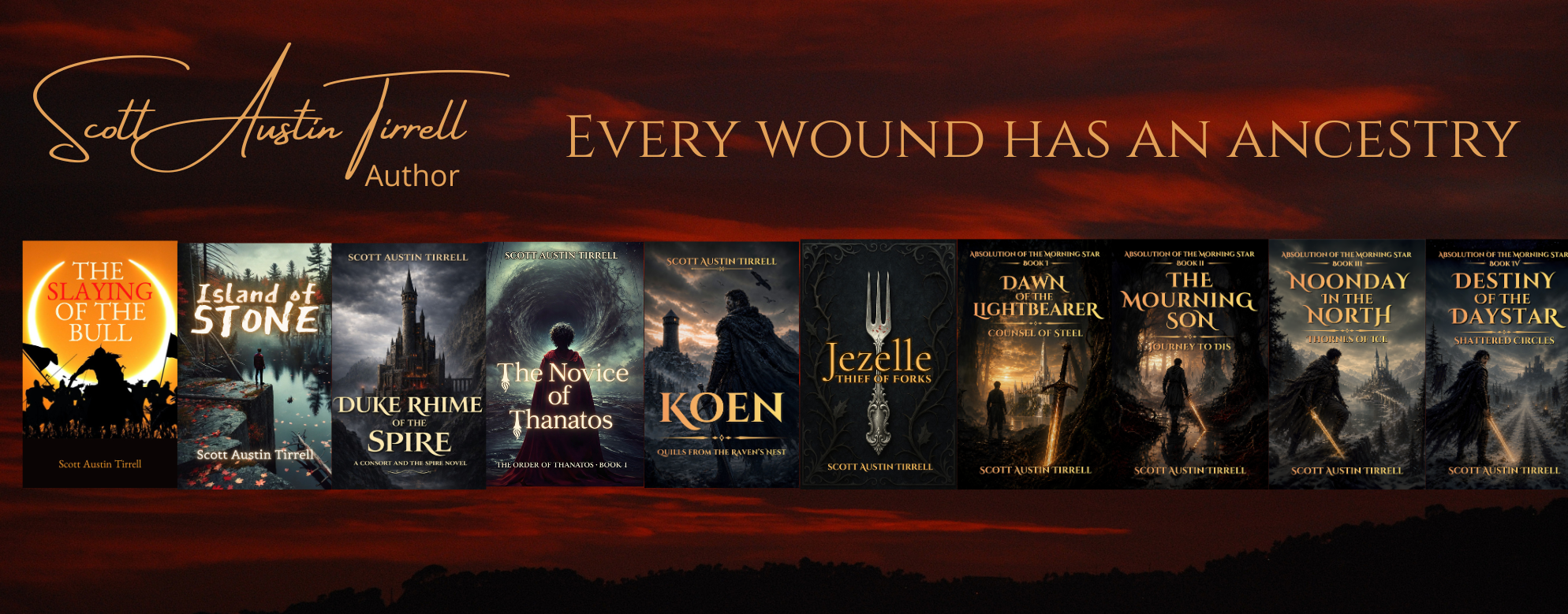
Koen begins as a son who believes in his father’s dream. Emperor Vesper, the great Uniter, the architect of Lucardia’s peace, offers a vision that Koen wants to believe in. He gives everything to it. He slogs through battlefields, leaves his home, abandons love, and walks into the wilderness to face witches and monsters for a miracle. He carries the weight of that dream on his back, believing that if he just suffers enough and sacrifices enough, he can make his father proud. He returns home, changed but not broken, ready to complete his father’s dream.
And that’s when he discovers the betrayal.
Not just political maneuvering or cold disregard, but something more profound. Something Koen never imagined his father was capable of. A betrayal so personal and so terrible, it sets fire to the peace he thought he’d won. The spark of it becomes a cinder. That cinder becomes a blaze. And it all ends with war. Koen, once the dutiful son, becomes the rebel—because opposing his father’s will is the only way he can truly exact his vengeance. Koen’s sacrifice is profound, and in the end, it costs him everything. Vesper has him executed.
Then there is Sylvanus. Condemned for treason, labeled “The Slaughter,” forced to live an existence worse than death, locked away in the ruined stronghold of Runemaul, stripped of title and voice, and left to rot in quiet disgrace. A prince who once stood for change, now reduced to a ghost of memory. His survival is not a kindness. It’s torture.
Erik, Koen’s son, grows up in the shadow of the silence. He never truly knows his father—not the man, only the myth. Koen becomes a name whispered in disgrace, a legacy tied to suffering and ruin. Instead, it’s Brant who raises Erik. A hardened knight. A man of duty more than affection. A stern father figure who makes Erik toil as a blacksmith’s apprentice. But there’s something unspoken in him, something steadfast. He’s not the kind of father stories are written about. But Brant cares for Erik. What began as duty became love—but by the time Erik sees it, it’s too late.
Vesper’s oldest son, Ivar, fares no better. Once the heir to greatness, he grows too bright, too admired. Vesper—ever the visionary, ever the paranoiac—begins to see in him not a successor but a threat, especially in the wake of Koen and Sylvanus’s rebellion. And so, slowly, methodically, he poisons him. Not to kill. To weaken. To unravel. To remind the world that no one, not even a son, rises without his permission.
And then there’s Count Alric in the tale of Duke Rhime of the Spire. No throne. No empire. Just a debt. And a daughter. Evaline becomes his offering—a bride sold to a man of power and secrets. Her marriage is not a union but a transaction. A daughter handed over like a writ of clearance. The cost of his freedom stamped across her future.
But the one that stays with me most is Jezelle’s father—a man who leads his seven-year-old daughter to a brothel and leaves her there. No storm. No shouting. Just the quiet cruelty of walking away. That kind of abandonment doesn’t fade. It calcifies. It shapes everything that comes after. Jezelle doesn’t carry a wound. She carries a world that was shattered too soon, a betrayal few of us can know.
So why write these fathers? Why populate my world with men who fail the ones they’re meant to protect?
Maybe because I fear them. Because I saw glimpses of them growing up—in other homes, in other lives. Because for every good man like my father, there are too many who disappear, or break, or turn the love of a child into something conditional. Maybe, in writing them, I’m facing the fear of absence. Perhaps I’m imagining the world my friends grew up in—the one they didn’t choose—and trying to understand it.
Or maybe it’s simpler than that. Perhaps I’m honoring the man who never became these things. The man who showed up. Who stayed. Who never once traded love for power, silence, or fear. Fiction lets me hold up the worst of what fatherhood can become—and by contrast, I remember what it should be, and I’m thankful for what I have.
The fathers in my books are complicated. Often cruel. Sometimes monstrous. But never forgettable. And perhaps that’s the actual fear—not to be hated by a father, but to be invisible to one. In writing them, I remember. And in remembering, I give thanks for what I have.
Cheers!
Discover more from Author Scott Austin Tirrell
Subscribe to get the latest posts sent to your email.

I think you are exploring the range of what a “man” can be – not just in the fathers but in what they produce. Your fictional fathers are tortured by events that didn’t touch your own life, and you want to see what that made them do. None of us controls our destiny; none of us turns out to be kind – or cruel – unless we wake up to our choices. Otherwise we are shaped. perhaps your own father did awaken: many do when faced with parental responsibility. Others – your fictional fathers – let ‘bigger tides’ rule them. Since those fictional fathers came from you, you might ask whether you have seen ‘bigger tides’ yourself. Could you, perhaps, have become those men?
LikeLiked by 2 people
It certainly makes me pause and think. I’ve chosen not to be a father for many reasons I won’t go into here, but these characters are, in many ways, my children—good and evil—and perhaps writing them is how I explore paths not taken, or choices that might’ve been mine in different tides.
I don’t believe every character we write is an extension of self, but they often spring from questions we’re still turning over. You’re right—many of my fictional fathers are ruled by larger forces. I suppose I’ve felt those currents too, at times, even if my life hasn’t mirrored theirs directly. Maybe that’s why I write them—because I wonder whether, under different stars, I might’ve made the same desperate decisions.
Realistically flawed individuals choosing poorly fascinates me—pure evil doesn’t exist in my world, only people who didn’t know better, or who were faced with impossible or unfair choices. That journey toward awareness—or failure—is the heart of a good story.
LikeLiked by 1 person