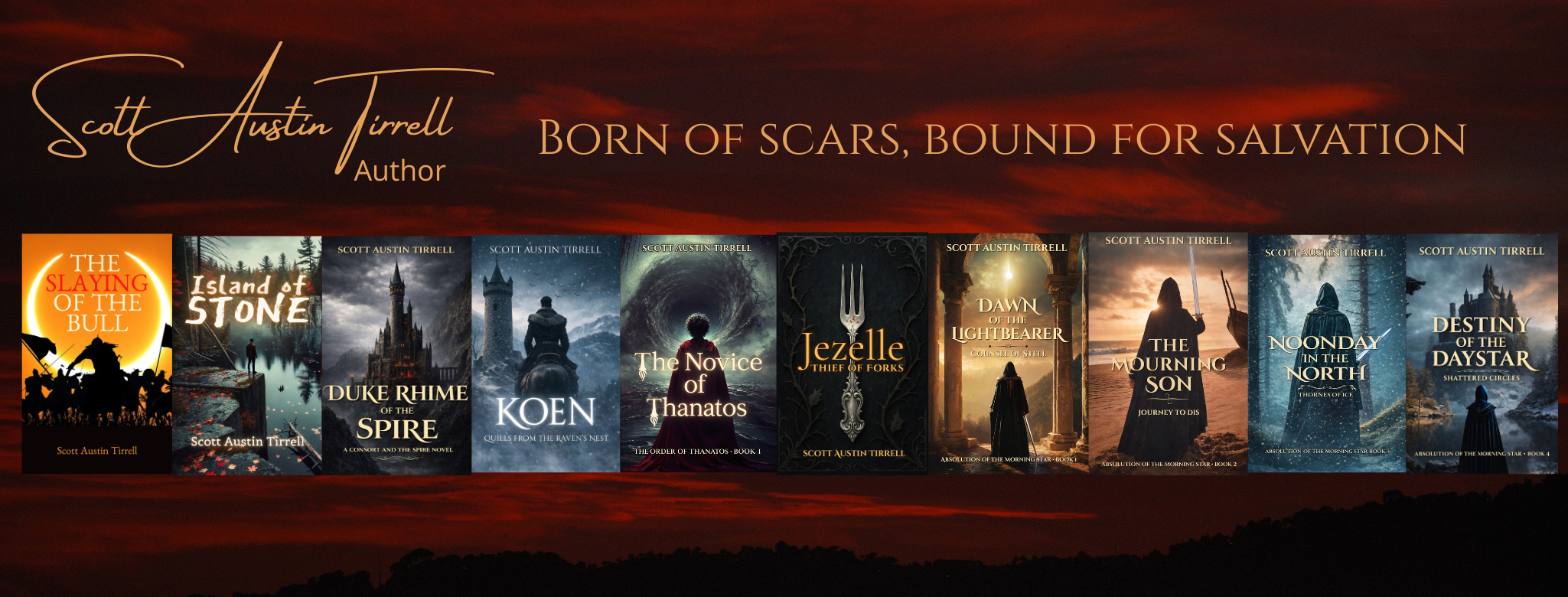

Welcome back to the final part of my six-part series detailing the history of Eldenspire and the family that called it home, the Battenbornes. Duke Rhime of the Spire is available for pre-order now and releases July 29th!
Here is what we learned from Part V. Varion the Cunning (650–670). Duke Varion of Eldenspire ruled not through fire, but through quiet cunning, cloaking ruthless ambition in civility and loyalty. While publicly denouncing magic, he secretly amassed forbidden relics in a hidden vault—an arsenal not for himself, but for a future generation. Known as the Iron Steward, Varion prospered his realm with diplomacy and discipline, yet his growing power drew the ire of King Vaelric. Found dead beside his wife in a sealed room, Varion’s end was shrouded in mystery, but his legacy lived on through his son Rhime—proof that the serpent had only shed its skin.
Now, for Part VI. Rhime and Evaline (670-).
Rhime Battenborne is not his father. Nor is he his grandfather. He is the product of many tests that led to failure. When he took his father’s place as Duke of Eldenspire, he did so without declaration. He received no delegation, no sword, no crown from his childhood friend, the king. He simply sat in the high chair of the Spire, and no one told him to move. But in his stoicism, the realm sees strength and thus, the other dukes named him Presider over the Council of Lords.
But Rhime is ambitious. He had been raised beneath basalt and shadow, honed in silence, taught not to strike, but to wait, for change is coming. When he was fourteen, his father gave him a key to the spire and told him to learn, and so he did.
From 670 to 690, the kingdom of Westerly continued to wither beneath the useless king.
Vaeric of House Drageoir would be the first to tell you he was never supposed to be king. His elder brother, Kallic, was reared from the crib to rule, but his untimely death left the throne to a man expecting a life of ease and little duty. At first, he tried to fill the shadow left by his brother, and was once lauded for his youthful discipline. But, in time, he grew increasingly erratic. His court twisted inward, riddled with advisors from petty families, courtiers loyal to no one, and priests who argued over omens while harvests failed. His wife died without having given birth to an heir, and his mistresses bore him only daughters who died twisted and silky soon after birth. The king aged and grew fat. Now, he cannot sire an heir.
And through it all, the Step grew drier, the Wastelands crept forward, and Eldenspire stood untouched with its dark serpent waiting, watching, coiling, preparing to strike.
Rhime gathers.
He sends no proclamations, yet his influence spreads quietly across the realm. Not in speeches or war cries. In hard silence and unspoken expectations.
The young Duke of Eldenspire is seen at the edge of the world and in the halls of dying lords. He drinks from the same cup as rebels, then watches them hang. He blesses marriages between forgotten houses, then collects the bride’s dowry in blood.
In Rokemoor, an entire village wakes to find its elders dead—their mouths sewn shut with silver thread. In Solbridge, a merchant guild collapses overnight, its vaults emptied and its master drowned in his own counting room. In Cairnhold, the ashes of an old convent no priest can name scatter on a wind, the stone scorched but unburned. Each place shares two things: They were allies to the crown, and Duke Rhime of Eldenspire was there.
Debts long ignored by the Battenbornes are now being called in. Promises are whispered again. Alliances cemented with coin and blood. Ancient pacts—sworn not on ink but on breath and bone—begin to stir beneath the cracked parchment of law. And in the east, the Wastelands grow quiet, as if holding their breath.
Eldenspire, untouched for generations, is now alive with movement: Supplies stockpiled in the hollows. Granaries overflowing. Cisterns full. Riders dispatched without banners. Vaults opened for the first time in centuries. Old books pulled from the dark. Ancient names spoken once again.
Amid this season of transition, Rhime seeks a bride. Evaline Lysena, second-born of a minor house, is sent to Eldenspire to settle her father’s debts. She does not know the true reason, but she’s heard the whispers. The tower waits, and its silent occupants need her more than she knows. Evaline will be tested, broken, and remade. And through that crucible, she will forge a destiny that echoes through the ages.
The serpent has not struck. Not yet. But the stone is warm. And the Spire is watching.
Thus concludes my brief history of the Spire and the family that calls it home. If you wish to discover more about Rhime’s rise and Evaline’s adventures, be sure to check out Duke Rhime of Spire! The book trailer can be found here, and the first chapter here.
Cheers!
Discover more from Author Scott Austin Tirrell
Subscribe to get the latest posts sent to your email.

Excellent 💟
Have a nice afternoon 🌹🌺
Grettings regards 🌎🇪🇦
LikeLike