
Lying in bed last night, I stumbled across a short interview between guitarist-virtuoso Steve Vai and Billy Corgan of Smashing Pumpkins fame. (It still feels strange to call Billy a legend, since I remember when their first album came out.) The clip was from Billy’s new show, The Magnificent Others with Billy Corgan. It reminded me of something that feels obvious only once you hear it: you never know where inspiration will strike.
I’m not a guitarist—I’m a drummer—but I’ve long admired Vai’s playing and, more than that, his devotion to the instrument. I don’t know how to play guitar, but I’ve been around enough of them to recognize god-level mastery. In the interview, the conversation turned toward the difference between discipline and passion. Vai explained that by age thirteen, he was practicing at least eight hours a day, and on weekends, he often pushed for thirty. Corgan remarked on the sheer discipline required, but Vai made a necessary correction.
Discipline, he said, is pushing through something you don’t want to do. It’s grit applied to work you’d avoid if you could—like forcing yourself to do push-ups every night. You may hate every rep, but you know it’s good for you, so you do it anyway.
Passion, though, is different. Passion is the thing you want to be doing, even when it’s difficult. For Vai, those eight-hour days weren’t a punishment. They were the reward. While most kids his age were out with friends, he was locked in with his guitar, not because he had to be but because he couldn’t imagine being anywhere else. At times, it was hard and he struggled, yes, but it was never work.
That hit me like a cymbal crash. I immediately thought of my writing.
Lately, the longer I’ve been at it, the more my process has looked like discipline and less like passion. Every night at six, I shut down what I’m doing and sit down to write for two hours. I aim for at least 1,000 words, ideally 2,000, regardless of my mood. That sure sounds like discipline. But where’s the passion?
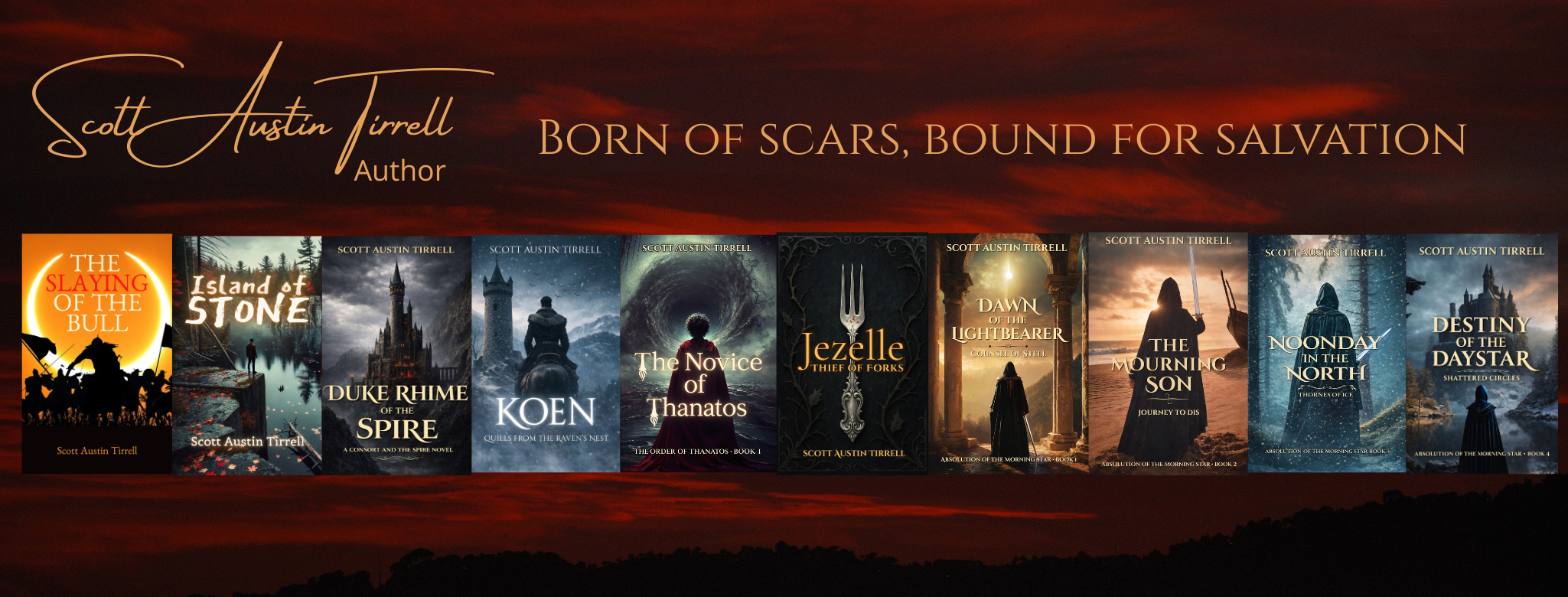
The truth is, it’s been hard to feel passionate about anything recently. The world feels darker. My day job has become a grind. Having my in-laws in town added to the busyness. And in that environment, writing has suffered. I was deep into The Monk of Thanatos, the sequel to The Novice of Thanatos, but its academic setting wasn’t resonating when my workday was already spent in higher education. After hours of university politics and problems, the last thing I wanted was to immerse myself in a fictional monastery-school.
So I paused. I turned instead to Sylvanus, a new project that takes place between Koen: Quills from the Raven’s Nest (which should see the light in October) and Dawn of the Lightbearer, the first book in my Absolution of the Morning Star series. For a while, that shift worked. But then came a quick trip to Seattle to see off the in-laws, and since returning, I’ve struggled to find the groove again.
And the question gnawed: Am I losing my passion?
Because let’s be honest—being a writer often sucks. It demands long hours. It pays poorly. It drowns you in rejection and criticism. Your brain rarely gets to rest, and the cycle never ends. Finish one book, and another waits to begin, with no promise of relief. Under all that weight, it’s easy to slide from passion into discipline—writing not because you love it, but because you’ve built the habit and fear what happens if you stop.
And then you start to wonder: if I’m not enjoying this, why do it at all?
I’ve wrestled with that question more than once. I’ve threatened to quit over a hundred times, and three of those were severe enough that I nearly did. One break lasted almost a decade. Yet somehow, here I am.
Part of the answer lies in the word itself: passion. There are two definitions—one with a lowercase, one with an uppercase. The first is about joy, fire, the thing that lights you up. The second, the capital-P Passion, is about suffering. Strange that a single word can carry such opposite meanings, but in this case, it feels exactly right.
Writing is both. It is joy, but it is also suffering.
And yet, as I sat there turning these thoughts over, I realized something: the passion is still there. It hasn’t gone, even if it’s harder to hear under the static of life. What muddies things is expectation—the fantasy of money or fame. Sure, it would be wonderful to make a living at this instead of clinging to a paycheck from elsewhere. But that’s not why I write, and it never has been.
I write because I have stories to tell. I have worlds that need to exist, ideas that need voices, characters that need flesh. I write because I can’t not write.
When the struggle comes and the words turn to molasses, that’s when I need to remember these truths. Molasses is thick and slow, yes, but it is also sweet. With a bit of warmth and patience, it will flow again.
And so will the words.
Cheers!
Discover more from Author Scott Austin Tirrell
Subscribe to get the latest posts sent to your email.

I am also someone who is driven more by passion than duty (lots of fire in my chart!). My experience has been that when I start to lose that sense of internal motivation, it is often because I am trying to discipline myself AKA force myself to put in time when I don’t feel like it.
Two tactics have (not always, but often) helped me get out of this self-created trap. One is to allow myself choices. I remind myself that if I start working on Project A and I’m not feeling it that Projects B and C are always options! I have gotten some excellent hours on Project Cs driven by my strong desire to avoid Projects A and B (also, laundry! cleaning bathrooms!).
The other is the 10 minute commitment. I commit to spending at least 10 minutes on the first priority project before I give up and move on to something else. It turns out that I hardly EVER spend only 10 minutes… that’s enough to get me in the door (without complaining and resistance) and then the actual pleasure of being inside the project pulls me forward.
LikeLiked by 1 person
This is great advice, and I will certainly use it. Especially the 10-minute rule. The hardest part of writing is starting (followed by stopping).
LikeLike
I enjoy writing. I don’t know if it is a passion, but there is a satisfaction when a small idea becomes a big on and ultimately a full book. I don’t set word totals but I do try to write every day.
Steve Vai is an incredible guitar player and you can see the passion that drove him to his success.
LikeLiked by 1 person
I know what you mean about passion turning into discipline. I also relate to the question of whether to quit writing if the only reason to keep doing it is so you can keep thinking of yourself as A Writer.
I like the idea of committing to a set minimum writing time, whether it’s 10 minutes or 2 hours.
LikeLiked by 1 person
Duty is when you owe someone else – like doing a job because it pays the bills. Passion is when you owe nothing but still want to give pleasure – even if only to yourself. (But why wouldn’t you share it?) A task can embody or hold both. And mingled into those two is ‘curiosity’: wanting to find out how the story becomes complete – reaches ‘closure’. It never does, of course: each trail leads to another and there’s a huge wilderness to explore. Discipline is what holds you to a task even when there’s neither passion, duty nor curiosity. And when you realise that discipline is simply ‘choice’, you can relax into it: make it properly a choice, rather than a chore. Discipline creates space for opportunity. It should never feel that discipline is a self-imposed duty: it’s always a choice ‘in the moment’.
It can seem odd to be sitting in front of a blank page, waiting for inspiration. And indeed, that ‘waiting’ can act as a block. But there are many other tasks we can undertake: expanding the ‘world’ in which our stories are set. We can even explore characters and kingdoms that may never become part of any published tale, but they add ‘colour’ to that world. And that helps passion to return.
LikeLiked by 1 person