
Alan Watts (1915–1973) was a philosopher, writer, and speaker who gained fame for introducing Eastern philosophy to Western culture. His lectures often blended humor with an almost mystical clarity, challenging the way we think about reality. One of his most haunting ideas was that human beings might be “the dreams of gods” — that what we call our lives, identities, and choices could be the imagined stories of a greater mind dreaming itself into infinite forms.
In this view, we are not separate, independent entities, but characters in a vast cosmic play. Just as a dreamer forgets they are the dreamer to experience the dream, consciousness may forget itself to live as you, me, and everyone we know. Our joys, sorrows, and struggles are not meaningless accidents — they are the universe exploring itself through narrative.
This idea resonates deeply with the act of writing fantasy. When a writer sits before a blank page, they take on the role of a dreamer. Out of silence and nothingness, they conjure cities that never stood, gods who never walked the earth, and characters who move and breathe as if they had lives of their own.
The more deeply a writer enters the world they’re shaping, the less they feel like its master and the more they feel like a witness. Characters surprise their creators. They argue back. They make choices we didn’t expect. At times, it feels as though they’re dreaming themselves into existence, using us merely as the channel through which their stories can be told.
Watts often spoke of the universe as lila — a Sanskrit word meaning “play.” In the same way, fantasy writing is a kind of divine play. The writer envisions a stage, populates it with characters, and lets them come alive. What emerges is not just a story but a world, a dream within a dream.
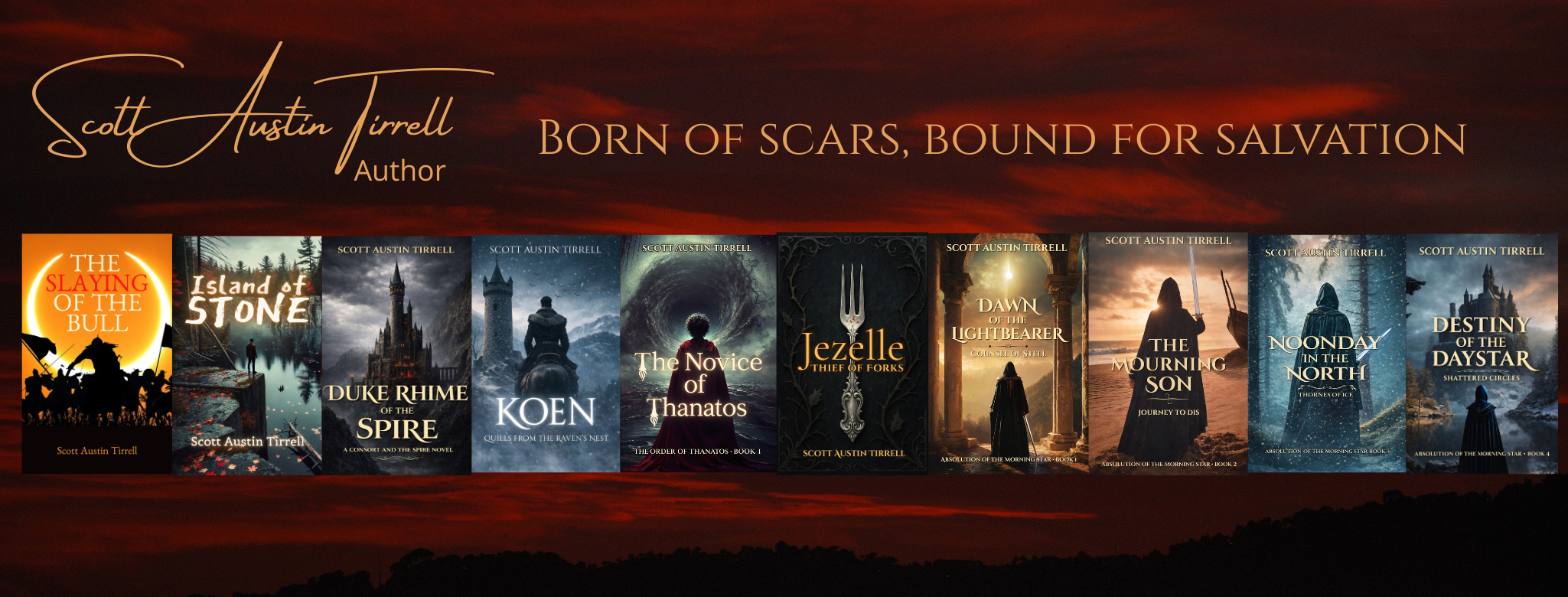
In my own series, Absolution of the Morning Star, this theme beats at the heart of the narrative. The world of Lucardia is steeped in myth, ruled by gods and haunted by the dead. Erikson Gray, the boy who discovers the cursed sword Lightbearer, lives out his destiny while hearing whispers that may or may not be his own thoughts. To him, the sword feels like an external force, but it may also be something more — a dream of an ancient power flowing through him.
The characters of Lucardia — whether monks of Thanatos, thieves in Grafton Notch, or heirs to broken thrones — act out their parts as if their choices are their own. Yet unseen hands tug at the strings: the Red Cloths, the legacy of Ethilopius the Wise, the schemes of gods. This mirrors the way writers craft fiction. We dream up these lives, but within the dream, the characters believe in their freedom.
And here’s where Watts’s idea folds into storytelling: if our own lives are the “dreams of gods,” then perhaps writing fantasy is our way of participating in that cosmic creativity. Just as we breathe life into our imagined heroes and villains, perhaps some greater storyteller breathes life into us, curious to see how our story unfolds.
Fantasy has always thrived on this tension between what is “real” and what is “imagined.” Its worlds are not bound by physics as we know it; instead, they bend around myth, spirit, and wonder. A haunted forest resists being crossed, not because of geography, but because memory and grief themselves take root there. A sword can whisper because the past is not dead — it lives inside us, guiding and consuming us in equal measure.
When readers lose themselves in such worlds, they willingly step into the dream. They suspend disbelief not to flee reality, but to touch some deeper truth: that reality itself is, perhaps, not as fixed or rational as we assume.
So what if Alan Watts was right? What if we are all just characters in someone else’s book?
From one angle, that idea is terrifying. It suggests that our sense of autonomy is an illusion, that our lives might be stories told by a hand we cannot see. However, from another perspective, it is profoundly liberating. If the universe is a dreamer, and we are its dreams, then every joy, every failure, every betrayal, and every triumph has meaning within a vast and living story.
As a fantasy writer, I find that thought deeply inspiring. When I write the Absolution of the Morning Star series, I feel that same paradox Watts described: I invent the characters, but they also act beyond me, as though they are real, as though I am the dream and they are the dreamers.
And maybe that’s the true magic of storytelling — it is not simply escapism, but a mirror. In dreaming up other worlds, we glimpse the possibility that our own world is also imagined, that we are both the players and the play. If we are, as Watts suggested, the dreams of gods, then every story we tell is a way of dreaming them back.
Cheers!
Discover more from Author Scott Austin Tirrell
Subscribe to get the latest posts sent to your email.

“as though I am the dream and they are the dreamers.”
by Paramahansa Yogananda (Excerpts from Man’s Eternal Quest):
Dreams are actually lessons in the working of Cosmic Consciousness. They come to man for a reason; their purpose is to awaken in him a realization of the dream nature of the universe and of the method of its operation.
The sages of India since ancient times have spoken of the universe as a materialization of the thought of God. It is easy to say, of course, that this universe is a dream. But the verisimilitude of “life” in our everyday experiences makes it nearly impossible for us to believe that the world is nothing more than a cosmic dream. It is necessary that we first develop mind power in order to be able to realize that the universe is actually made out of the thought of God and that, like a dream, it is structurally evanescent.
We know that thoughts are invisible. But in dreamland they may be made visible by the force of energy. So originally this whole universe—in the form of God’s thoughts—was invisible, hidden within the cosmic stream of consciousness. Only when those thoughts were crystallized by God’s cosmic intelligent vibration, or energy, did they become visible to us as the material universe.
— Read more: https://yogananda.com.au/py_talks/dream_nature_of_the_world.html
LikeLiked by 1 person
I do wonder why the idea that we are not as ‘autonomous’ as we might think should terrify. We probably wouldn’t mind something wonderful and inescapable. There seems to be some little ‘widget’ in our psyche that can’t bear the thought of ‘fate’ … It needs to be able to explore and not be directed down a single route. Those same Eastern philosophies that Alan Watts favoured tell us that the fear of fate *is* a madness – and that the idea of self-determination is also delusional. But a universe can be ‘random’ – even chaotic – and still not admit of self-determination. If everything is interconnected, how could self-determination be ‘real’?
Perhaps what we really fear is inescapable malice: being the plaything of evil … That’s certainly a rich field for the fantasy author to explore.
LikeLiked by 2 people
Hope feels like the essential ingredient. Whether it comes from believing we can shape our own future or trusting that things will turn out well, that sense of possibility is what keeps us moving. Even if control is an illusion, the belief that we might influence the outcome gives us something to hold onto. Without that, despair creeps in when things don’t go well. As you said, if we could be certain fate was kind, surrendering would be easy — it’s the fear of a hostile fate that makes autonomy feel so necessary.
LikeLiked by 1 person