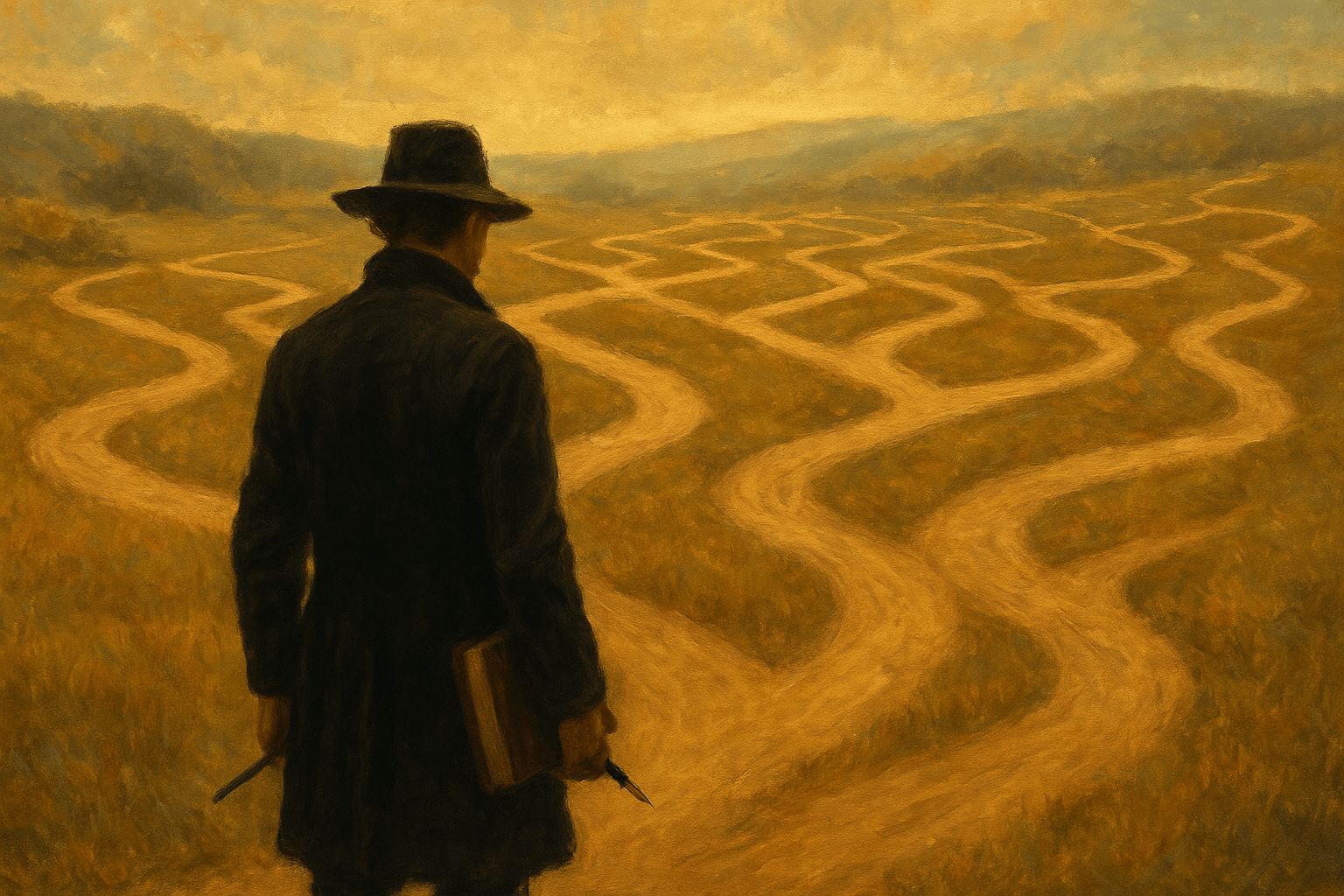
Writing is a system of choices. That sounds simple, almost mechanical, but when you are in the thick of it, the simplicity disappears. Every word is a crossroad. Every pause is a possibility. Every decision branches into another, until a forest of paths stretches out behind you. Some lead to brilliance. Some lead to ruin. And sometimes, the worst part is you don’t know which is which until much later, when you are too far along to turn back without tearing everything apart.
It is both discovery and discipline. I often think of writing as a journey through destinations that are fixed — the city the characters must reach, the climax waiting like a mountain on the horizon — but the roads between them are infinite. That’s where the choices live. Should I start by explaining the problem? Or do I let it bleed in slowly, hiding beneath the surface until the reader feels it before they see it? Do I reveal the heart of the story immediately, or bury it like a treasure that demands to be unearthed? Even the first sentence is a choice of gravity. It may be discarded later, rewritten three times over, but the beginning still matters, because it is the first step on the path, setting the tone for the entire book. The wrong beginning can cast a shadow over every step that follows.
Sometimes, a single decision is enough to change the fate of an entire book. One turn of the wheel, one moment of instinct, and suddenly the road ahead is unrecognizable. That is the danger and the wonder of writing. A choice might open a door into a world you didn’t know existed, or it might lead you to a dead end where the only option is to burn the pages and walk away. I have done both. I have scrapped entire drafts because of one wrong choice. And I have stumbled into revelations I never could have planned, moments that took the story — and me — somewhere I hadn’t expected to go. Those are the gifts and the perils of the craft.
However, instinct, to me, is stronger than logic. The more you try to control the story, the more it resists. If you bind it too tightly with plans, it becomes just that — a plan, lifeless on the page. I prefer to trust that wandering is part of the work. To lose yourself, even to circle aimlessly for a time, is not failure but necessity. Some of my strongest writing has come from those lost hours, from choices that felt like mistakes until they revealed themselves as discoveries.
But instinct has its torment too. The ghosts of other paths never vanish. I often wonder about the choices I didn’t take. Would my stories be more successful if I had framed them differently, if I had followed another trail at the fork? I have left entire books behind because they strayed too far, and even in the ones I finished, I feel the pull of the “what if.” A novel can be haunted by its unwritten versions, and sometimes I wonder if my current work is already falling into that trap. Yet even those doubts are part of the process. A book published is still alive in the author’s mind. It is never truly finished. But that is a good thing, because a book thought as perfect in the writer’s mind will not be a good book.
It isn’t all chaos, though. There are moments when choice does not feel optional at all. A character, once alive, has a will of their own. They will make the decision that is true to them, whether I would make it or not. It may not be the safest or the most pleasing, but it is the right one, because it belongs to the character, not to me. When I lose interest in a draft, when I find myself drifting away as I read it, that is usually why: somewhere along the way, I forced a choice that didn’t belong. I recall that when writing Koen: Quills from the Raven’s Nest, Koen fell ill at one point, which led to a four- or five-chapter diversion. It was something like 15,000 words. Somehow, in his delirium, the whole story got pulled off track. When he came to, I was like, “How did I get here?” In the end, I decided to scrap it all, and it didn’t impact the story one bit. They were good chapters, but they didn’t truly represent the character. It led him to strange decisions and felt like a dream. I suppose I could have played with that, but the book was too long anyway, and cutting those chapters brought it to a more marketable size.
And so the act of writing is never about perfect control. It is about listening to the story, about walking a path you cannot see in full, about trusting that the road will meet you as long as you keep moving. Each choice is a step, some wrong, some right, some that lead to dead ends, some that open into vistas you never could have imagined. That is both the risk and the reward. Writing is not a straight march toward a conclusion. It is a labyrinth of decisions, and the beauty is that sometimes the wrong turn is the only way to find where you truly need to go.
Cheers!
Discover more from Author Scott Austin Tirrell
Subscribe to get the latest posts sent to your email.

That was a lovely journey into the jungle of decision trees and the magic of it all, especially that relationship between writer and story, the odd ways they work together. It’s one of the things I find most daunting about novel-length books, it feels like a game of Jenga. And you can definitely trace mis-steps back to those line-by-line choices. Best almost not to think too hard about it or I’d never do it again, ha! Thanks for sharing your experience and opening the control panel for us to have a look Scott.
LikeLiked by 1 person
This is exactly why I will never use AI for writing. It’s a shortcut around the process you describe here.
LikeLiked by 1 person
Perhaps some of those turns that are discarded are ways to learn more back story about the character?
Speaking of word choice, I encountered what I believe is an incorrect word choice in Koen, which also distracted me in AMS: query (a question) is used when what was intended (I believe) is quarry: a person or animal being hunted or looked for (also, confusingly, an open pit mine). English is an absolute gold mine of words and meanings!
LikeLiked by 1 person
Thanks, Holly. I reported it to Grendel Press to make the edit. I’ve gone through the book twenty times, and my editor missed it, too. Good catch! Gold mine is not quite the word I would use, quagmire maybe 🙂 But who doesn’t like a good swamp?
LikeLike
I imagine the Knights of Norn may have rather mixed feelings about all things swampy…..
LikeLiked by 1 person
This is very true 😉
LikeLike
Chapter 25, p. 448 in the Kindle version, Wendell and Matheson talking just before they enter the strait. Wendell says “Pull in the SALES” which should be “Pull in the sails”
LikeLiked by 1 person
Thanks again! I had hoped having a editor would avoid these issues 😉 Your last catches have been addressed and I will send this one along to them as well.
LikeLike