I constantly struggle between being a writer and a bookseller. Really, I just want to write, but why write if no one reads it? So, one necessitates the other. I’m a decent writer. I can at least give myself that credit. It is hard-earned after struggling with self-doubt for years. But I’m not such a good bookseller. Two weeks away from all things writing and selling allowed me time to rethink my approach. Below is what I came up with. It is probably nothing novel, and some of this I have always known, but systematically laying it all out helped me untangle the mess.
Selling a book is not about convincing someone to buy a story; it’s about convincing them that your story gives them something they need. Every writer learns this lesson at some point, though usually the hard way. We begin by writing what obsesses us — our fears, our questions, our ghosts — and in doing so, we forget that a reader opens a book not to admire the author’s craft, but to feel seen. Readers seek out stories that name their hunger, soothe their loneliness, and offer meaning where life has failed to provide it. The work that endures does so not because it is clever or well-marketed, but because it fulfills a fundamental human need.
For a long time, I resisted thinking of my stories in those terms. It felt commercial, almost clinical, to reduce art to needs. Yet the longer I wrote, the more I understood that the needs we fulfill as storytellers are the exact needs that drove us to write in the first place. Every novel I’ve written began as a way of giving shape to questions I couldn’t resolve. What does faith mean when the gods are silent? What does love become when it’s entangled with power? What remains of a person when the world strips away their worth? These questions pulse beneath the surface of my books, and they’re not unique to me. They are the silent ache that drives readers to stories of loss, transcendence, and defiance.
Understanding this doesn’t make the work cynical; it makes it honest. When a writer knows what emotional hunger their work answers, they write with precision. They stop chasing trends and begin writing toward the pulse of their readers’ inner lives. For me, that pulse beats strongest in the tension between death and meaning, power and corruption, survival and identity. My characters — Erik, Koen, Jezelle, Mishal, and Evaline — were born from these needs. Each of them is trapped in a system that defines their worth and must choose whether to accept it or destroy it. Through them, I’ve come to see what my books truly offer: not escape, but recognition.
In Absolution of the Morning Star, Erik begins as a boy who believes the world can still be saved. When he takes up Lightbearer — the sword that holds a fallen angel within — he is seduced by the promise of purpose. The sword whispers meaning into his emptiness, and for a while, he believes it. Erik’s journey is not about heroism, but about the seduction of destiny—the lie that power can redeem the broken. His story fulfills a need that many readers carry quietly: the longing to believe our suffering has purpose, even as we fear that it doesn’t. In Erik’s hands, Lightbearer becomes both salvation and damnation, a mirror of the human desire to find meaning in the very thing that destroys us.
Koen, Erik’s father, embodies another hunger — the need for atonement. A man who once believed he could rebuild the world through strength, Koen lives in the wreckage of his own decisions. His every act is an attempt to balance the scales, to prove that redemption is still possible in a world where the sacred has rotted. He resists his fate at any cost. Readers connect to Koen because he represents the exhaustion of trying to be good when goodness no longer seems to matter. His strength is haunted, his victories hollow. Yet there is dignity in his persistence, and that is what readers cling to: the idea that even in ruin, one can still act with purpose, that something pure remains after everything is stripped away.
If Erik’s story speaks to those seeking meaning, Koen’s speaks to those who have already lost it and are trying to rebuild from the ashes. Both characters inhabit a moral landscape where faith and corruption are indistinguishable. This world is not fantasy for fantasy’s sake — it’s a stage where readers can wrestle safely with their own disillusionment. The gods of Lucardia are metaphors for the systems that define us: religion, empire, and inheritance. By watching these characters question the very foundations of their reality, readers are given permission to question their own.
In Jezelle: Thief of Forks, the need shifts from metaphysical to visceral. Jezelle is not seeking meaning; she’s seeking survival. Given to a brothel as a child, abandoned by her father, and forced to grow up in the filth and cruelty of Grafton Notch, Jezelle’s world offers no illusions of divine order. What she seeks is control — the ability to reclaim her body, her story, and her name. Her journey fulfills the reader’s need for resilience in the face of violation. It’s not about triumph; it’s about endurance.
Jezelle’s survival resonates because it refuses to be clean. She doesn’t transcend her trauma; she carries it, weaponizes it, and learns to live alongside it. Many readers come to dark fiction not because they enjoy suffering, but because it tells them the truth: that pain doesn’t always resolve, that healing isn’t a straight line, and that sometimes the only victory is surviving another day. Jezelle gives voice to the rage and silence of those who were never supposed to survive. Through her, readers find catharsis — the brutal kind that burns rather than soothes.
Mishal, from The Novice of Thanatos, fulfills a different but related hunger: the need for truth within a corrupted faith. His story is about obedience, doubt, and the courage to see what others refuse to see. When Mishal arrives at Thanatos, the monastery dedicated to guiding souls across the Threshold, he believes he is entering a holy order. What he discovers instead is a machine built on silence and sacrifice. The priests who speak of salvation are also its jailers. Through Mishal’s eyes, readers confront the institutions that claim moral authority while hiding their rot.
What Mishal’s story offers is not rebellion for its own sake, but the search for a spiritual honesty that religion often denies. Readers who have grown up in systems of belief — be they religious, familial, or cultural — understand the terror of realizing that the thing you worshipped may be hollow. Mishal’s defiance gives them a language for that disillusionment. His promise to expose the corruption of the Order, even if it destroys him, fulfills a deep psychological need: to see hypocrisy unmasked and innocence transformed into conviction.
In the world of The Order of Thanatos, death is not the end but the mirror. The Threshold, the boundary between life and what lies beyond, becomes the book’s central metaphor. It is the line every person must eventually face — the moment when belief collides with truth. Writing these stories has taught me that readers don’t fear death as much as they fear the meaninglessness of life. When Mishal learns that crossing souls is not a transcendence but an imprisonment, he speaks to that primal dread: the possibility that all our striving serves a power we do not understand. And yet, his choice to keep seeking truth, to keep walking toward the darkness rather than away from it, affirms what readers most want to believe — that awareness itself is a form of salvation.
Evaline, from Duke Rhime of the Spire, inhabits yet another kind of need: the hunger for love that does not destroy the self. Her story begins with duty — a young noblewoman married off to a man whose darkness is both seductive and suffocating. Rhime Battenborne is not necessarily a monster, but he is human with many faults, and therefore has the potential of becoming one. Evaline’s journey is a descent into the heart of love’s corruption, where devotion becomes captivity and passion becomes ruin. Does she join Rhime in his fall, or is she strong enough to let go and let him slide into his own ruin? Readers who have loved destructively recognize themselves in her. She embodies the question that so many are afraid to ask: how do you love someone without losing yourself to them?
Through Evaline, my work confronts the intersection of romance and horror — the way intimacy can mirror possession. Her world is not lit by hope but by fascination. Yet within that darkness is the reader’s need for transformation. Evaline’s strength is not in escaping Rhime, but in learning to see clearly the spell he has cast — and choosing to survive it no matter what. In a world that romanticizes suffering, her clarity becomes a form of rebellion.
When I step back from these characters — Erik with his cursed purpose, Koen with his exhausted faith, Jezelle with her feral will, Mishal with his sacred doubt, Evaline with her fatal love — I see the shape of the need my books fulfill. It is the need for meaning amid decay. My readers are not seeking easy answers; they are seeking recognition of their confusion, their grief, their quiet rebellion against a world that feels both godless and suffocatingly divine. The stories offer a kind of mirror, not of what is good, but of what is true.
This understanding will change how I write and how I speak about my work. When a reader asks what my books are about, I will no longer say, “They’re dark fantasy about faith and death.” I will say, “They’re about finding truth in corruption and what it costs to survive when meaning collapses.” Because that is what readers are really looking for — not another world to escape into, but a world that reflects their own fears back at them in a way they can endure.
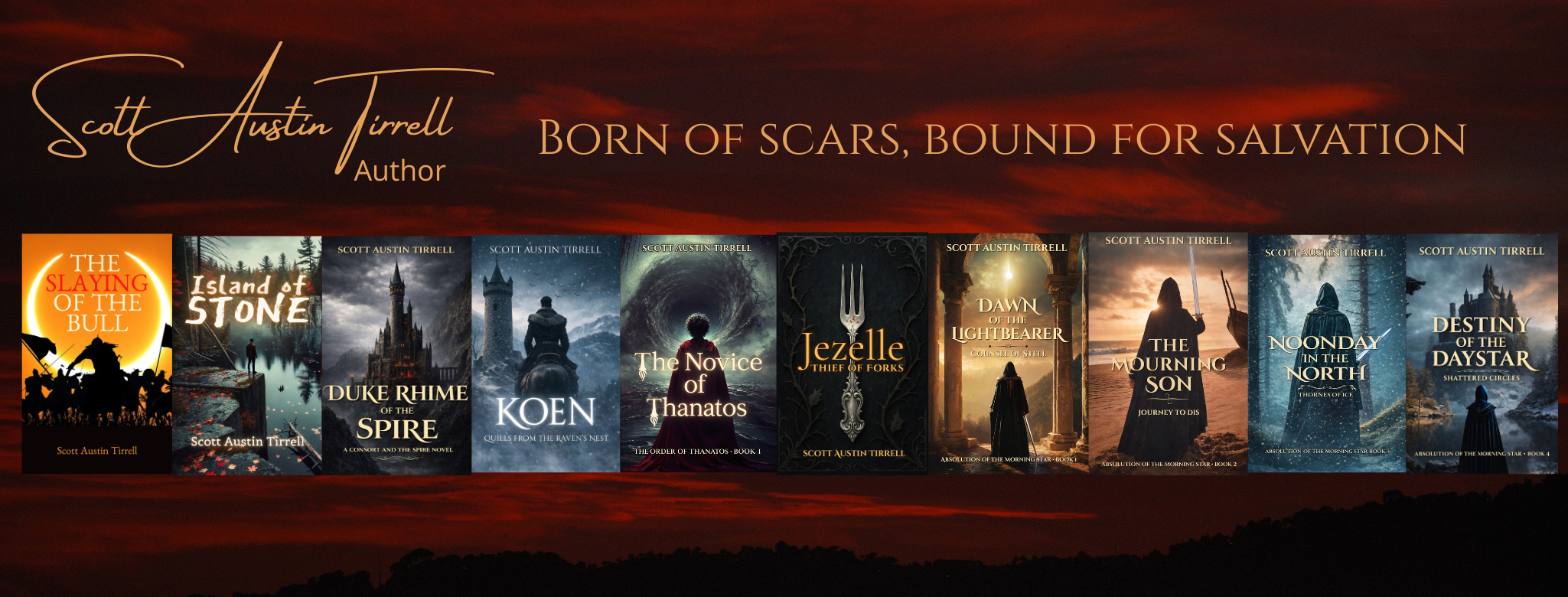
Knowing the need my books fulfill has also changed how I will think about selling them. Marketing often feels antithetical to art, but it doesn’t have to be. It’s not manipulation; it’s connection. It’s an invitation. To sell a book honestly is to say, “This story may give you what you’re missing.” A reader who picks up The Novice of Thanatos isn’t just looking for gothic monasteries and forbidden knowledge; they’re looking for something that tells them their doubt isn’t a sin. A reader drawn to Jezelle: Thief of Forks isn’t seeking spectacle but validation — proof that survival, even when it’s ugly, is still sacred. And the readers of Absolution of the Morning Star, Koen: Quills from the Raven’s Nest, or Duke Rhime of the Spire are reaching for something that explains why the light hurts as much as the dark.
Every writer must answer the question: Why does this matter to anyone but me? For a long time, I mistook worldbuilding for meaning, as if the depth of the lore could replace the depth of feeling. But the more I wrote, the more I realized that mythology is only a vessel. The true substance is empathy — the moment when a reader sees themselves, distorted but recognizable, in a character’s ruin. When a reader tells me that Jezelle made them cry, or that Mishal’s defiance reminded them of questioning their own faith, I understand what I’ve given them: not answers, but language for their own silence.
We live in an age of noise, where stories compete not for attention but for emotional bandwidth. Readers don’t need more stories; they need stories that see them. That is what gives a book life beyond its publication date. That is what turns an invented world into a mirror. Discovering the need your work fulfills is not about branding — it’s about intimacy. It’s the recognition that somewhere, a stranger will open your book and find their own reflection trembling in your sentences.
For me, that reflection is always the same: a soul standing at the threshold, unsure what lies beyond, but stepping forward anyway. Erik does it when he lifts Lightbearer. Jezelle does it when she escapes the brothel and runs into the cold streets. Mishal does it when he vows to expose the Order. Evaline does it when she looks into Rhime’s eyes and finally sees the truth of what he is. Koen does it every time he keeps walking, even when he no longer believes there’s a path left to follow.
That is what my books give: the courage to walk into the dark and keep searching for meaning. Not because the light will save you, but because you’ve decided you’re worth saving.
Cheers!
Discover more from Author Scott Austin Tirrell
Subscribe to get the latest posts sent to your email.

OMG, Scott! What an extraordinary essay you’ve written! Thank you for the gift of your insight.
LikeLiked by 1 person
I suspect you’re over-thinking. When people read a book that’s labelled (marketed) as ‘fantasy’, they want a story that explores being human. We’re not gods but we can be heroic. And when handed short shrift, we can survive with dignity and ethics intact. We know there are ‘bad people’ out there but each of us feels we can be ‘better – even as we also find out that we aren’t ‘good people’. We all harbour our sins and regrets. Each of your characters tries to be good but – thankfully – ends up being human. In Dark Fantasy, we expect our villains to be especially forbidding. We expect them to cast grim shadows and to crush humanity out of those who oppose them. We therefore expect the heroes and heroines to have a nugget of integrity that makes them face their fear – as we wish to do.
So then – how to stand out in a crowded market … Show the darkness (which must be convincing); show how it corrupts; and then show how the integrity of your hero or heroine saves them. Integrity is what the dark antagonists have lost; they surrendered to power and they ended up being puppets to something even darker. But integrity won’t let us take what others have and need. It won’t let us crush and ruin and it won’t let us just roll over to be crushed and ruined. Frodo doesn’t ‘defeat’ Sauron; he remains Frodo – even when he loses almost everything. Sauron doesn’t ‘die’ but Frodo’s act frees the Men who had been turned into Nazgul. It breaks all the power that Sauron had invested in the binding and his spirit was again forced out of Middle Earth.
Distill out the humanity of your hero or heroine. Find the actions in your story where their humanity is tested – where they might have surrendered but didn’t; where they might have been crushed but escaped (quaking with fear). Weave a much shorter story (just one quarter of a page of A4) from those elements: one that leaves readers wanting to explore the bigger story of your book. Luck is ok,. but it’s integrity that matters.
Keep up the writing. And good luck on the journey to understanding how to market your works. A good agent will help, but you’re the creative one.
LikeLiked by 1 person
The printed word magically allows stories to reach people the writer has never met, even long after the writer has passed on AND yet, ultimately, stories that resonate connect back to the primal magic of stories told around the fire, when the teller can see the faces absorbing the words and the magic — resonance in real time. I hope in a small way these comments on your blog help you see our faces, firelight flickering in our eyes, more clearly as you write.
LikeLiked by 1 person
I couldn’t agree more. Writing is so solitary, and if you let it, you can become disconnected. This blog, although it can be a labor, allows me to connect in a small way with my readers, and therefore, it is a labor of love.
LikeLike