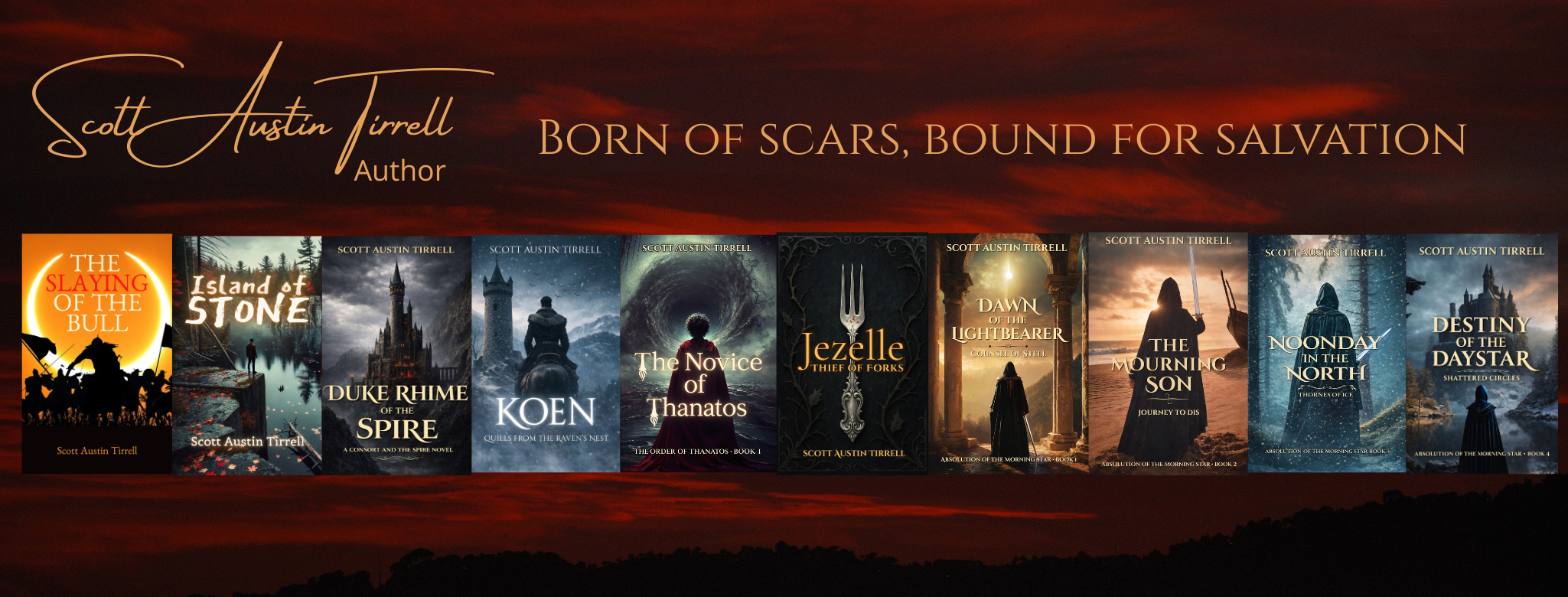
I’ve been plunging into the weeds of reworking Jezelle: Thief of Forks, the darkest story I’ve written thus far. I’m on chapter 22 of 28, so I’m getting there. Before I began this dissection, I thought it was the best book I had ever written. It is humbling to see how much better it is becoming when pushed to dig deeper.
To understand Jezelle, I’ve truly had to dig, deeper than I expected—into the sharp places where instinct overrides desire, where survival eclipses intention, where hope is a fragile thing that keeps trying to rise only to be crushed again. I don’t want to drown readers in despair, but I refuse to turn away from the truth of what suffering is, or from the quiet miracle of taking one more step when the world offers nothing but shadows. Jezelle will assume a very prominent role in my Lucardian universe and the ability to rise to that moment requires a backstory of struggle. I won’t go into why I felt compelled to write such a dark tale—only that it felt right at this moment.
What I keep learning, through her, through others, and even through my own path, is that intention isn’t always enough to shape a life. We like to imagine every character—every person—moving toward the light, toward change, toward some fragile version of hope. It’s comforting to believe that people naturally strive upward and will find their happy ending. But many do not move by choice at all. Their intentions flicker like stubborn candles, but the forces acting on them—danger, loss, poverty, power, cruelty—are stronger than whatever direction they would choose for themselves. They go where they are pushed, not where they long to go.
Hope for people like this is not a compass. It’s a spark easily extinguished. Traumatized people aren’t incapable of intention or desire—they simply live in worlds where intention matters less than survival. They may reach for something better, but the current drags them past, carrying them toward some unknown bend in the river. Some grow up so long in uncertainty that they already know: if they reach for that rock, it will slip from their fingers. Sometimes it is safer not to grasp at hope. Sometimes it is safer simply to go where the river takes you.
Darkness becomes familiar not because they chose it, but because they have no say in where life carries them. Meaning gathers there not as philosophy but as clarity: pain forces recognition in ways safety never can.
Jezelle is full of small intentions—tiny hopes she guards in the corners of her mind. She wants safety, warmth, choice. But the world does not care what she wants. She flees Ruby’s Roost not because she believes a better life is waiting outside that door, but because the door opens for a single heartbeat and the force of opportunity pushes her through it. Every time she finds a new flicker of hope—a new light to cling to—the world snatches it away and drags her somewhere darker. Her intentions spark movement, but the world decides the direction. Still, she keeps reaching, keeps imagining that maybe this time she’ll land somewhere she can breathe. Even shattered hope gives enough momentum to take the next breath.
Readers connect with characters like this because not all healing happens in bright places. Some heal sideways, in motion, in defiance, in the stubborn refusal to stop breathing. Some heal not by escaping the forces that shaped them, but by learning to carry themselves through the current anyway—sometimes even swimming with it, even if the destination is ruin.
And when the darkness finally stops feeling like a personal flaw—when they understand it as the predictable imprint of the world that pressed down on them—something shifts. Not redemption. Not revelation. Just a necessary truth: the darkness isn’t who they are. It’s the shadow of the world they are forced to live in. And maybe—just maybe—there is a light waiting around the next bend in the river.
Hope may be the ending for some stories. But for others, survival is the ending—continued breath, continued movement, the faintest thread of autonomy in a world determined to absorb it. The victory isn’t escape. The victory is endurance.
Not everyone is searching for hope. And there is nothing less human about that. In fact, it may be the truest story we ever tell.
Cheers!
Discover more from Author Scott Austin Tirrell
Subscribe to get the latest posts sent to your email.

We are not light or dark according to what we do; we are light or dark according to the choices we make – even if those are then shattered by the world around us. And we can have hope even if the world continually crushes it: the hope that we have light within us, even in the heart of darkness. You write a good teaser for Jezelle’s choices.
LikeLiked by 1 person
Thanks! Jezelle is the the thief of forks after all 🙂
LikeLike