
As many of you know, I stepped back from blogging to focus on my fiction. It has given me time to rethink and reevaluate. I’ve been doing a lot of soul searching, holding up the mirror and seeing what I see. I’m coming up on the sixth year of this journey. In my last post, I reviewed my accomplishments for the year, as I always do around New Year’s time, but it is important to take stock of more than just numerical metrics. Hence, this confession. I’ve written about some of this before, but I keep coming back to it as I try to work it out within myself. I hone and refine, trying to find its pulse. I write this not as a pity party, but because putting it down here makes me accountable to you, and, more importantly, to myself.
My name is Scott Austin Tirrell, and I refresh the page like it’s a sacrament.
Not the holy kind. The millennial kind: thumb, glow, silence. Thumb again. Silence again. If my books had a heartbeat, I’d be that person in the ER slapping the monitor and yelling, Come on. Do something.
And look — I know how this sounds. I know there are bigger problems in the world than my Amazon dashboard not throwing confetti (that is more true now than at any point in my life). But my nervous system doesn’t care about perspective. It cares about proof. It cares about being seen. It cares about the simplest, dumbest, most human thing:
Does any of this matter to anyone but me?
When I say “external validation,” I mean all of it. Reviews. Ratings. Sales. KU pages. DMs. A comment from a stranger. A repost. An agent request. A line in an email that suggests a living, breathing person engaged with my words and didn’t immediately fling them into the sea. I find myself craving the glory! And I chase it the way you chase a dropped coin down a storm drain: with optimism that borders on delusion.
Because here’s the ugly truth I must admit to myself: I have a visceral need for external validation of my fiction writing, and it’s unhealthy. I know this. I’ve been told this by others. It’s not the harmless kind where you’re like, “Oh wow, someone liked my book, neat!” It’s the kind where every quiet day feels like a verdict, and I live under it.
And it’s every day. Not “sometimes.” Not “when I’m feeling insecure.” Every day. It puts me in a mode of stress I can’t escape, and it is starting to impact me physically.
People can explicitly tell me I’m a good writer. I can even be proud of the work—truly proud—and still catch myself asking the same stupid question like I’m checking for weather:
Okay, but did anyone really notice?
When the response trickles, it’s hard to build self-confidence. That’s not me being dramatic; that’s just math. Confidence is supposed to be a structure you build from within, sure. But try building that structure while you’re also holding it up, and the only scaffolding you ever get from the outside is… a polite silence.
My brain does what brains do: it fills the silence with a story. And the story is always the classics.
No one cares.
You’re wasting your time.
You’re not as good as you think.
You’re not good at all.
You’re an imposter.
You’re an extra in the narrative of your life.
It doesn’t help that I write dark fantasy that asks readers to invest, think, and let it linger. I don’t write empty stories. I’m not trying to produce cotton candy for the algorithm. I’m trying to build architecture. Interconnected narrative. Depth in character and worldbuilding. Those “ah ha” moments that make someone put the book down and stare into the middle distance like they’ve seen a ghost. I want my work to be rich and substantial.
And that might be part of the problem.
Because the kind of fiction I’m making doesn’t always do the quick little tap-dance that earns instant applause. It asks something of people. Mental investment. Attention. Discomfort. Time. The most expensive currencies we have.
But when the response is slow, it doesn’t feel like, “oh, that’s normal,” or “this made them uncomfortable, and they need a moment.” It feels like I built a cathedral and everyone walked right past it to go buy popcorn.
Now. Sometimes the validation hits. Sometimes there’s a sale, a review, a message, a tiny flare in the dark. And it feels incredible–for about fifteen seconds. It’s a brief excitation. A spark. A little jolt of Yes, okay, I’m real, I’m doing it, I’m not crazy. Then the doubt creeps back in like fog under a door.
What’s worse: the negative response doesn’t fade. The negative response sets up a little chair in my brain and starts paying rent. I still go back to negative reviews from years ago, like they’re scripture. I can recite them. I can feel them.
Positive ones? I almost never reread. Because apparently my brain has a strict policy: compliments are fleeting; criticism is a tattoo.
This is part of being an older millennial, I think — right on the Gen X border. I didn’t grow up drowning in participation trophies. They existed, sure, but they weren’t the culture. But I did grow up being praised for specific things: intelligence, wit, creativity. I was the best artist in my class; my yearbook has the superlative as proof. I was known for my drumming and received standing ovations from hundreds for drum solos. That kind of validation is clean and direct. People see you do the thing. They react in real time. The feedback loop is immediate.
Writing came later. And writing is lonelier. You send the work out like a message in a bottle, hoping it washes ashore to people waiting and not smashed on the rocks. And because writing came later, there wasn’t that early chorus saying, “Yes, this is your gift.” There were sales and reviews, the occasional reader who shows up like an angel with a lantern—rare, cherished, almost mythical. Most of my inner circle doesn’t even read fantasy. So my validation source becomes… the void.
And the void is not a nurturing mentor.
I only joined social media because of writing. X wasn’t some childhood playground for me—it was a megaphone I picked up because I thought, “Well, if I want people to find my world, I have to go where people are.” I stepped into the community, learned the dance, tried to promote the work, and tried to be visible.
And I’ve learned something vicious: visibility is not the same thing as being valued.
Right now, I’m revising Jezelle: Thief of Forks after feedback from a dream agent. I did the work. I tore the book apart for almost three months, then rebuilt it. I’m on my last read-through. I started querying again, even though it’s not the ideal season and I’m staring down the grim little reality that I’m going to run out of agents.
And here’s the sting that keeps catching in my throat: the dream agent passed after requesting the full manuscript. She gave helpful feedback. I applied it. I reached out to see if she’d take a second look.
No.
If you’ve never been in that position, it sounds simple. Professional. Clean. “Not for me.” But emotionally? It feels like you ran a marathon because someone told you the finish line mattered, and when you arrive, sweaty and wrecked and hopeful, they’ve already packed up their banner and gone home.
I wouldn’t say it shattered me. It didn’t. It hurt, absolutely. But I get it. No hard feelings. The more rejection I get, the less it stings. Not because I’m stronger—because I grow numb. Like I’m developing calluses. And it’s at this exact point that external validation becomes truly poisonous, because I start bargaining with the universe again.
Just let me sell a book a day.
That’s it. That’s my immediate desire. Not to be rich. Not to be famous. Just to know there is someone out there stepping into my world. A book a day at roughly $2 royalties per book means $730 a year. This gives you a sense of my ask of the universe, and where I fall as a writer. Now, for my dream? If I could only make enough writing fiction that I could do it for a living. Comfortable. Stable. Doing what I love without needing to justify it like a guilty pleasure. That would be bliss.
But that dream feels so far away, and when I dwell on it, I start chasing approval like it’s a life raft. Like if enough strangers say “good job,” I won’t feel like an extra in my own life. That the approval will build and spread and grow.
Which brings me to the part I’m trying to change. I’m tired of living like my work isn’t real until someone else stamps it.
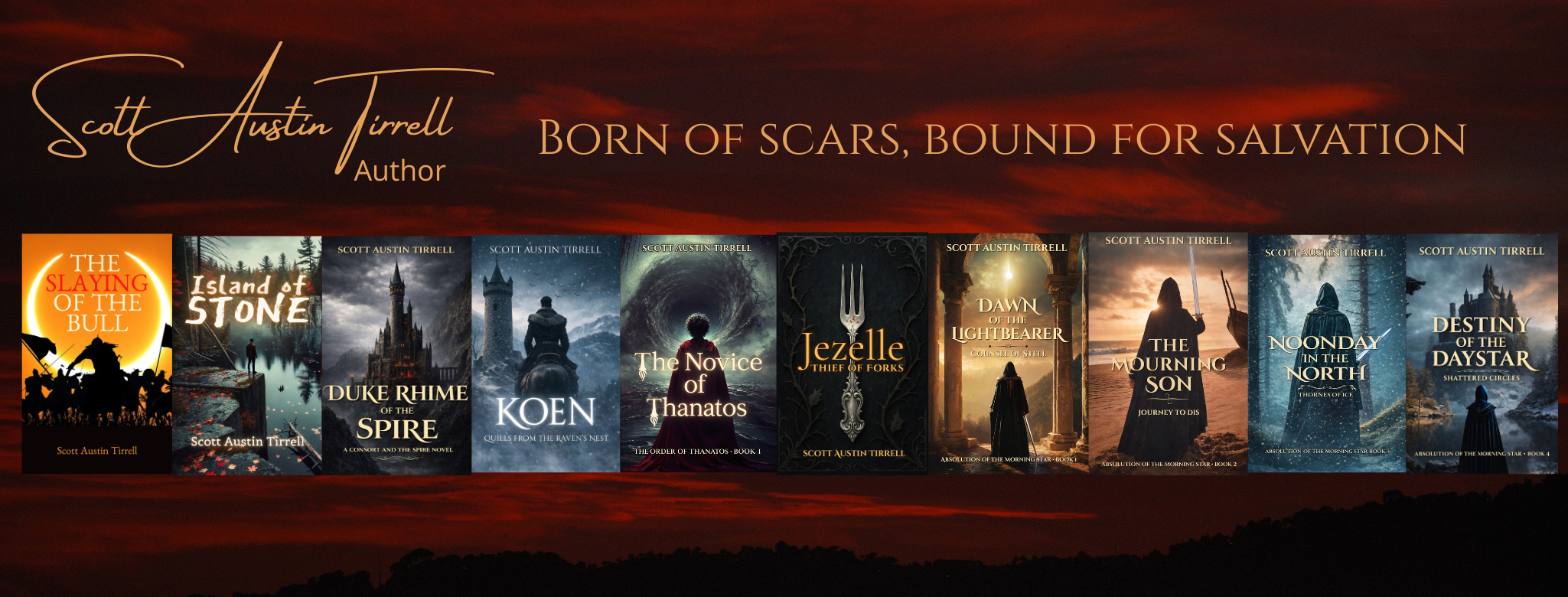
I’m proud of my books. All of them. The Absolution of the Morning Star series. Koen: Quills from the Raven’s Nest. The Novice of Thanatos. Duke Rhime of the Spire. The Slaying of the Bull. Island of Stone. The worlds I’ve built, the characters I’ve bled into existence — they are not nothing. They are not filler content. They are not “cute little projects.”
They’re real. They took years. They took pieces of me.
And my desire to share them is natural. It’s human. It’s part of the contract of art: you make a thing, and you hope it touches another person. But my problem is this: I’ve been treating validation like oxygen instead of dessert. So I’m trying to do something that feels both obvious and incredibly hard: I’m trying to validate the work from inside the work. Not in a delusional “I don’t need anyone!” way. I do need people. I want readers. I want a connection. I want the books to travel. But I’m trying to uncouple “I can keep writing” from “someone approved of me today.” Because if my ability to continue depends on the world’s applause, I’m going to spend my whole life performing CPR on my own motivation.
And I don’t want that. I don’t want to write like I’m begging. I want to write like I’m building.
Internal validation is quieter. It doesn’t arrive as a notification. It doesn’t spike your blood sugar. It doesn’t give you the quick high. It’s more like a deep, steady fire. It’s finishing a draft and knowing—without anyone else saying it—that the bones are strong. It’s rereading a scene and feeling that sharp little satisfaction: Yes. That’s the line. That’s the voice. That’s the depth I wanted. It’s recognizing the craft is improving. The decisions are getting cleaner. The themes are getting sharper. The world feels more lived-in, more haunted, more true.
It’s also accepting that the best things in life don’t come when you’re strangling them.
I believe this, even as I struggle with it: if you desire something too much—if you stress over it day and night—you push it further away. You narrow your world to one outcome and call everything else failure. You build a shrine to a future that doesn’t exist yet, and then you kneel at it until your knees bleed. The best things in my life have shown up sideways. Unexpected. Not because I worried them into existence, but because I kept moving and they simply appeared.
So this is my realization. Not a pity-party. A refocus.
I’m going to keep writing dark fantasy that requires mental investment. I’m going to keep building interconnected stories with depth and “ah ha” moments. I’m going to keep making work that isn’t empty, even if the world sometimes prefers empty because it’s easier to consume. And when the external validation comes—and I hope it does—I’m going to let it be what it is: a gift, not a god. Because the truth is, I can’t live my creative life refreshing a page like it’s going to tell me who I am. I have to decide that. I have to decide that my work has value before it is witnessed. Not because I’m arrogant. Not because I’m above needing people. But because I want to be the protagonist of my own life, not a background character waiting for someone else to write my worth into the script.
I’m here.
I’m making things that matter to me.
And that has to be enough to continue—today, tomorrow, and the quiet days in between—until the world catches up.
Or doesn’t.
Either way, the work stays real.
Cheers!
Discover more from Author Scott Austin Tirrell
Subscribe to get the latest posts sent to your email.

That conclusion – “I’m making things that matter to me” – sounds very healthy. I’ve known a few people who put themselves in the public eye in various ways. And they’ve all admitted that they went through a phase of waiting expectantly for the reviews of their work. But some of those reviews were ‘crushing’ – not only if they were negative (even brutal) but also if they amounted to ‘faint praise’. When you know you’ve done good work – on the back of a large amount of difficulty – of course you look for more than just ‘faint praise’. We all know, intellectually, that critics (or agents) are busy; that they see many more works than just ours. But we want them to ‘notice’ us in particular. As you’ve identified for yourself, we want that ‘external’ validation. We want to know that what we do ‘matters’ to the world. But actually, our best work comes when we decouple from that: when we just do what we love – because it matters to _us_. Keep writing, Scott … It _is_ good work. And not because I or anyone else says so, but because _you_ know so.
LikeLiked by 2 people
Whew, Scott! That kind of takes my breath away! You speak the truth in a sharp, unvarnished way, and I think you speak for all of us writers. I wish you the success you so richly deserve in 2026.
All the best,
Will
LikeLiked by 1 person
When you remember that you are enough and always have been, there are no limits to what will be possible. Until then no amount of validation will fill the void created by telling yourself that you are not enough—that you must do more, accomplish more, become more worthy in some way…and at some level you do know this already. You do not need more sales or more income to discover this most basic truth.
LikeLiked by 2 people
I can relate to what you’re going through. I inly have articles but I would love to get followers others have. I ask my sisters and niece to repost my articles in their own page as they get better engagement. I try several things but I have not been consistent. So, I wish I can help.
LikeLiked by 1 person
I write poetry. It doesn’t use many words and if it all goes wrong it hasn’t taken months of my life. However to get to the reasonably happy spot I am in, I had to send out 312 poems last year. 53 were accepted. There is no money in poetry so I will never find a pot of gold.
So, if you are driven by the desire for publication, can get words on paper and keep up your determination, which I believe you can, you will be a success.
Or, you can take all that ability to work hard and weave complex plots and write cozy mysteries about people in New England who inherit a bakery and a family secret. They are very popular. People seem to make money from them. It will, of course, need a small operation to remove your self-respect . . .
I just had a brilliant idea – a crossover of fantasy and detection with a dash of insanity – Duke Dragonheart Eldrich Investigator. Go on, you can do it . . .
Best of luck whatever you decide – just keep the internal critic under control and keep ploughing away. Robert M Pirsig, as someone is bound to tell you at some point, was rejected 121 times before his classic book was published. I say classic . . . as a millennial you’ve probably never heard of it.
Any way, keep writing. You have the core skills. You have a lot of other skills. Make the most of them.
LikeLiked by 1 person
We know the Morning Star Series only from Knausgård and love the books of this series.
As an author, you are constantly in contact with your editor and agent. You pretend that writing is about solitary decisions. For me, writing has always been a team effort involving me as the author, and the editor, agent and sales manager.
Good luck with your writing
Klausbernd 🙂
LikeLiked by 1 person
I know exactly where you are coming from, Scott. Validation has to come from inside yourself. If I had waited for positive reviews and mega sales, I would never have published my second book. You are a writer. You enjoy writing. When someone recognises your talent / enjoys your work / understands your art, that is, as you say, dessert. You are a writer. You have to write. If you don’t, you’ll be incomplete – I know, I’ve tried not writing. It doesn’t work. Find joy in your art and delight in the appreciation when it comes. Like you, hardly anyone I know offline reads my work. Polite silence. It’s hurtful, isn’t it? But your art is the important thing. It’s you. Thank you for being so honest in this post.
LikeLiked by 1 person