Governments, whether modern-day or fantastical, are all very good at pretending the past is dead. They build roads over old paths. They raise new temples on the bones of older shrines. They rename holy days, outlaw certain prayers, scrape symbols from door lintels, and teach children that whatever came before was foolishness at best and blasphemy at worst.
Given enough time, the lie almost works.
Almost.
The past is stubborn. It usually returns quietly. Roots may split old mortar, no one may remember the fire that blackened the stones in a lonely place, or why a grandmother, half-humming a song while kneading bread, suddenly stops when her grandchildren ask where the tune came from. People laugh at the old superstitions, yet still obey them anyway, just in case.
Those are the kinds of things governments fail to kill. They are too small for conquest to notice. A law can forbid a temple, but it cannot easily forbid a shiver. It cannot stop a child from remembering what an old woman whispered with wet eyes. It cannot reach into the ground and pull out every root.
It is these small irregularities that have always interested me. The scratch that festers. The insult no one thinks important enough to mend. The prayer muttered by someone who claims he no longer believes in anything. The little lie that becomes architecture. These are the things I like to notice, for they are the spark for stories. If we look back at human history, a kingdom rarely rots from one great wound. More often, it dies from a myriad of small ones left untended.
That idea has been following me through my current writing project, Sylvanus: Sword and Sons.
Sylvanus is a prince of an empire built on conquest, faith, and a carefully maintained version of history. He was raised beneath the impending shadow of the state-sponsored Caspian faith, with its ever-watchful Sword and Sun. He was taught what was holy and what was savage. He was taught which gods mattered, which gods were false, and which gods had been defeated so completely that no thinking man should fear them.
Ah, but the old world does not care what princes were taught.
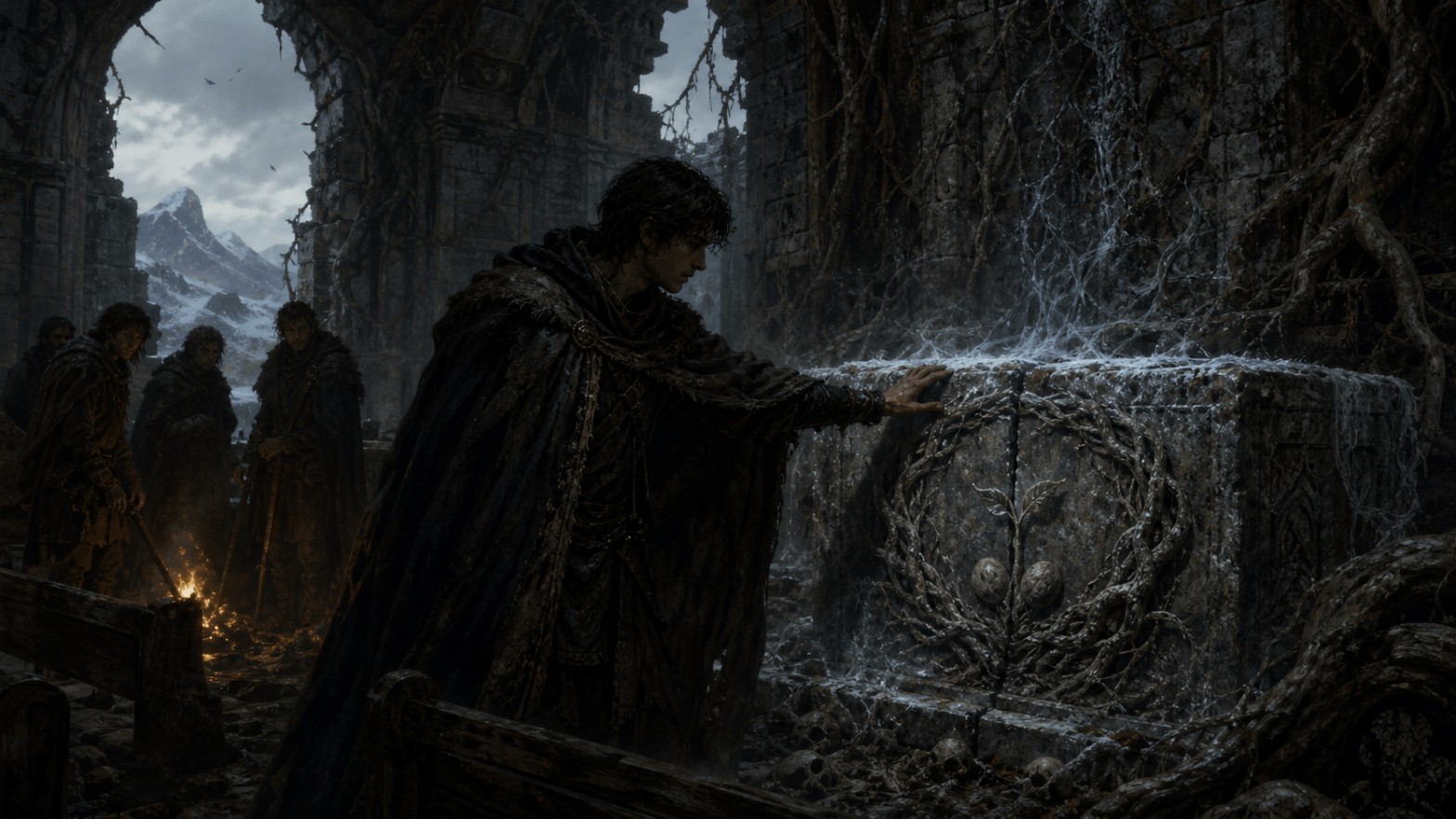
In the chapter I am working on now, Sylvanus and his men take shelter in the ruins of a Green Faith temple, a religion on the verge of extinction in Lucardia. It is no grand place. No choir sings there. No priest waits in the shadows. There is no clean revelation, no bright divine answer. Only cold stone, rot, animal stink, roots crawling through the walls, and an altar split through its center.
For Sylvanus, the ruin should mean nothing. Worse than nothing, really. It should prove his father right. The old faiths were weak and ineffectual. Their gods failed, prayers went unanswered, and their mighty temples burned without recourse. All the followers bent the knee to the Sword and Sun or died.
Yet standing there with an army of his father’s pursuers at his heels, half-starved, wounded, hunted, and uncertain, Sylvanus finds the place strangely comforting.
That comfort unsettles him because it touches something deeper than politics. Sylvanus has begun to understand that rebelling against his father cannot remain a rebellion against one man. Vesper did not conquer by sword alone. He triumphed through story, doctrine, prophecy, and the holy certainty of the Caspian faith as he chose to wield it. If Sylvanus rejects his father’s vision for Lucardia, then he must ask a more frightening question: how much of the faith he inherited was faith, and how much was empire speaking in a sacred voice?
I keep coming back to that discomfort.
Sylvanus has no sudden conversion. I dislike conversions that happen too cleanly, whether religious, political, or moral. People do not shed their fathers in a single moment. They do not step from one worldview into another as though changing cloaks. The old training remains in the hand, in the tongue, in the reflex. Sylvanus can feel comfort in that ruined temple and still mishandle what he finds there. He can question his father’s words and still speak with the arrogance of a man raised with every advantage. He can begin to see the old world as more than a blasphemy, yet still fails to completely understand what he has scratched away.
Certainty is rarely where the life is.
Fantasy, especially dark fantasy, often becomes most interesting when belief turns messy. A character stands between inherited doctrine and lived experience, and the world refuses to remain as small as he was told it was.
The Green Faith in Lucardia is harvest and hunger. Maiden and Hag. First sheaf and last sheaf. It carries the understanding that things move in cycles, whether kings approve or not. Growth, rot, death, return. Unity, fracture, unity, fracture. The Caspian faith may rise loud, then soften, then rise again, but it does not stop the wheel. No empire does. Vesper tries to control this change of seasons by using the ouroboros as his standard. Perhaps if he accepts this base truth, the converts from the Green Faith will look past his transgressions, much like Christians adopting pagan holidays as their own.
That is the lie of empire: the belief that it has ended the cycle.
It has merely taken its turn.
Ruined temples have power in fantasy because they remind us that every age believed itself permanent. Every king thought his banners would outlast the weather. Every priest thought his doctrine had finally settled the argument. Every conqueror looked at the ashes of what came before and mistook silence for defeat.
Silence is a dangerous thing to misunderstand.
The old world is not innocent simply because it is old. I have no interest in turning Lucardia into a simple reversal in which the empire is false, and everything it crushed was pure. That feels too easy. Old faiths can be cruel, and forgotten powers can be hungry. Grandmothers’ warnings may preserve wisdom, but they may also preserve fear. The thing whispering in the ruin may be sacred, wounded, spiteful, curious, or too old to fit any human category.
That is the kind of divinity I find compelling in dark fantasy: a presence older than the current argument. Something that does not owe the living an explanation.
Sylvanus enters the ruin thinking in practical terms: pursuit, shelter, supplies, the road north, his brother, his father, rebellion. The ruin interrupts him. It reminds him that Lucardia is made of more than politics. Beneath the maps and banners are buried faiths, old bargains, half-remembered names, and powers that survived the purges by becoming whispers.
He is beginning to rebel against his father, and the ruined temple forces him to see what that rebellion may require. Vesper’s empire and Vesper’s faith have been braided together for so long that pulling against one threatens the other. Sylvanus cannot simply reject his father’s cruelty while keeping untouched the holy language used to excuse it. If he is going to turn against Vesper, he must also look hard at the faith Vesper pushed across the land, pushed upon his sons, and ask whether belief can survive after being made into a weapon.
That is where the old faith stops being background. It presses against the present. It complicates the rebellion. Koen’s return, the North, the witches, the Green Faith, and the sins of House Zulikaarme may all be roots from the same buried tree.
I have always been drawn to fantasy where history does more than decorate the walls. Ancient ruins should not exist merely so characters can camp in them. I want the stones to accuse. I want symbols to matter even when the people looking at them do not fully understand their meaning. I want old prayers to leave residue. I want the past to reach forward and put a hand on someone’s shoulder.
Maybe that is because the real world is full of things people tried and failed to bury. Old griefs. Old injustices. Old hopes. Old stories. Old gods, too, though perhaps not always in the literal sense. We still serve powers we do not name. We still fear the dark. We still make offerings, even if we call them something else. We still inherit stories long before we understand them.
Sylvanus does not know whether the thing in the ruin is a god, a witch, a memory, or a warning. He only knows that when he touches the altar, something answers. Something cold. Something faint. Something old enough to make the empire feel young. It is something for a man who has only known nothing clothed in regalia.
Perhaps that is where wisdom begins for him. Not with disbelief. Not with some clean rejection of everything he was taught. It is with the first honest question: If my father was wrong in his treatment of his power, what else did he make holy that should never have been?
And sometimes, in a world built on sacred lies, a question is rebellion enough.
Cheers!
Discover more from Author Scott Austin Tirrell
Subscribe to get the latest posts sent to your email.

So many wonderfully crafted sentences here! A pleasure to read….
LikeLiked by 1 person
When faith is real, it does not seek empire to prop it up. The core of empire is violent repression and above all greed. The promise of power draws those without faith, to attempt to fill an endless pit of self-doubt. Faith closes the pit: erases it. Only when faith is hollow does it need to convert. Only when it is dark and empty does it call out to be filled with the bodies of sinners. Sylvanus, it seems, begins to see what the Buddha saw: all evil lies in the fears of Men.
LikeLiked by 1 person