I have lived in Lucardia for five years.
That is a strange thing to write, because Lucardia is not real. Not in the common sense. You cannot point to it on a map. You cannot buy passage there by ship or rail. You cannot walk its roads unless I build them first. And yet, in the ways that matter to me, I have lived there.
I have walked through its forests and cities. I have stood in its churches and ruins. I have watched its kings fail, its priests lie, its children suffer, its dead refuse to pass quietly into the dark. I have spent years listening to the voices of that world, following its histories backward through bloodlines and wars and betrayals, trying to understand why its people are broken the way they are.
I love Lucardia. That has never been the problem. The problem is that I have had a much harder time convincing other people to love it as much as I do.
There are readers who have stepped into that world and understood what I was trying to do. They have seen the machinery beneath the darkness—the faith, the politics, the myth, the grief, the long argument between power and mercy. Those readers mean more to me than I can properly say.
But the truth is still the truth.
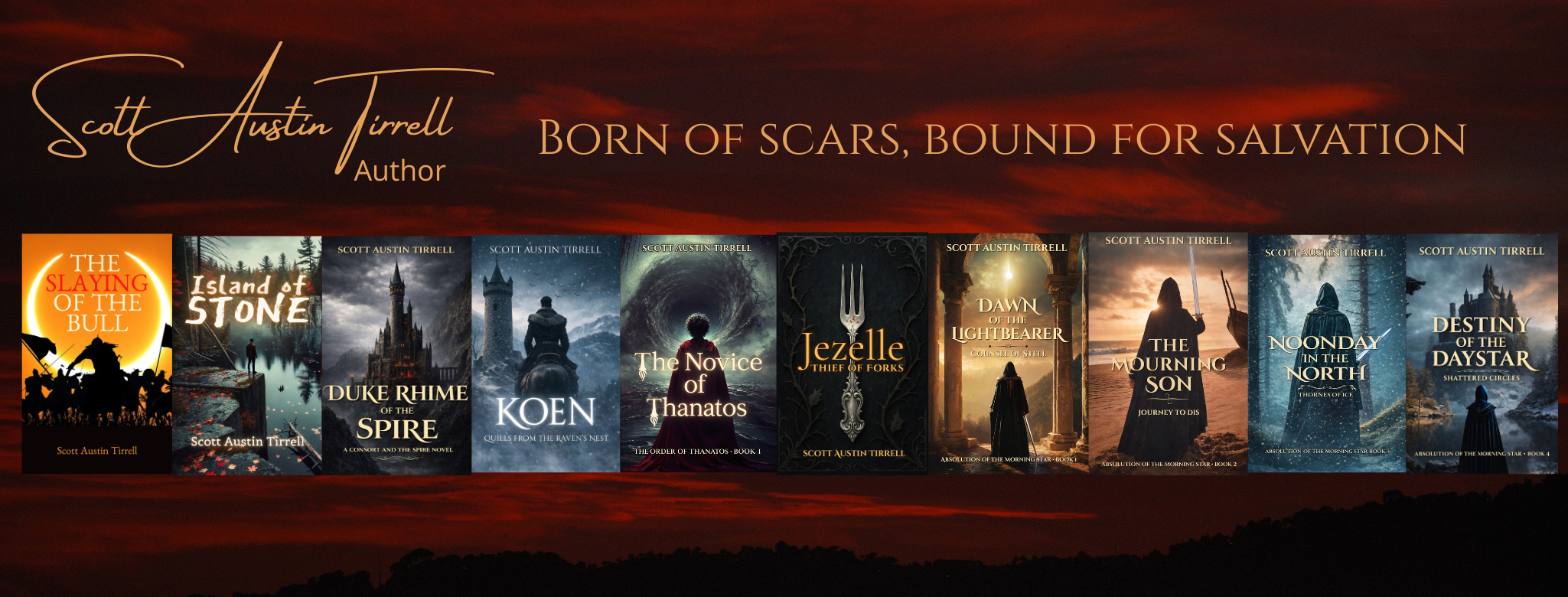
No matter how much I write, no matter how much I revise, no matter how much I push, no matter how deeply I believe in the stories, I cannot seem to make others as enthusiastic about Lucardia as I am. This is made more painful by the silence felt from the release of my last few books. Jezelle, especially, was my soul on the page—the very best I could wring from my Lucardian world. It has sold just eight copies since its release in April. Without sales, the algorithm will make it disappear just as Duke Rhime of the Spire, Destiny of the Daystar, The Novice of Thanatos, and Koen did before it. I am already watching it happen, helpless with a cry in my throat.
Maybe the books are too political. Maybe they ask too much too early. Maybe the world is too dense, too tangled, too unwilling to flatter the reader with simplicity. Maybe I have spent so long building a realm of empires, religions, betrayals, monsters, and dead gods that I forgot how difficult it is to invite someone through the door.
Or maybe the cold shoulder is not for Lucardia at all. Maybe it is for me.
That is the frightening thought. Not that a created world has failed to catch fire, but that the hand striking the flint does not know how to make sparks.
I do not say this in despair. I say this because every honest writer eventually has to look into that mirror. There is a difference between faith and stubbornness. There is a difference between devotion and refusal. I still believe in Lucardia. I still intend to finish Sylvanus, The Monk of Thanatos, and whatever comes after. Those stories matter to me, and I will not abandon them because the road has been hard.
But lately, something else has begun to stir.
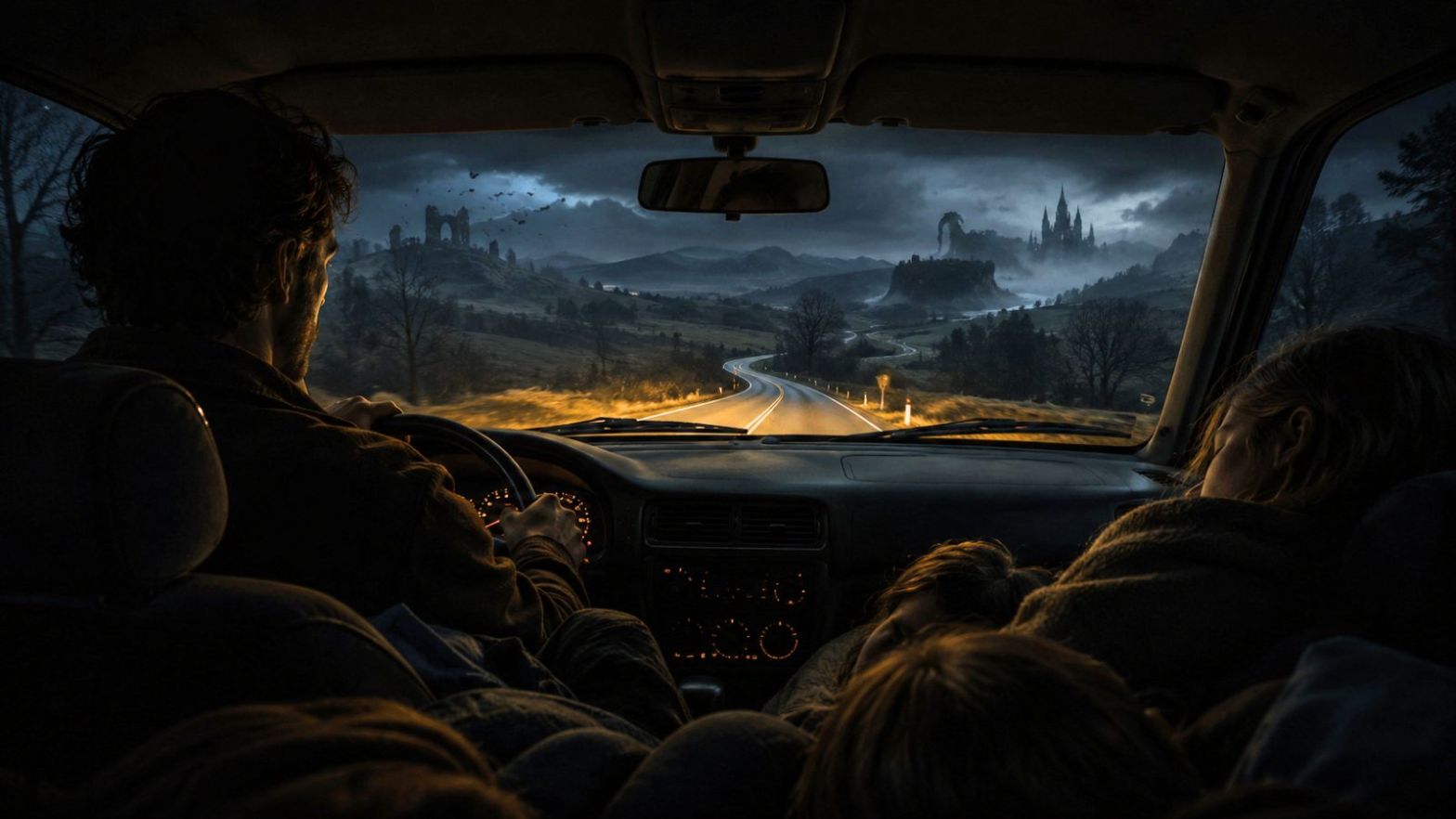
The idea came to me while driving through the long, winding country roads of upstate New York. My wife and in-laws were asleep in the car, the world outside reduced to dark trees, old hills, and the thin line of road opening beneath the headlights. There is a strange kind of silence that comes during those drives. Not true silence, of course. The engine hums. The wind whips through open windows. The tires whisper against the road. But the mind opens. It wanders into old rooms. It lifts the latch on doors you did not know were there.
I found myself thinking about the argument every writer eventually has with himself:
Do you write for yourself? Or do you write what people want?
The easy answer is to say you should only write for yourself. That sounds noble. Pure. Artistic. It is the kind of thing writers say when they want to appear untouched by hunger.
But I do not think it is entirely true.
Writing only for yourself can become a kind of vanity, just as writing only for the market can become a kind of surrender. Somewhere between those two sins is the harder path: to write something that burns in you, while still remembering that a book is meant to be read by another soul.
I have researched the fantasy market enough to know what is moving right now. Desperation has made me dig deep for the magic. I have rattled the bones and sifted through the tea leaves. I have seen the appetite for twisted love, darker stories, sharper hooks, more immediate concepts, books that can be understood in a breath and still carry depth beneath the surface. And as I drove through those sleeping roads, an idea rose bright from the mud and tangle. It is still dark fantasy, I don’t think I am capable of departing the genre entirely, but it is more attuned to the market I’m seeing.
At first, I tried to drag it into Lucardia. That was my instinct after living there for so long. It is always where my mind goes first. I have seven books written, three more being written, and more than two dozen yet to find the page, rattling around in my head. It is the great house I have built, and when a new story appears, my first impulse is to find it a room there. I turned the idea over and over, looking for where it might fit. Could it belong in one of the borderlands? Could it be part of the old religions? Could it be tied to the Threshold, the Nephilim, the Red Cloths, the long shadow of Caspia?
Maybe. With enough force, almost anything can be made to fit. But the more I tried, the more the idea resisted me. It did not want Lucardia’s politics. It did not want its empires. It’s faiths. It did not want the weight of five years of history pressing against its back before it had even taken its first breath. It wanted to be something else. Something leaner. Stranger. Hungrier. It wanted a new sky and a fresh breath. But more than anything, it wanted a different audience.
And for once, I wondered whether I should let it have one.
That is not an easy thought for me. Lucardia is not simply a setting. It is the place where I taught myself how to write fantasy. It is where I wrestled with faith, power, death, empire, corruption, and the awful beauty of human longing. I laughed some and cried a lot. It is where I built my mythology stone by stone. Leaving it, even for a little while, feels less like changing projects and more like stepping out of a cathedral before the final hymn.
But perhaps that is exactly why I need to do it. Perhaps all that is weighing me down and keeping me from flying.
My departure would not be forever. It is just for a moment. Perhaps I need to test something. Perhaps I need to know whether the struggle is Lucardia itself, with all its density and difficulty, or whether my writing simply has not yet found the right shape to reach people. Perhaps a new world, unburdened by old wars and ancient lineages, might reveal something I cannot see while standing inside the walls I built.
Admittedly, I am only on the first chapter. That is hardly anything. A seed. A flicker. A thing too small to name with confidence. But it came in the fevered rush that is any writer’s drug. Something interesting is growing there, and I want to see how it sprouts!
Yes, I know. There is danger in that. Every writer knows the seduction of the new idea. It glows because it has not yet betrayed you. It has no middle act. No structural problems. No marketing failures. No years of disappointment clinging to its cloak. It hasn’t fallen into a cruel silence yet. It is beautiful because it has not yet become work.
I have learned that lesson more than a dozen times. And still, I feel it. A strange passion. A pull. A sense that this story may have teeth. So, against my better judgment, I am listening.
That does not mean I am finished with Lucardia. Far from it. There are still stories there I need to tell. Since my return from vacation, I have put my hand to Sylvanus, too. Written an entire chapter, in fact. After a week away, it proves it still wants to be written. The dead still gather at the Threshold. The great powers of Lucardia still move in the dark, and I still want to see where their schemes end.
But perhaps I can love a world without being entirely chained to it. Perhaps taking a half-step away is not betrayal. Perhaps it is merely a pilgrimage that will bring purpose back to Lucardia.
Writers are often told to build a brand, stay consistent, feed the machine, and train readers to expect a certain thing. The funnel has become the golden idol. There is wisdom in that. But there is also danger. A writer can become the first prisoner of his own creation. He can mistake endurance for purpose. He can remain in one world not because the fire still demands it, but because he is afraid of what it means to leave.
I do not want to do that. I want to follow the fire, wherever it may bring me.
For five years, that fire burned in Lucardia. It may burn there again tomorrow. It may never truly stop. But right now, on the edge of something new, I feel another flame catching. And I think I need to see what it becomes. I will not name it, I may never speak of it again until it is ready for the world or ends in the bin. I have developed strange superstitions. But a new universe has opened, and I want to dance there for a while, if only to see if I can still dance.
Cheers!
Discover more from Author Scott Austin Tirrell
Subscribe to get the latest posts sent to your email.

Looking forward to reading whatever is ready next, Sylvanus or this new creation…
LikeLike