
Chicago was never high on my list of places to visit.
I had imagined it as something like New York: crowded, gritty, dirty, and weighed down by the age of an old northern city. Large cities are not usually my preferred destinations anyway, so while I was curious about Chicago, I did not arrive with great expectations.
I was wrong.
Chicago was cleaner and more beautiful than I expected. It had much of New York’s grandeur without its relentless crush of people. The city was crowded being the US’s third largest, certainly, but its pace felt closer to Boston. It seemed possible to stand still, look around, and take it in. It had a distinct charm that I can’t quite place my finger on.
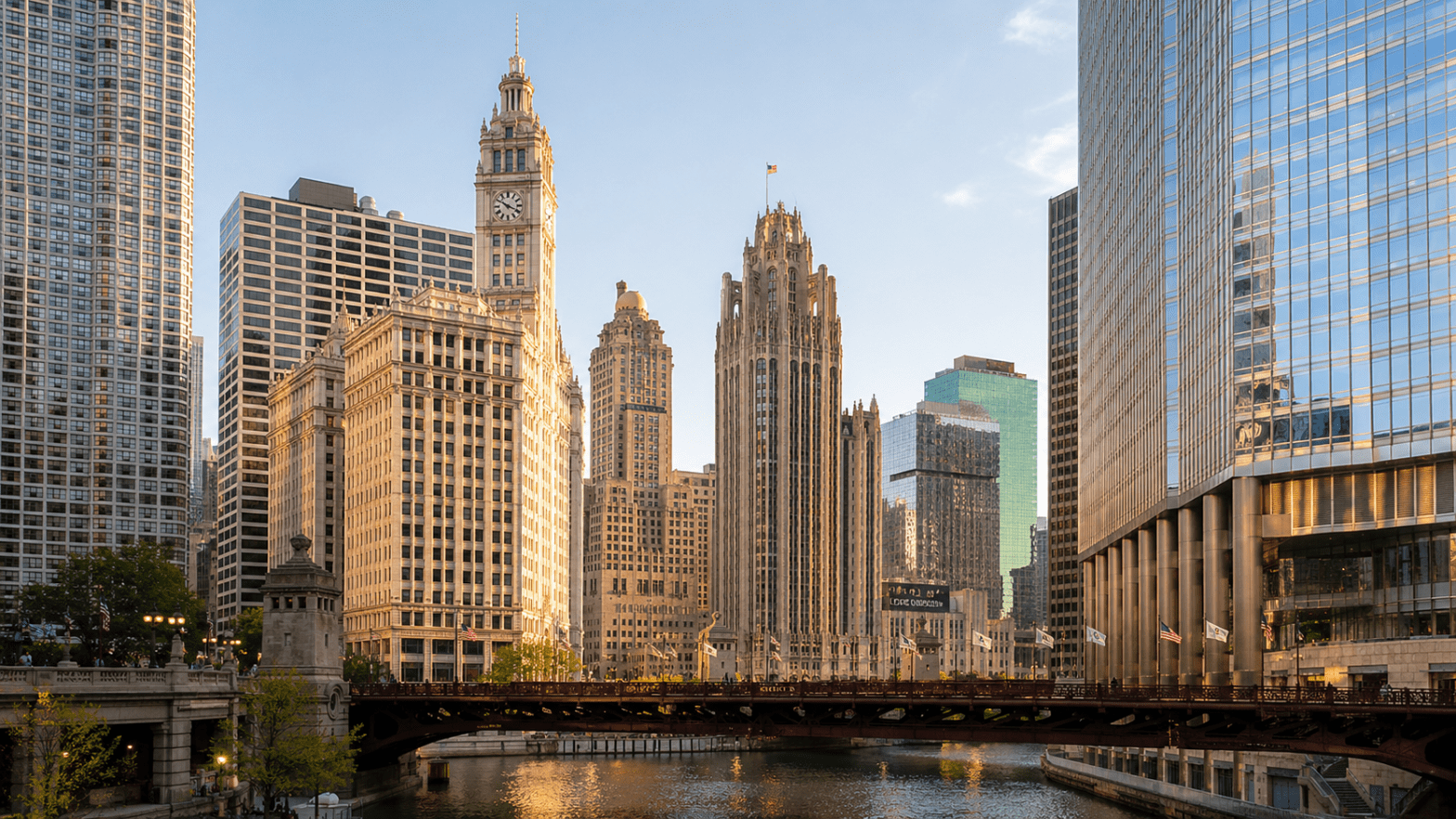
My first real impression came near the river, when we stepped into the intersection of State Street and Wacker Drive and found ourselves surrounded by the city at its center. The architecture immediately demanded attention, particularly the Gothic form of the Tribune Tower rising above the street, which immediately snatched my eye (while I tried my best to ignore Trump Tower).
It reminded me of the Bab-ilu Tower in Highwater, the tallest tower in my Lucardian world. I did not consciously model Bab-ilu after the Tribune Tower, but seeing that tall, ornate structure among the modern buildings felt strangely familiar, as though something from my imagined world had briefly appeared in the real one. It is a strange blend of a cathedral and a skyscraper, and it instilled the same awe that I would expect if I were to see Bab-ilu in this reality.
Architecture became one of the defining pleasures of the trip. Chicago is a city that makes you look upward. Yet some of my favorite views came from farther away, particularly during the long walk from the Museum Campus back to our hotel near Oak Street Beach (a 3-mile journey). Much of the walk followed the lake, offering changing views of the skyline as we moved north.
That walk also changed my understanding of Chicago. I had never realized how much of a waterfront/beach culture existed along Lake Michigan. The Great Lakes are strange in that way. Standing beside one, looking toward a horizon with no opposite shore in sight, I had to keep reminding myself that I was beside a lake and not the ocean. It is different, though, especially in how the water moves. There are waves, but they are less rhythmic and more chaotic.
We stumbled upon a food festival during the walk, one of those unplanned discoveries that often becomes more memorable than the things carefully placed on an itinerary.
Food was another major part of the trip. My in-laws love pizza and thoroughly enjoyed trying Chicago deep-dish pizza. We also had an excellent meal in Chinatown, where we found a restaurant serving Xi’an cuisine, the city where my wife attended college.
For her, the meal carried an added layer of memory. We ate liangpi, cold noodles dressed with sesame paste and vinegar, and roujiamo, meat tucked inside crisp bread, often described as an ancient predecessor of the modern sandwich (it is mentioned as far back as 4000 years ago). The food gave her a chance to revisit a place she once lived, while allowing the rest of us to experience a small part of it with her.
Traveling with my in-laws also changed the rhythm of the trip. They move slowly—sometimes frustratingly slowly—and my wife and I would ordinarily cover much more ground in a day. We always prefer to walk whenever possible because walking is how we absorb a city. You notice the buildings, storefronts, parks, alleys, and transitions between neighborhoods that disappear when traveling underground or passing through in a car. But this pace really emphasized that. I had more time to study the city. Instead of hurrying toward the next destination, I could examine the ornamentation on a building, watch the boats pass along the river, or turn back to see how the skyline had changed behind us. We may have seen fewer individual attractions, but in some ways, we saw more of Chicago.
The trip also gave me an unexpected shared experience with my family: the World Cup.
My wife and her parents have watched it for years, but I don’t recall ever watching a single World Cup match before. I am not much of a sports person, and I did not expect to become particularly invested. Instead, I enjoyed it. Part of that was the game itself, but much of it was being able to participate in something that mattered to all three of them. It was something we could watch together and understand together, regardless of our different backgrounds or interests.
I now find myself looking forward to the next game.
The journey home was far less pleasant. Our flight was delayed, and we arrived back late. Someone placed a bag on top of my mother-in-law’s bag in the overhead compartment, and milk leaked from it until her bag was soaked through and sitting in a puddle (we hope by milk they did not mean breast milk). The owner offered no apology. We then had an argument with the cab attendants, endured a crazily fast ride home, and discovered that we had been charged an enormous tip that had been quietly added to our fare.
We finally arrived home at one in the morning.
I love traveling, but flying increasingly feels like the price one must pay to get to the enjoyable part.
Even after that ending, however, my strongest feeling was that I could have stayed in Chicago longer. I wanted more time to explore its neighborhoods, architecture, food, and lakefront. I would gladly return, perhaps next time with only my wife, so that we could move at our usual pace and see the entire city.
There is a pattern I have noticed in my travels. The places I expect to love do not always live up to the picture I have created beforehand. The places I assume will not suit me often become my favorites.
Perhaps surprise is part of the reason. When we expect little from a place, it has the freedom to reveal itself without having to compete against our imagination, and as you know, my imagination is quite extensive.
Chicago surprised me.
Sometimes the places we never planned to love are the ones that make us most eager to return.
Cheers!
Discover more from Author Scott Austin Tirrell
Subscribe to get the latest posts sent to your email.

Re the power of expectation, apparently there is a recognized ailment of being disappointed by Paris. For whatever reason, Paris is a city the Japanese travel to with extremely high expectations. The impact of being seriously disappoint is called “Paris Syndrome” https://en.wikipedia.org/wiki/Paris_syndrome
LikeLiked by 1 person
I’ve heard much the same about Venice. I am surprised every day with the power of the human imagination. I suppose we shouldn’t be surprised with its ability to bend reality. It is such a delicate mechanism. When I travel, I always try to temper my expectations so as not to be disappointed. Perhaps that is what I did with Chicago. When you have little to no expectations, the only way is up 🙂
LikeLiked by 1 person
My sister claims that the secret to happiness is low expectations. I think this does apply when traveling to much-hyped destinations!
LikeLiked by 1 person
Another curious phenomenon: Jerusalem syndrome. One of my brothers, who has spent some time in Israel, had a friend who fell victim to this and decided that he was a prophet… which I think would be a Type 1 case? https://en.wikipedia.org/wiki/Jerusalem_syndrome
LikeLiked by 1 person