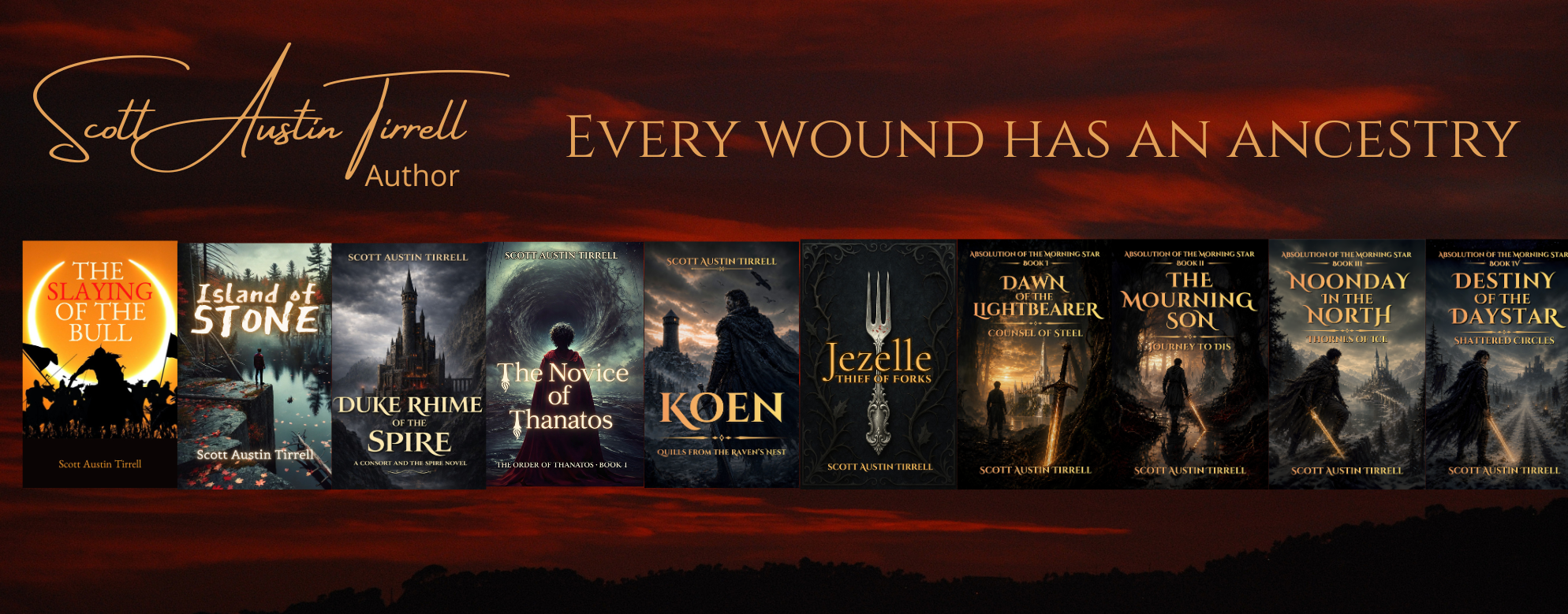
I have spent some time beating myself up for not finishing Absolution of the Morning Star sooner.
The series was moving along nicely. Four books were complete, and only two remained. I knew where the story was heading, even if some of the roads were still obscured. Then I got sidetracked by Koen.
At first, Koen: Quills from the Raven’s Nest was meant to be a single prequel. Koen had always existed in the history behind AMS. He was Erik’s father, a prince remembered as the Great Aggressor, and one of those dead figures whose choices continued shaping the world long after his departure from it.
Most importantly, I had mentioned he had disappeared for three years, mostly to instill some mystery. It was an innocent act, but it came to plague my mind.
That absence mattered. Something had happened to him on his journey, and whatever it was had changed the course of his marriage, his family, and eventually Lucardia itself. I wanted to understand what.
This is where my training becomes dangerous.
I have degrees in history and psychology. The historian in me wants to know what happened before the story began. The psychologist wants to understand what those events did to the people involved. I am uncomfortable drawing conclusions until I understand the foundations beneath them.
So, I followed Koen into the past.
What began as an explanation became a life. Koen stopped being a piece of history and became a husband terrified of losing his wife. His journey north was no longer an interesting absence in a timeline. It was an act of desperation rooted in love, infertility, dynastic expectation, and his inability to accept that some wounds cannot be repaired through force of will alone.
His later reputation could not be understood without Rachel. The political consequences could not be separated from the private suffering that created them.
That should have been enough.
I had written the prequel. The questions surrounding Koen’s disappearance had been answered, and I could return to the final two books of Absolution of the Morning Star.
Except Koen had revealed another absence.
There were important events that took place after his journey—events that would help create the political world Erik eventually inherits. Koen could not witness all of them. He could not tell the whole history because, for some of it, he was elsewhere; for the rest, he was too enscounced in it. He was also now a broken man who would tell an unsatisfyingly grim and depressing tale.
That job belonged to Sylvanus, Koen’s co-conspirator against their father. He was younger, livelier, not yet completely sullied. He was a breath of fresh air to turn into morning breath.
So I began Sylvanus: Swords and Sons.
Through Sylvanus, I could explore the rebellion forming against his father, the relationships among the sons, and the political transformation that would eventually reshape Lucardia. What had been distant background in Koen became immediate. Rumor became experience. Historical outcome became personal choice. I could show Koen’s deterioration from an observer’s point of view.
Once again, the past refused to remain a summary.
A rebellion is not merely a sequence of battles or changes in allegiance. It begins inside families. It enters friendships and marriages. It forces people to decide whether blood, duty, justice, and love can still coexist. By the time a rebellion earns a name in the history books, countless private decisions have already made it inevitable.
As I worked on Sylvanus, however, another unanswered question remained.
What happens to Erikini?
She begins as a girl whose family was destroyed by men serving Koen’s father. She then travels beside Koen, witnesses some of his transformation, and develops feelings for a man whose heart ultimately belongs elsewhere, even if she is too young to know it yet. Koen’s actions will affect the rest of her life, but his book cannot contain the full consequence. Neither can Sylvanus’s.
Erikini needs her own story.
Her book will follow the rebellion from another vantage point, but it will also be about the Koen she imagines and the Koen who truly exists, something perhaps shared by all of Lucardian during this time. She will hear stories of his defiance, watch his reputation grow, and build meaning from a man she does not fully understand. When she finally reaches him, the reunion cannot become what she has imagined.
History is rarely experienced evenly. One person lives an event while another receives it through rumor. One remembers a liberator, another a traitor, and someone else the man who failed to return home. All may be describing the same person.
Thus, one prequel became three books.
Then, I realized that Jezelle: Thief of Forks, another book I feared was an excuse not to finish AMS, belongs to this history as well.
The reasons cannot yet be explained without revealing too much, but Jezelle’s story is not as separate from Koen, Sylvanus, Erikini, and Absolution of the Morning Star as it first appears. Her life in Grafton Notch forms another strand in the same gathering history. What seems like a street-level story about an abandoned girl and the family she creates from the grime will eventually touch the larger epic in ways that have been present from the beginning, though not immediately apparent by design.
And so a four-book series emerged:
- Koen: Quills from the Raven’s Nest
- Sylvanus: Swords and Sons
- Erikini: Love and Treason
- Jezelle: Thief of Forks
I will likely call it The Blood and Banners series.
The title fits because these books are about both inheritance and allegiance. Blood ties people to families, dynasties, old crimes, and obligations they did not choose. Banners ask them to choose where they stand when those inherited bonds begin tearing the world apart.
Realizing the scale of this new series was not entirely comforting.
Every book added to The Blood and Banners delayed my return to Dusk of the Demon, the fifth volume of Absolution of the Morning Star. Depending on the speed of the work, I may not return to Erik’s story for close to another year.
That bothered me.
I worried that I had allowed myself to become distracted. I had spent years building momentum in the main series, only to turn around and walk deeper into its past. Instead of approaching the ending, I appeared to be moving farther away from it.
Writers are often warned about this. We build elaborate histories, invent secondary characters, and discover fascinating roads that lead everywhere except toward completion. Worldbuilding can become procrastination with a respectable name. There is always another ruined kingdom, forgotten war, or dead ancestor whose story might be told.
At some point, we have to stop excavating and finish building what’s above us.
But I eventually realized that this was not what had happened. I had not wandered into an unrelated corner of Lucardia. I had uncovered the foundation of what comes next.
Dusk of the Demon is where history will collide with the present.
The wounds opened in Koen, Sylvanus, Erikini, and Jezelle will not remain contained in the past. They will move forward through bloodlines, loyalties, beliefs, consequences, and people until they reach Erik and the world of Absolution of the Morning Star. What happened to one generation will become the crisis of another.
The prequels are not postponing the conclusion. They are preparing it.
When The Blood and Banners series is joined with the six volumes of Absolution of the Morning Star, the result will be one larger epic of ten books in two parts. Readers will be able to begin with Koen and gradually discover the hidden history that creates the world the child inherits. But I am trying to design the epic with multiple entry points, each giving the story a different flavor.
That realization changed how I felt about the delay. I will still finish AMS. I have carried Erik’s story for years, and I owe both him and the readers who have followed the series an ending. But I no longer see the books Koen, Sylvanus, Erikini, and Jezelle as interruptions. They are the ancestry of the wound.
This is how history works, both in life and in fiction. The present does not arrive cleanly. It is formed by decisions, accidents, betrayals, loves, fears, and compromises whose consequences may not become visible for generations. A ruler inherits a border created by a forgotten war. A child carries the burden of a parent’s failure. A religious practice survives long after anyone remembers why it began. We inherit consequences even when we have forgotten their causes.
My training makes it difficult for me to accept the consequence without understanding the cause. The historian wants to uncover the structure beneath the event. The psychologist wants to know how that structure shaped the people trapped inside it.
Lucardia is where those two instincts meet. Its history is not decoration. A ruin beside the road should matter. Someone built it. Someone destroyed it. Someone benefited, and someone else inherited the loss. The same should be true of a throne, a church, a marriage, or a family name. One life presses upon another. One wound finds a new body.
Of course, not every piece of history requires a novel. Some things should remain a half-remembered song, a broken monument, or a contradiction between two people who were taught different versions of the past. A world feels larger when some doors remain closed.
But these particular doors needed opening. Koen’s disappearance could not remain an empty space. His rebellion with Sylvanus could not be reduced to a paragraph of history. Erikini could not simply vanish after serving her purpose in someone else’s story. Jezelle’s place in the greater epic could not remain disconnected from the forces gathering around her, especially as she became a viewpoint character. Together, their stories form the road to Dusk of the Demon.
I thought I had delayed the ending by turning toward the past. Instead, I discovered that I could not write the ending I wanted until I understood everything arriving there with it.
Every wound has an ancestry.
Sometimes, before we can discover whether the next generation will heal it, preserve it, or pass it on, we have to follow it all the way back to where the first blood was spilled. It is messy, and I wish I could say this was all planned when I first started writing Dawn of the Lightbearer, but that isn’t so. It is where the characters took me, and as I am just their chronicler, I had to follow.
Cheers!
Discover more from Author Scott Austin Tirrell
Subscribe to get the latest posts sent to your email.

The past and the path are one. Every choice reverberates both forward and backwards. This is how we transform and redeem the past while choosing what future we will inhabit. In fiction and in life 🙂
LikeLiked by 1 person
So very true!
LikeLike
BTW I am now caught up — finished The Slaying of the Bull while on vacation. I think I have read all of your novels at this point — at least everything currently in print.
LikeLiked by 1 person
That is so awesome! Just in time, too, as Sylvanus is fast moving to completion. I just crossed the halfway point, and the end is in sight. I hope to have the first draft before the semester starts and release it by the end of the year. I then intend to continue straight into writing Erikini’s tale.
LikeLiked by 1 person
Awesome news!
LikeLike
I’m curious. Now that you have worked through my catalog (thank you again for all your support), which is your favorite?
LikeLike
Hmm, Jezelle or Koen, probably.
LikeLiked by 1 person
Thanks! These are my favorites, too. It helps me validate that my writing is moving in the right direction. Sylvanus is going in a similar direction (and so will Erikini).
LikeLiked by 1 person
Do you ever think you need to update the first 4 books with details from those that precede them in the chronology of your world but were written later?
LikeLike
Yes, and I do so periodically when I know of an issue. Actually, reclaiming Koen’s rights was partly because I wanted complete control over the material and to make a few small changes to help with the later books. When the first four are finished, I will run through all again to make sure there are no holes or inconsistencies before moving on to Dusk of the Demon. Some may say it’s cheating, but I see it as a huge benefit of being self-published. Currently, I am not aware of any huge holes that ruin the whole plot. It has mainly been little things that probably only I notice. I keep detailed notes and spreadsheets to help as well. Since publishing Dawn of the Lightbearer, I’ve updated the prologue about five times (since it deals with Koen and Sylvanus) and gone through the entire book twice to ensure it meshes. Luckily, much of what is said of Koen in AMS is largely Empire propaganda. I’ve done the same for The Mourning Son. I actually did a major overhaul of that book once and heavily modified several chapters for consistency.
LikeLiked by 1 person
That’s definitely one advantage to being self-published.
LikeLike
All life is a moving tapestry, with forces rolling from generation to generation and community to community. Great wars – and even great peace – do not arise from nowhere. Those who shake the world are themselves shaken. Even Genghis Khan was shaped from before he was born; we just don’t know who will be at the sharp end of the spear of destiny at the time it strikes. And often, I suggest, they don’t know either, until after the blood has started to flow. Then they are caught in a story and must play out their part.
LikeLiked by 1 person
Well said!
LikeLike