My Flashback Fridays series has forced me to spend a lot of time with a man I barely recognize.
He has my name, my memories, and most of my insecurities, but he is standing at the beginning of a road I have now traveled for six years. He has just published Island of Stone. He is excited, terrified, and still a little delicate about the whole thing. He compares the book to a newborn baby sent naked into the world and wonders whether anyone will care for it. He hopes it will succeed, but he does not yet know what success means.
When I began this blog in April 2020, I had no idea what would follow. I had returned to an old manuscript during the pandemic, finally gathered the courage to publish it, and started writing about the experience because I needed somewhere to put all the nervous energy, and I had read someplace that if you were to be a successful writer, you needed a blog to connect with your audience.
At that point, I was looking backward. I had several manuscripts from my twenties, and I believed my writing future might involve polishing and publishing those older books. I mean, why not? I had some extra time, and the novels were just collecting dust. I was not yet ready to begin something entirely new. The addiction hadn’t started yet. And I certainly did not know that Lucardia was waiting for me in the dark recesses of my mind.
Reading those first posts now is strange.
There is anxiety in them, of course. That has never been in short supply. But there is also a wonderful innocence. I was thrilled to have a book in the world. A single sale mattered. A comment mattered. The idea that a stranger might read something I wrote felt miraculous. I really had no idea what I was getting myself into. I had not yet learned to turn every miracle into a spreadsheet. That came later.
Once I began writing Dawn of the Lightbearer, something broke open. After nearly a decade away from creating new fiction, I found the world and genre that united everything I loved: history, psychology, religion, mythology, and the strange things people do when power, love, and fear begin pulling them in different directions.
I wrote Dawn in about five months.
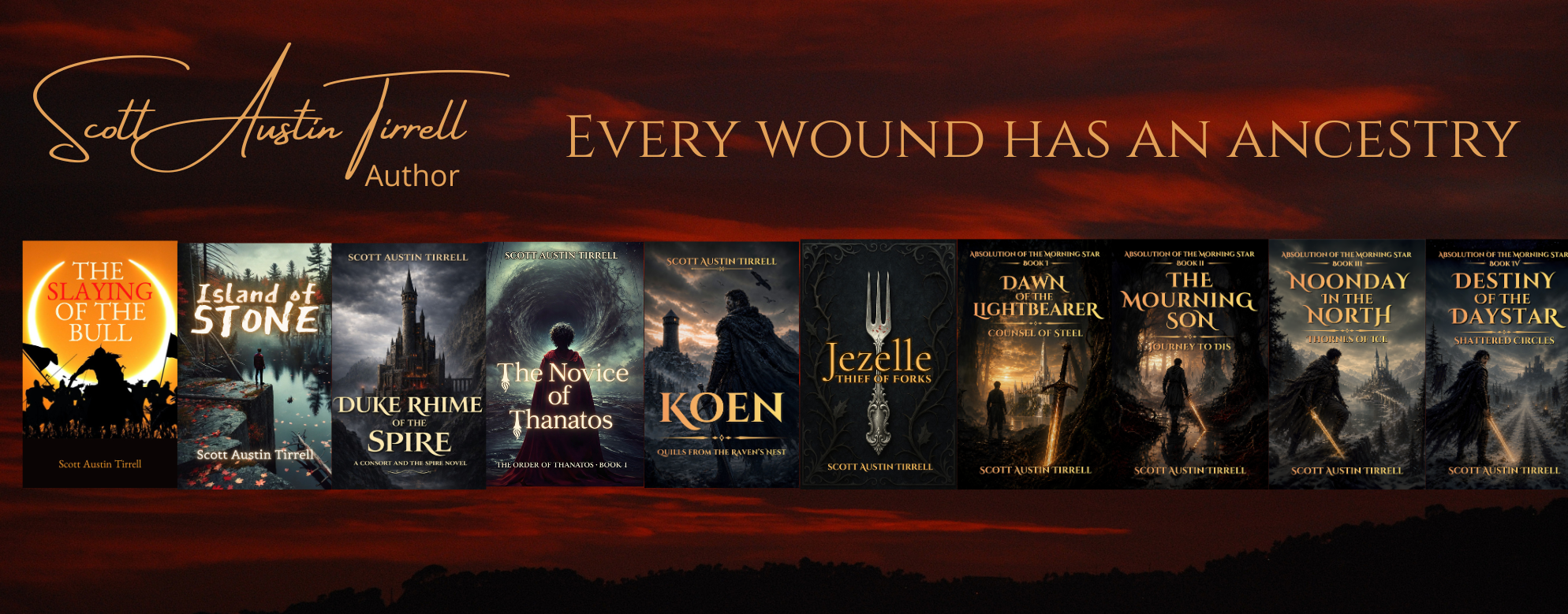
Then came The Mourning Son. Then Noonday in the North. Then Koen, Destiny of the Daystar, the Thanatos books, Duke Rhime, Jezelle, Sylvanus, and more ideas than I could reasonably fit into one lifetime.
For six years, the momentum rarely stopped. I became disciplined. I set goals and tracked word counts. I learned to move forward when a chapter was imperfect rather than polishing the life out of it before reaching the next page. I learned how to publish, format, advertise, build websites, create graphics, contact reviewers, query agents, negotiate publishing contracts, and decipher Amazon systems apparently designed by mischievous spirits called Algorithms.
The work grew, but so did the machinery around it.
At first, the machinery served the writing. It helped me finish books and place them into the world. Eventually, however, the relationship began to reverse. I was no longer simply writing stories and using the necessary tools to publish them. I was feeding an entire system that always demanded another task.
Another post.
Another graphic.
Another advertisement.
Another release.
Another revision.
Another platform.
Another book.
The system rewarded movement, or at least gave me the reassuring sensation that movement must eventually lead somewhere. When sales slowed, I worked harder. When a release disappeared, I started planning the next one. When one of those pesky algorithms refused to cooperate, I changed keywords, experimented with advertising, or redesigned something I had already redesigned.
My answer to nearly every disappointment was more labor.
For a long time, that worked—or seemed to. Then came 2025. By almost every measurement I had taught myself to value, it was the best year of my writing career. I released six works, including Destiny of the Daystar, The Novice of Thanatos, Duke Rhime of the Spire, an Absolution of the Morning Star box set, and the Grendel Press edition of Koen: Quills from the Raven’s Nest. I continued working on several other novels, including Jezelle, The Monk of Thanatos, and Sylvanus. Sales increased by 33.85 percent over the previous year, even without including the publisher’s numbers for Koen. It was my best-selling year since I began.
My blog grew too. I published eighty-nine posts totaling more than 88,000 words. Website views rose by 134 percent. Likes increased. My social-media following grew. I passed 10,000 followers on X and kept going.
For a person who had spent years asking whether anyone was paying attention, this should have felt like an arrival. Instead, by November, I was exhausted.
I had posted twice a week for most of the year before finally admitting that I had run out of energy. Even then, I framed stepping back as a strategic decision so I could focus on fiction. Rest apparently required a productivity justification.
That should have told me something.
Still, at the end of the year, I made another ambitious plan. I hoped to publish Jezelle traditionally, finish The Monk of Thanatos, possibly complete The Confessor of Thanatos, begin Dusk of the Demon, and perhaps return to Sylvanus.
It was a ridiculous amount of work. I knew it was a ridiculous amount of work. Then I wrote that if I could finish only two books, my yearly average, I would consider 2026 as prosperous as 2025.
Only two books.
That sentence makes me laugh now, although perhaps not for the right reasons.
The strange thing about ambition is how quickly yesterday’s impossible achievement becomes today’s minimum expectation. Writing one book had once seemed enormous. Then I wrote several. Publishing one was terrifying. Then I published ten works. Instead of allowing those accomplishments to settle, I used them to construct a taller platform from which to judge myself, until the reward for completing a book became permission to demand another.
This was not entirely the fault of productivity. Discipline changed my life. Without it, Lucardia would probably still be a handful of vague ideas and abandoned chapters. Goals helped me become the writer I once only imagined being.
The problem began when output stopped being a tool and became evidence of worth. If I wrote 2,000 words, I had been good. If I published a post, maintained momentum, made a sale, or completed another chapter, the day counted. But if I rested, wandered, read without taking notes, traveled without checking my sales, or simply lived outside the machinery, some part of me believed I had fallen behind.
Behind what, exactly? I still do not know.
There is no finish line in writing. The road extends as long as you are willing to walk it, and if you spend the entire journey staring at your pace, you will eventually forget why you left home.
By April 2026, the bill came due. For exactly six years, I had ridden what I called a writer’s high. I had published ten works totaling more than 1.2 million words. I had built a world with thousands of years of history, tangled religions and politics, hundreds of named characters, and nearly thirty possible book ideas.
I also had three manuscripts open on my desktop, and I could not make myself continue any of them.
This was new. I had experienced difficult chapters, revision fatigue, uncertainty, and the occasional desire to throw a computer through a window. But I had always possessed the push. Even when the writing was hard, I wanted to reach the other side.
Now, I knew where the stories were going. I still loved the characters. I had outlines, scenes, conflicts, and more than enough material. I simply did not want to write.
At first, I called it writer’s block. Work had been especially brutal, and exhaustion from the day job certainly contributed. But the longer I sat with it, the clearer it became that the story was not the problem.
I had encountered something like this once before. In 2022, while editing Noonday in the North, I became convinced that the manuscript had failed. Promoting my books, adjusting to a new job, and editing had pushed me to the breaking point. Then my wife and I traveled to Spain, and I completely stepped away. When I returned, I realized the book was not broken. I was just tired.
Apparently, I needed to learn the lesson again on a much larger scale.
Looking through my blog archive for Flashback Fridays has made the pattern difficult to ignore. I can watch the transformation happen one post at a time.
The early writer is uncertain but delighted.
Then he becomes determined.
Then productive.
Then professional.
Then increasingly watchful.
He checks sales after returning from vacations. He worries that speaking confidently about success will make it disappear. He treats good months like frightened animals that might bolt if acknowledged. He celebrates growth while immediately calculating what must happen next. Even joy begins arriving with an expiration date. A good review feels wonderful until I notice how few reviews there are. A strong sales month matters until the next one begins. A publishing contract offers validation until I see what the publisher cannot provide. Website growth feels encouraging until I compare visitors with book sales. Every success becomes provisional. Every disappointment enters the permanent record. That is an exhausting way to live beside your own art.
I do not regret the work. That is important to say. I am proud of the books. I am proud of the world. I am proud that the frightened man writing in April 2020 continued despite having no idea where the road would lead. I am grateful for every reader who has entered Lucardia, every comment, every review, and every person who has followed this blog long enough to watch me celebrate, complain, recover, and complain again.
The problem was never that I cared. The problem was that I began making the writing responsible for too much. It needed to give me joy, purpose, validation, income, identity, community, and proof that the years had mattered. Every book entered the world carrying the emotional weight of all the books before it. A quiet release was not merely disappointing. It seemed to cast judgment backward over the entire journey.
No story can survive that burden forever. Neither can the person writing it.
Flashback Fridays began as a simple way to revisit old posts and show how things had changed. Instead, it has become something closer to an archaeological dig. Beneath the announcements, goals, statistics, and frustrations, I can see the deeper story:
I spent years learning how to become a writer. Then I learned how to become productive. Then I tried to become successful. Then I tried to redefine success to fit within my narrative and deaden the impact of failure to meet my metrics. Then I opened my eyes and refound the passion of writing for the sake of writing. That is important, because somewhere around the circle, I nearly wrote the joy right out of it, and that is not a place I want to return to. I had been there before, and it led to a decade of wasted years.
The answer is not to abandon goals, stop publishing, or pretend I no longer care whether anyone reads my books. I care deeply. Stories are meant to cross the distance between minds. I want Lucardia to find its people. But I cannot force myself to sit at the desk every day and answer the question of whether the world values me.
The work must sometimes be allowed to remain what it was when I first discovered it in China and rediscovered it during the pandemic: a place where history, imagination, and the hidden parts of myself meet. A place I enter because something waits there that does not exist until I write it.
That is part of why I chose Sylvanus when I finally began moving again. I did not choose it because the spreadsheet declared it the most efficient project or because I had devised the perfect marketing plan. I chose it because I could feel the road opening. The characters began speaking again. The history beneath Koen and Absolution of the Morning Star started pressing toward the present. I truly wanted to know what happened next. That desire—not obligation, fear, or the need to maintain an average—is the current I need to follow.
I am still ambitious. I doubt that will ever change. There are books I want to finish, stories I owe endings, and readers I hope to reach. But prosperity cannot always mean two more books, eighty-nine more posts, another percentage increase, or a larger number beside my name.
Perhaps some years, prosperity means protecting the desire to continue.
The man who began this blog did not know whether his book would succeed. He had statistics against him and no idea what he was doing. But he was hopeful.
Six years later, that man knows much more about writing and publishing. But now he is just trying to remember the wonder, explore it, and bring it back to the page so that someone, anyone, even if it is himself, can read it and share in the miracle.
Cheers!
Discover more from Author Scott Austin Tirrell
Subscribe to get the latest posts sent to your email.

In addition to all the other positive traits this blog post evidences, your self-awareness is most impressive, Scott. Best wishes.
LikeLiked by 1 person
Thank you! I wish I could say my self-awareness is intuitive, but it has taken a lot of self-reflection. Also, having the valuable tool of six years of blog posts to look back on helps too! It’s an unintended benefit for sure.
LikeLiked by 1 person
Your journey is far from over. I can’t wait it read what you will think about your books and your writing in let’s say…five years from now?
LikeLike
Blind hope becomes wise hope – as a fine wine matures with age.
LikeLiked by 1 person
Thank you for your honesty, Scott! I know what you mean by wanting to throw the computer out of the window! I’m glad you are rediscovering the joy of writing again!
LikeLiked by 1 person