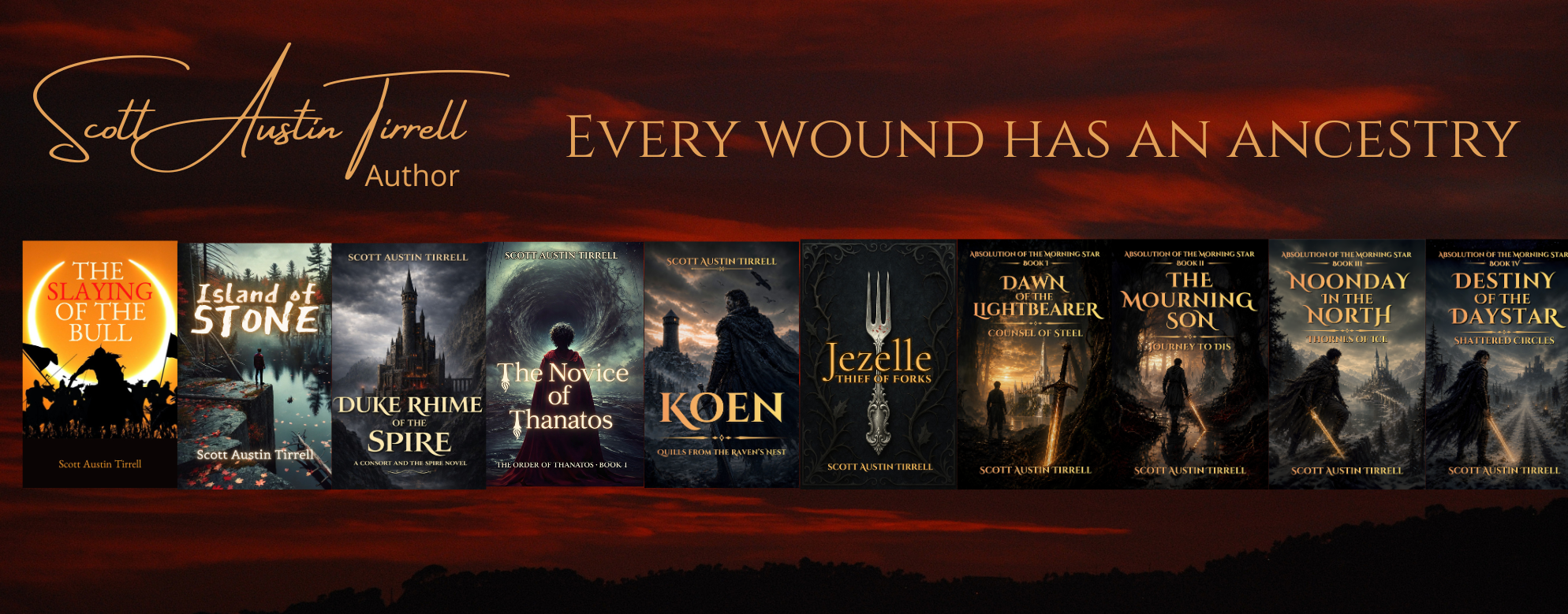
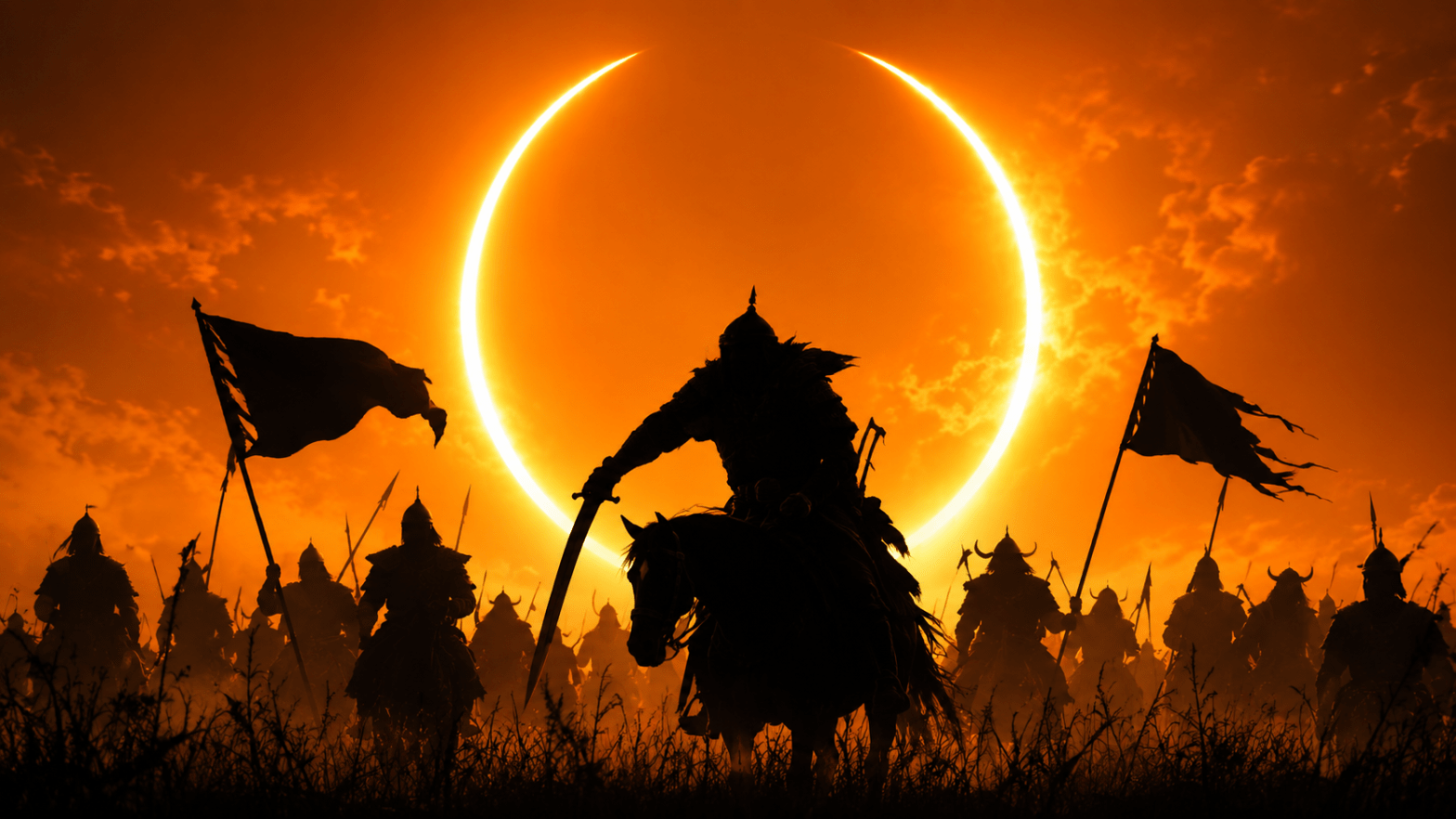
I have decided to retire The Slaying of the Bull.
That is a stranger sentence to write than I expected. I have abandoned story ideas, cut chapters I once loved, killed characters, scrapped outlines, and consigned more than a few half-written manuscripts to folders where they will probably remain until some future archaeologist excavates my hard drive. But I have never retired a published book.
The Slaying of the Bull has been part of my life for nearly twenty years. In some ways, it predates my life as a serious writer. It predates Lucardia, this blog, and most of what I now understand about storytelling, publishing, worldbuilding, editing, and the strange business of putting something deeply personal into the world and asking strangers to read it.
So retiring it feels significant. Not sad, exactly, and certainly not shameful. It feels more like closing the cover on a very long chapter.
The seed that eventually became The Slaying of the Bull was planted in college. I was taking a Chinese history course as part of my Asian history minor when I encountered something I knew surprisingly little about: the Mongol invasion of Europe.
I knew about Genghis Khan and the Mongol Empire, of course, especially its impact on China, but I had never really considered what happened when those armies crashed into the medieval European world. It fascinated me. Christian knights in their armor facing off against quick steppe warriors with their bows- it was a true clash of Eastern and Western culture.
That class ended up changing far more than my writing. It deepened my love of history, contributed to my fascination with China, and eventually helped send me halfway around the world. After college, I moved to China, lived and worked there for two years, met the woman who would become my wife, and came home on a very different path from the one I had expected to follow.
Somewhere in all of that, I became obsessed with the Mongol push into Poland and Hungary. And I mean obsessed. There wasn’t nearly as much material available on the subject as I expected, which only made me want to know more.
I chased down histories, maps, battles, religious movements, architectural plans, political alliances, strange theological ideas, and obscure historical personalities. I wanted to understand not simply what happened but what the world might have felt like to the people standing in the path of something enormous and terrifying. There was so much mystery, too, which made the chase enthralling, and I hoped to convey that in the book. Eventually, it all began turning into a story.
Around 2007, I started writing what would eventually become The Slaying of the Bull. Back then it had a different title: The Lion’s Order. I finished an early version and did what aspiring writers were supposed to do: I queried agents. A lot of agents.
The process was different then. There weren’t searchable databases of agents, and many still preferred query by snail mail. I collected a rather impressive assortment of rejection letters, became discouraged, and eventually put the manuscript away. Amazon KDP was created in 2007, so there was no viable route to self-publishing yet. At the time, shelving it felt like failure. Looking back now, I don’t see it that way at all. I simply wasn’t finished becoming the writer required to bring that vast and complicated story to the world.
More than a decade passed. Then came the pandemic.
Like everyone else, my life changed dramatically. Working from home eliminated a brutal commute and unexpectedly returned something I hadn’t realized I had lost: time. And with that time came writing.
I published Island of Stone, another manuscript from my younger years, as an experiment in self-publishing. Then I started looking at The Lion’s Order again and had the dangerous thought that has probably gotten more than one writer into trouble:
I can fix this.
But fixing a book that was then almost 600 pages is a huge undertaking. I didn’t simply clean up some old prose and correct a few commas. I tore into the manuscript. Characters changed, the focus shifted, the ending was rewritten, entire sections disappeared while others grew, and tens of thousands of new words appeared. Eventually, The Lion’s Order became The Slaying of the Bull.
When I published it in June 2020, I didn’t see it as the end of anything. I saw it as a beginning. It became the first planned volume of a series I called The Tocharian Gospels. I had ideas for several books and had already written a substantial portion of the next one. I could see the road stretching out in front of me.
Then something unexpected happened — Lucardia, and the road turned (that moment is captured in yesterday’s Flashback Fridays post).
Looking back at The Slaying of the Bull now, I can see one of the most important lessons it taught me as a writer: research does not earn its place in a novel simply because it was difficult to find.
That sounds obvious now. It wasn’t obvious to me then.
I researched the hell out of this book. I studied maps and historical accounts. I researched churches, cities, battles, religions, military movements, architecture, clothing, geography, theology, and politics. Whenever I could use a real historical person rather than inventing someone to fill a role, I tried to do it. Real battles became part of the story, real places became settings, and real religious conflicts became threads in the plot. I searched for connections and hidden mysteries. I compiled binders of research on all sorts of topics. I fell down rabbit holes about extinct religions, mysterious tunnels, and the codes built into cathedral stones.
I loved every minute of it. I still do.
The problem comes after the research. You spend ten hours uncovering some marvelous historical detail, and it starts to feel precious. Surely the reader needs to know this. Look how fascinating it is. Look how hard I worked to find it. So you put it in.
Then you spend another twelve hours discovering something else, and that goes in too. Before long, the story is carrying an enormous backpack filled with fascinating facts, while the characters stand around wondering when they’re allowed to start walking again.
That may be one of the most valuable things The Slaying of the Bull taught me. The lesson wasn’t necessarily to research less. It was to understand the research’s purpose.
I never stopped loving history or disappearing into obscure rabbit holes. If anything, I may be worse now. But somewhere between The Slaying of the Bull and the books I write today, the role of research changed.
History became foundation instead of furniture.
That distinction has become enormously important to me. Lucardia is saturated with history: pieces of medieval Europe, ancient religion, philosophy, medicine, politics, war, folklore, theology, alchemy, empire, architecture, heresy, burial practices, mythology, human cruelty, and human hope. I research all of it, sometimes obsessively.
The difference is that I no longer believe the reader needs to see every beam simply because I spent a week building it. Much of the best worldbuilding never appears directly on the page. It sits underneath everything, determining why a character believes what he believes, why a city looks the way it does, why two nations hate each other, why a religious symbol matters, why an old road runs through a particular valley, or why someone fears the dead. Instead of laying out my calculations of why it takes a week to get from point A to point B, it just takes that long. Or, why the best armor in Lucardia comes from Dover. It just does.
For another example, take the Green Faith in my books. It is mentioned here and there as the predecessor to the Caspian Faith as the dominant religion in Lucardia. It is largely built on pre-Christianity faiths of Northern Europe. I have a 30-page file that breaks down the religion—its history, its philosophical underpinnings, its iconology, detailed descriptions of its many gods, how it relates to the Caspian Faith —everything—but almost none of it appears in my books. However, if I need to throw a shrine into a temple, I have something to build from that feels rich.
The research supports the illusion that the world existed before the reader opened the book and will continue existing after the final page. That is a lesson I learned slowly, and The Slaying of the Bull was one of the places I learned it.
The book also became part of my education in self-publishing. I learned about editing, formatting, covers, distribution, pricing, categories, reviews, promotion, discoverability, and perhaps most importantly, patience.
Self-publishing gives writers extraordinary freedom. There is no gatekeeper standing between you and the publish button, and that is one of its great strengths. It can also be one of its dangers. Nobody tells you when a book isn’t ready. Nobody makes you wait. Conversely, nobody stops you from believing that one more revision, one new cover, one marketing experiment, or one more frantic push will suddenly make everything fall into place.
You learn by doing. Sometimes you learn elegantly, and sometimes you learn by falling down the stairs. I have done both.
The Slaying of the Bull was part of that education, and so was Island of Stone. Those books were bridges between the writer I had been and the writer I was becoming. They helped bring me back to writing after years away, and that matters more to me than whether either of them became a commercial success.
Because without that return, I don’t know that Lucardia exists.
There is another reason The Slaying of the Bull will always matter to me. I wasn’t merely writing historical fiction. I was working through things: faith, religion, history, violence, and the strange distance between what religions teach, what institutions become, and what human beings do in the names of both.
I was also trying to reconcile the skeptical part of myself with the part that still feels awe when staring into the dark and wondering whether something might be staring back. Those questions never went away. If anything, they became more important. I had some profound religious and philosophical moments in writing the book, ones that impact me to this day.
In fact, I can draw a fairly straight line from some of the questions I was asking in The Slaying of the Bull to the questions that now run through Lucardia. What happens when faith becomes an institution, and what happens when that institution becomes power? What happens when a comforting religious truth collides with an uncomfortable reality? What if the heretics know something? What happens when salvation requires something terrible? What happens when good and evil refuse to stand politely on opposite sides of the room?
The world changed. The characters changed. The stories certainly changed. The questions remained.
Maybe that is one of the strangest things about being a writer. We think we keep writing new stories, but sometimes we are simply finding better ways to ask the questions that have haunted us all along.
So why take The Slaying of the Bull out of print?
Because I think books can complete their work. That doesn’t mean they failed, that we regret them, or that we need to hide them. Sometimes a book simply belongs most powerfully to a particular stage of a writer’s life, and The Slaying of the Bull belongs to one of mine.
I once imagined continuing The Tocharian Gospels. I had plans for where the story would go and what would happen next. I no longer do. My creative life went somewhere else.
When I look at the book today, I can see two things at once. I see a story I cared deeply about, one that occupied my imagination for years and helped shape me as a writer. I also see the distance I have traveled since writing it. Both can be true without diminishing either one.
I could return to it. I could strip it apart and rebuild it with everything I know now, restructuring the plot, deepening the characters, tightening the history, and turning it into a very different novel. I suspect I could make it considerably better.
But I’ve already done that and learned lessons I don’t want to repeat, and that matters.
There are other stories I want to tell. The lessons I learned from The Slaying of the Bull are already inside them. I don’t need to rebuild the old house when I have taken its strongest stones and used them somewhere else.
So The Slaying of the Bull is going out of print, but I am not erasing it. The old blog posts will remain, and the book will remain part of my bibliography and my history. Copies exist in the world. Somewhere, perhaps on a bookshelf or buried deep inside a Kindle library, somebody still has one. I may even send it to someone who’s interested in my beginnings upon request.
I like that.
I am certainly not ashamed of the younger writer who created it. That guy worked his ass off. He read things nobody asked him to read, chased obscure medieval references across continents, and spent years thinking about a forgotten 13th-century invasion because a professor mentioned it during a college history course. He wrote a very large novel before he fully understood how to write a very large novel, sent it into the world, collected rejection after rejection, and then, years later, had the courage to drag it back out and try again.
Without that cockeyed optimist—to borrow from Seinfeld—I don’t get here. Without The Slaying of the Bull, I wouldn’t have learned some of what I needed to learn about research, story, publishing, criticism, persistence, faith, failure, and myself.
Perhaps that is more than enough.
I think we sometimes measure books too narrowly. We ask whether they sold, whether they won anything, whether enough people read them, or whether they became what we imagined they would. Those are reasonable questions, but they aren’t the only ones.
Some books entertain us. Some find enormous audiences. Some change careers. And some books primarily change the person who wrote them.
The Slaying of the Bull did that for me.
For nearly twenty years, it has traveled with me. Now I think it has done its work, so I am going to let it rest. Not because it was a mistake or because I wish I had never written it. Quite the opposite.
I am retiring it because I can finally see how much it gave me, and because I no longer need to keep it on sale to prove that it mattered. With Sylvanus: Sword and Sons nearing completion (first draft should be finished this weekend), it feels like a good time. As soon as I type the end on that one, I will unpublish The Slaying of the Bull. That seems poetic to me and a worthy goodbye.
Cheers!
Discover more from Author Scott Austin Tirrell
Subscribe to get the latest posts sent to your email.

This was a fascinating post. I urge any new authors, and any who have been writing for a long time, to read it carefully for there is so much to learn here.
It reminded me of a novel I’ve been researching and writing for 20 yrs or so about the siege and fall of Constantinople in 1453, and how the mercenary soldier Giovanni Giustinniani Longo brought 500 men (when all of Europe sent almost no help), fought so hard and died trying to save it, then was called all through Europe “the coward who lost Constantinople”. Because of my age [79] I probably won’t get it done.
Also – I also want to add that I’ve had the same experience with agents. I think you have to have contacts to recommend you.
But this decision of yours to retire Slaying the Bull suggests to me that you’re entering some new and exciting region. Good luck with that.
LikeLiked by 1 person
Thank you so much, Alan! Your book sounds right up my alley. The Slaying of the Bull actually ends in Constantinople in 1242, before my main character embarks on a journey to Baghdad. Though my research took place hundreds of years before your historical context, I am sure it is comparable in intrigue. The city has a fascinating and tumultuous history.
LikeLike
Totally fits with my experience reading the Bull. A major learning experience for a developing writer who had not yet discovered that the prime directive is to attend to what the story needs, and to view the massive stack of research from which the story emerged as a nursery, not the focus. Also wondering, reading this blog, if maybe you lived through this era in a previous incarnation, hence the fascination.
LikeLike
It is interesting that you say that. What is fascinating is that I am also interested in my genealogy. In my research, I discovered that I am a direct descendant of King Bela of Hungary, as you know, one of my viewpoint characters. He is my 24th great-grandfather on my mother’s side. I did a post about it here: https://scottatirrell.com/2020/09/15/oh-to-be-king/
LikeLike