I have spent an enormous amount of time editing Sylvanus: Swords and Sons over the last three weeks. More time than I typically do for pure writing, and probably more than makes rational business sense, but I am in love with this tale and want to make sure it is as good as I can make it.
The first draft came in at 136,765 words spread across thirty chapters. As I write this, the manuscript sits at 130,630 words and now has thirty-two chapters, after I realized a couple made more sense broken in two. Despite all the rewriting, reconsidering, and occasional new material, I have cut far more than I have added. Over 6,000 words have disappeared.
Finishing the first draft was only the beginning. Since then, I have been working through the manuscript again and again—tightening prose, cutting repetition, sharpening dialogue, checking continuity, reconsidering scenes, questioning word choices, and occasionally staring at a paragraph for far longer than any paragraph deserves, then tinkering and tinkering, only to delete it.
You’ve got to kill your darlings.
Years ago, I probably would have done a couple of editing passes, proofread the manuscript, and considered the book finished. I don’t work that way anymore. Finishing a book is exciting, but you have to fight the urge to let it go too soon.
One of the things I have learned after doing this for several years and writing a shelf full of books is that editing goes much deeper than fixing sentences or even correcting scenes. Every manuscript teaches me something new about the way I write. Every book exposes habits I didn’t know I had, and every time I go through this process, I get a little better at recognizing what separates a draft that works from a finished book that feels deliberate.
With Sylvanus, I am trying to apply everything I have learned.
I have finished my first read-through, my developmental pass, and my own copyediting pass. I then moved to Grammarly and worked through the manuscript paragraph by paragraph, considering its suggestions rather than blindly accepting them.
Grammarly is rather phenomenal at catching an awkward construction, an errant comma, or a sentence that has become too tangled. What it cannot tell me is whether Sylvanus sounds like Sylvanus, whether a moment carries the emotional weight it should, or whether the rhythm of a passage belongs in this particular book.
That part belongs to me.
Now I have moved into one of the stranger stages of editing: hunting down my own habits.
Every first draft reveals words used too often, and every time at least one surprises me. I never notice it creeping in while writing, but then I use AutoCrit to look for overused words and one rogue pops out of the bushes.
This time, the rapscallion was beneath.
Apparently, while drafting Sylvanus, nearly everything was beneath something else. Perhaps it is because Sylvanus is Koen’s younger brother and has always felt that Koen was their father’s chosen son. Who knows?
What I do know is that eyes were beneath brows. Roads disappeared beneath snow. Hands vanished beneath cloaks. Shadows gathered beneath trees. I wasn’t consciously thinking, This book needs more beneath. Yet there it was, scattered throughout the manuscript 339 times.
It initially made me laugh. Then I realized I had to go through all 339 instances and decide whether to keep it, cut it completely, find an alternative, or rephrase the sentence.
I managed to reduce the number to 70.
Finding these repetitions is part of what makes editing so different from writing. During a first draft, I am trying to keep the story moving. I am inside the scene, following characters, solving problems, and getting events onto the page. Sometimes I don’t have time to think of a more interesting way of stating a movement or expression before I lose my train of thought. It is only afterward that I can step outside the story enough to notice the little mechanisms I rely upon when I am writing quickly.
One of those mechanisms is something I have encountered before: my camera.
I am a visual person, and I tend to describe scenes through visual cues that function almost like stage directions: someone looks toward something, someone’s eyes move somewhere, attention shifts across a room, or a character watches another person before the important thing actually happens.
None of these constructions is inherently wrong. People look at things. Characters notice things. The problem is accumulation.
This isn’t a new discovery for me. I have caught myself doing it in previous books, which is exactly why I know to look for it now. That is part of what I mean when I talk about becoming a better editor. I have learned where some of my own habits hide.
So this time I am deliberately searching for those visual cues and asking whether each one actually needs to be there. Sure enough, I have found plenty of places where I put an invisible camera between the reader and the scene.
Instead of simply presenting what matters, I sometimes show the character turning toward it first. Instead of letting something appear directly in the reader’s imagination, I occasionally announce that someone noticed it. I suspect some of that comes from a lack of confidence during the first draft. I’m not quite sure the image has landed, so I unconsciously make the character point the camera toward it again.
These are tiny things. Most readers would probably never stop and identify one particular sentence as a problem. But repeated often enough, they create distance. They add little pieces of machinery between the reader and the world.
The difference now is that I know the machinery is there, so I am doing my best to strip away as much of it as I can.
That may sound like an absurd amount of attention to devote to a single book, especially when there is no guarantee how many people will ultimately read it. That uncertainty is an unavoidable part of writing and publishing, and I have spent more than enough time trying to solve it.
I still want readers. Of course I do. I want people to enter Lucardia, meet these characters, finish one of these books, and continue thinking about it afterward. I want them to be as excited about this world as I am, if for no other reason than to have some company on my journeys.
But I am slowly learning that readership and the value of creating something aren’t quite the same thing. Sylvanus has become a passion project in the purest sense of the term.
I love this story, and the more I have worked on it, the more convinced I have become that it is one of the strongest books I have written. There is a confidence to it that I don’t think I possessed when I began writing Lucardia years ago. The world is no longer something I am trying to construct around the characters. It simply exists now. Its history, religions, political grudges, families, wars, and institutions have accumulated enough weight to let me concentrate on the people trapped within them.
That may be what I am proudest of in Sylvanus.
This is a large story, but its scale comes from people rather than spectacle. At its heart, it is about empire, legacy, family, loyalty, and the terrible things people convince themselves are necessary in order to preserve all of them.
Sylvanus lives beneath—there’s that word again—the shadow of Vesper Zulikaarme, but also beneath the weight of everyone who came before him.
Perhaps I am allowed those two instances :).
Kings and princes inherit more than crowns. They inherit old alliances, old hatreds, old debts, expectations, myths, and decisions made long before they were born.
Religion and politics are intertwined throughout Lucardia, as they have been from the beginning, but I think I understand those forces better now as a writer. Institutions aren’t evil because someone hangs an EVIL sign above the door. They are made of people—frightened people, ambitious people, devout people, selfish people, people sincerely convinced they are protecting something important.
Those contradictions interest me far more than simple heroes and villains.
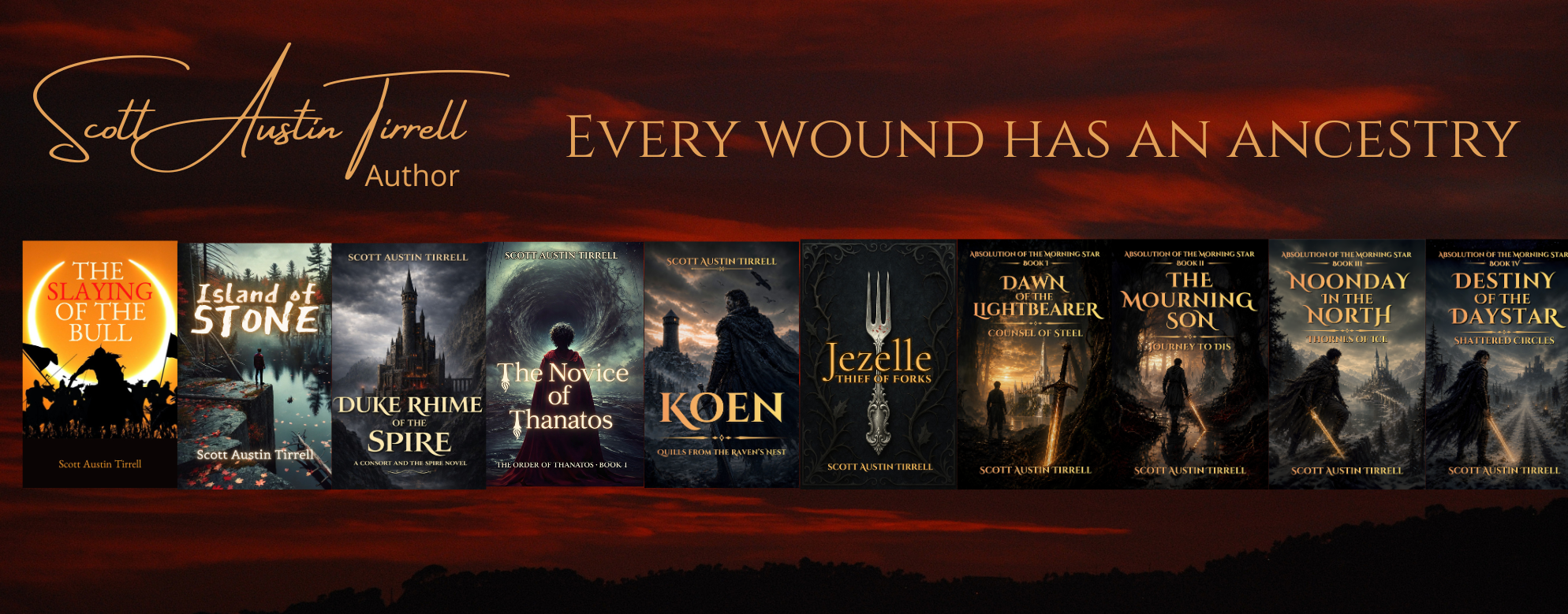
And then there is its partner in crime, Koen: Quills from the Raven’s Nest.
One of the things I love most about Sylvanus is how naturally it sits beside that book. It is a true sequel. These are brothers, but they experience the same family and the same empire from very different positions. Koen follows one path through this history; Sylvanus illuminates another. Things that mean one thing in Koen acquire another dimension when viewed through Sylvanus’s eyes.
Neither story replaces the other. They complement one another.
In some ways, writing and editing Sylvanus have made me understand Koen better. They have also given me new tools I want to bring back to the earlier book.
Koen was professionally edited before publication, and I remain grateful for the work that went into it. But books in a connected series have a relationship with one another, and now that I can see Koen and Sylvanus side by side, I want to make sure the prose, pacing, and presentation feel as cohesive as the stories themselves.
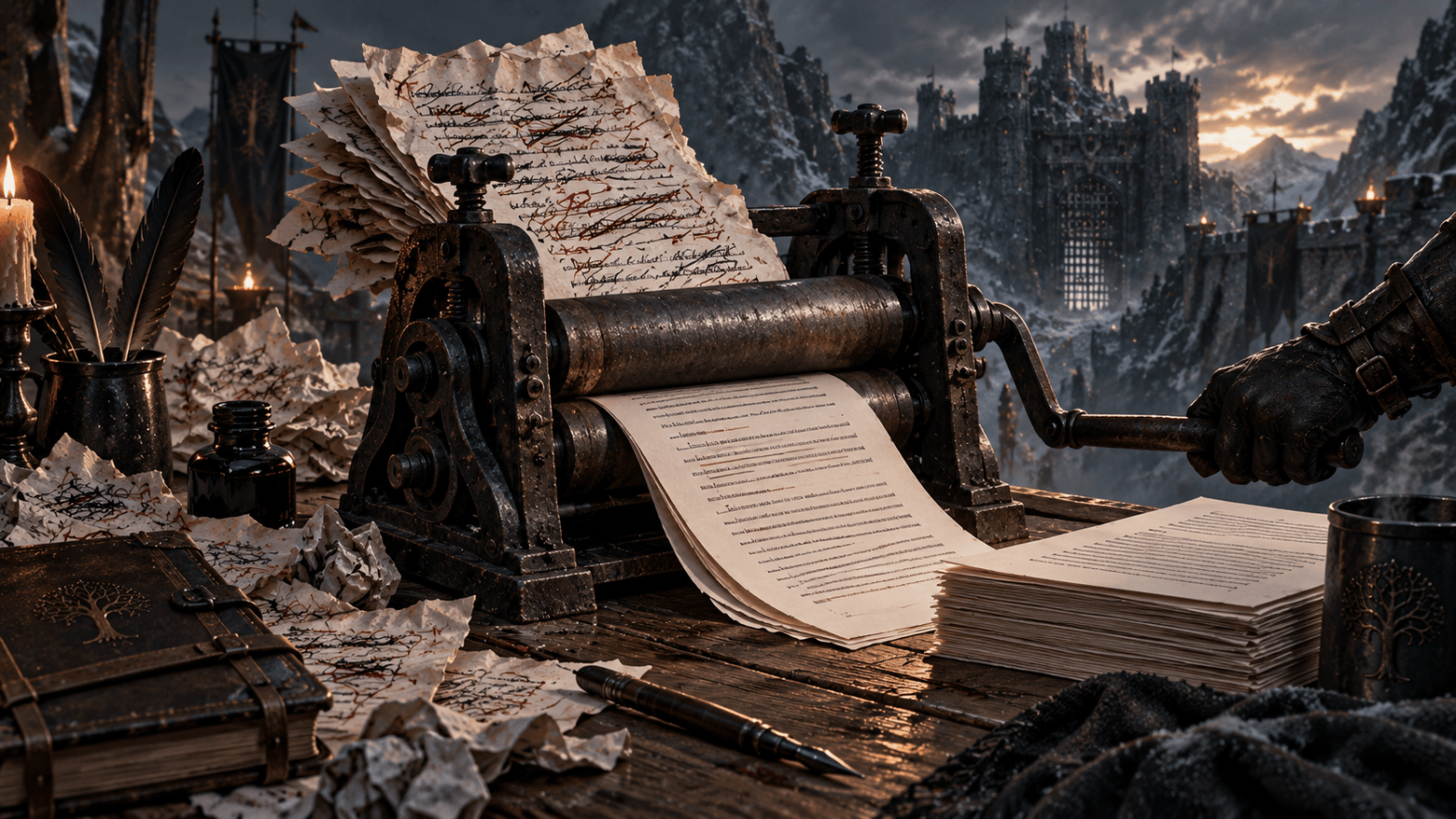
So, when I finish Sylvanus, I’ve decided to put Koen through my editing wringer once more.
I am not interested in turning it into a different book. I love what Koen is. I simply want to give it the benefit of everything I have learned while working on its sequel—looking again at pacing, prose, dialogue, exposition, repetition, distance, and all those tiny pieces of invisible machinery that I have become better at seeing.
I suspect there is another layer of sharpness waiting in there. And if Koen is the doorway into Blood and Banners, I want that doorway polished before the next part of the journey begins.
That is one of the strange things about doing this for years. There is never a point at which I suddenly know how to write a perfect book. Instead, the changes are incremental. I finish something. I learn. I notice more. I develop another tool. Then I bring all of that into the next manuscript.
For now, though, my attention remains on Sylvanus. I am searching for repeated words, removing unnecessary glances, dismantling little imaginary cameras, cutting sentences that repeat what the reader already understands, trimming descriptions that linger too long, and looking for places where fewer words can do more work.
The manuscript is over 6,000 words shorter than the first draft, but I don’t feel as though the story has become smaller. If anything, it feels sharper.
That is the goal: not fewer words for the sake of fewer words, and not endless tinkering because I am afraid to call the book finished. I want the words that remain to deserve to be there. I will know if I’ve accomplished my mission in the final read-through, which is quickly approaching.
Eventually, of course, I will have to stop. There is always another sentence that could be adjusted, another word that could be questioned, another beneath hiding somewhere in Chapter Twenty-Seven waiting to embarrass me.
At some point, every writer has to decide that the book represents the best work they can give it and let it go.
When I reach that point with Sylvanus: Swords and Sons, I don’t know what will happen after publication. That part has never been entirely within my control.
What I can control is the book itself. I can make sure that when someone opens Sylvanus—however they found it—I have given them the best version of this story I can create.
I’ve spent years worrying about the discovery problem, and I am sure I haven’t finished worrying about it. But I don’t want that problem to consume the energy that belongs to the work itself. There is something liberating about returning my attention to the part I can actually influence: writing good books.
I wanted to tell Sylvanus’s story. I wanted it to stand beside Koen and make both stories richer for the existence of the other. Now that I have gotten that story onto the page, I want to give it everything I have learned before I let it go.
However many people ultimately find it, I am glad Sylvanus’s story exists.
And I am very glad I was the one the muse selected to tell it.
Cheers!
Discover more from Author Scott Austin Tirrell
Subscribe to get the latest posts sent to your email.

Great insight into the distancing effect of the camera when placed not before the eyes of a reader, who is able to see things directly, but displaced from the reader to a character, who must point the camera at what you want the reader to see. Kind of a collision between your natural tendency toward the cinematic and the constraints of point of view, which (in this case) is preventing the reader from discovering things for themselves. Mystery writers (and horror writers as well, come to think of it) play with this tension all the time to heighten anticipation — the reader sees something or realizes something before the character does. In horror, we want to jump into the story and restrain the character — NO!!! DON’T OPE THAT DOOR! — in mystery we become impatient for the character to discover the significance of a detail we have just understood. Trapping the reader too rigorously in the viewpoint of a character removes this valuable tool, that allows us to explore and jump ahead of some of the characters, putting US (the readers) right inside the story rather than viewing from the outside.
LikeLiked by 1 person
Hopefully, I will accomplish it! You’ll likely be one of the first to see if I am successful, and do let me know if I fail 😉
LikeLike
Great visual by the way — I love it!
LikeLiked by 1 person