I never saw my grandfather paint, although his artistic talent may very well have saved his life.
As the Allies prepared for the D-Day invasion of Normandy in 1944, my grandfather was facing an assignment as a machine gunner, an extraordinarily dangerous occupation on the battlefield. He once told me that a machine gunner’s life expectancy in combat could be measured in minutes. There was even an old nickname dating back to the First World War, the “seven-minute men,” reflecting the grim belief that machine gunners might survive only seven minutes once the fighting began. Whether that figure was accurate or not, it conveyed the terrible uncertainty facing men assigned to such a dangerous role.
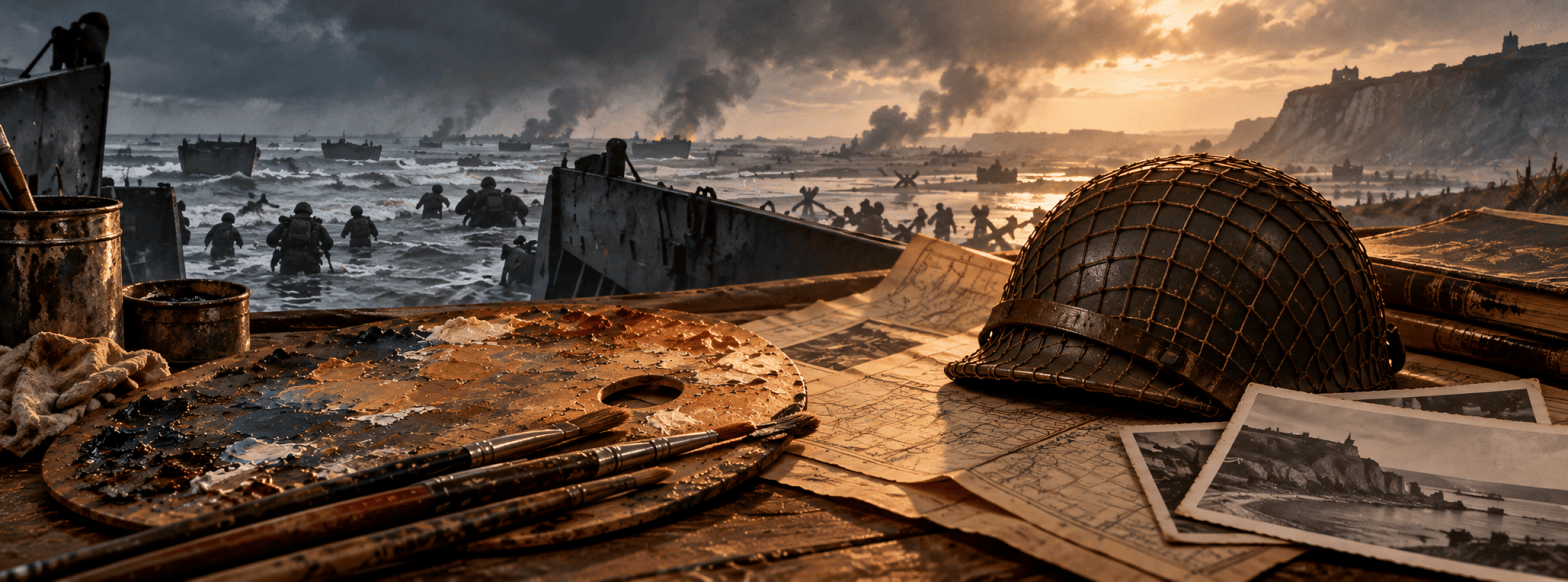
Then one day, a superior noticed my grandfather doodling and recognized that his artistic abilities might be better employed elsewhere. He was reassigned to work with maps at SHAEF, the Supreme Headquarters Allied Expeditionary Force, under General Dwight D. Eisenhower.
But his reassignment didn’t spare him the invasion. A staff sergeant with the 116th Infantry Regiment of the 29th Infantry Division, he landed at Omaha Beach in the third wave on D-Day. The 116th suffered more than 800 casualties that day. He subsequently earned the Bronze Star Medal, and his regiment participated in the capture of Fort Montbarey near Brest, France, in September 1944. His wartime service was hardly without danger, but I imagine his continued journey through Europe could have been much worse.
I often wonder how differently his life might have unfolded had that superior never noticed his drawings. There’s no way of knowing whether he would have survived the war as a machine gunner, but the reassignment changed the risks he faced. Something as seemingly insignificant as a doodle may have altered the course of his entire life and allowed me to exist.
My grandfather was a talented artist. My parents still have several of his paintings hanging around their house. As he applied to art school, was accepted, but did not go, I assume that he once dreamed of pursuing art professionally. Unfortunately, that dream never materialized. After the war, he spent his working life as a railroad clerk, providing for his family and eventually earning an early retirement.
Somewhere along the way, he stopped painting. The story goes that my grandmother disliked the smell of turpentine, so he put away his oils and brushes. Whatever paintings he created belong to a part of his life I never witnessed. I knew him as my stoic grandfather, not as the artist he once aspired to become.
I’ve been thinking about him quite a bit lately, particularly as I reflect on my own creative ambitions.
I’ve spent years writing novels, building the world of Lucardia, and bringing its characters to life. Eleven published works later, I’ve accomplished something I once only dreamed of doing. Yet audience size and commercial success have remained elusive, and I sometimes find myself questioning whether the thousands of hours I’ve devoted to writing have amounted to what I hoped.
I know what you’re thinking. “Oh, here he goes again.” But I am trying to work through this and get to a place of understanding and acceptance.
Lately, I’ve been thinking about what it means to find satisfaction in creative work, and whether I’ve ever fully understood what drives my own ambitions. I understand the familiar advice that we should create simply because we love creating, but I’ve never believed that loving something should require abandoning every other hope associated with it.
I genuinely love writing. I enjoy creating stories, developing characters, and exploring the complicated world I’ve imagined. If I didn’t, I certainly wouldn’t have devoted so many years to it. The compulsion to write is not always glamorous. And I am grateful for what I’ve accomplished, particularly to those readers who have discovered my books and enjoyed them.
Some readers have given me far more than a book purchase or a kind word. They’ve returned to my stories, become invested in my characters, and even devoted considerable time and energy to helping me become a better writer. Others have quietly supported my work by returning for each new release. I don’t take either form of generosity lightly. Their support is evidence that my writing has already touched people, and I’m enormously grateful for it.
What I struggle with is how small that circle remains and how little it seems to have grown despite years of effort. I don’t want to diminish what these readers have given me. Quite the opposite. I hope that someday many others might discover something equally worthwhile in my work.
Of course, I would love to make a living from my writing. The prospect of creating stories while traveling the world with my wife, free from financial worries, is enormously appealing. Fortunately, if I’m not stricken dead, I will have that opportunity in retirement regardless of my books’ commercial success. But what I’m searching for through my writing is something that financial security alone cannot provide.
I want my writing to be read, appreciated, and respected. I want people to discover something worthwhile in the worlds I’ve created, whether that’s a few hours of enjoyment, an emotional connection with a character, or a story that stays with them long after they’ve turned the final page. The books I’ve loved throughout my life have given me so much, and I would like to think that I might offer something similar to others.
I also want to be taken seriously as an artist. Perhaps that’s difficult to admit, but it’s true. From the outside, spending thousands of hours inventing imaginary worlds can look like a childish hobby or an exercise in self-indulgence, particularly when there is little financial return to justify the effort. I, too, don’t think that’s a fair assessment of creative work, but I understand how someone unfamiliar with the process might arrive at it. I wish they could see what I see: the possibility of creating something meaningful from nothing more than imagination and determination.
And perhaps most importantly, I want the people I love to understand why this matters so much to me in a way more tangible than me saying so. I want to offer them something that demonstrates that the countless evenings, weekends, and hours spent pursuing these fictional worlds haven’t been wasted. Not necessarily a fortune or widespread fame, but some indication that what I’ve created has value beyond my own enjoyment of creating it, and perhaps something that might enrich their lives as well.
I suppose that’s a form of seeking validation, and perhaps I place too much importance on it. But acknowledging those desires doesn’t diminish the pleasure I find in writing, nor does it mean I’m ungrateful for what I’ve accomplished. I can appreciate what I have and still long for something more. Gratitude and ambition aren’t mutually exclusive. They’re both part of being human.
And perhaps that’s why my grandfather’s story resonates with me.
He possessed a remarkable talent, one that had proven its worth under extraordinary circumstances. Yet somehow, in the ordinary course of life, that talent was set aside. Did he regret giving up painting? Did he ever imagine returning to it? Or did the responsibilities of work and family gradually push those ambitions so far into the background that he no longer thought about them?
I’ll never know.
He and my grandmother enjoyed some good years together after their retirements, but Alzheimer’s disease eventually changed everything. Caring for my grandmother took an enormous toll on him, and whatever opportunities he might have had to return to his art disappeared as he devoted himself to someone he loved. He would pass before her. She dozed off during his funeral, no longer aware of whose funeral it was.
As I contemplate the next chapter of my own life, I find myself asking questions that perhaps he once considered. How long should we pursue a dream that may never become what we hoped? At what point does persistence become stubbornness? And how do we measure the value of something we create when most of the world seems largely indifferent to it? Some can find that satisfaction entirely within, and that is awesome. Those people have my complete respect, but I am a storyteller. As I’ve said before, if there is no one around my fire to listen to my stories, it kind of voids the point.
I also want to create something that will outlive me. The thought that someone, decades from now, might discover one of my books and find enjoyment or meaning in a world I imagined is deeply appealing. The possibility that my stories could continue touching lives long after my own has ended gives my efforts a sense of purpose.
Some of my grandfather’s paintings still hang in my parents’ home, preserved by the family he left behind. In that respect, he created something that has already outlived him. But I have no children, and I sometimes wonder what will become of my own creative work when I’m gone. I hope my stories might find a life beyond me, carried forward by readers who discover something meaningful in them and share them with others. Perhaps that’s another reason reaching a wider audience matters so much to me. The more who read my work, the greater possibility that a small piece of me will carry on.
I wonder whether my grandfather ever felt that way about his paintings. Whether he hoped that something he created might survive beyond him, or whether he simply enjoyed the act of painting while he could.
There’s something remarkable about the fact that his artistic talent may have helped him survive a world war, only for him to abandon it during peacetime. I never thought to ask him how he felt about that, or whether he regretted the artistic life he never pursued. I was only sixteen when he died, too young to understand which questions I would someday wish I’d asked. Perhaps his answers could have helped me make sense of the creative struggles I face today. Maybe he would have told me that the satisfaction of creating was enough. Or perhaps he would have admitted that, despite everything else he accomplished, some part of him had always wanted more.
I think I would have understood either answer. I only wish I’d had the chance to ask.
Cheers!
Discover more from Author Scott Austin Tirrell
Subscribe to get the latest posts sent to your email.

How to be true to one’s self and to be at peace being whoever we are — not an unusual quest.
LikeLiked by 2 people
It is perhaps the quest.
LikeLiked by 1 person
Indeed. You are on the path! As are your characters…
LikeLiked by 1 person